Free shipping on orders over 50€ up to 500g
French Online shop for beads and accessories for the creation of DIY jewellery and other creative hobbies

Log-in

How to sand resin?

Made by :Oh la coquette !
Published on the :01/06/2022

What to use to sand resin?

Sanding resin can sometimes be a difficult step, especially when you are a beginner and know little about this material. Sanding resin, whether it is epoxy resin or UV and UV Led resin, requires a little patience because several steps are necessary.
In this technical sheet, our partner Oh la coquette, expert in polymer modeling and resin, gives you all her secrets to sand resin and give it back all its transparency and shine.

How to make beautiful resin finishes?

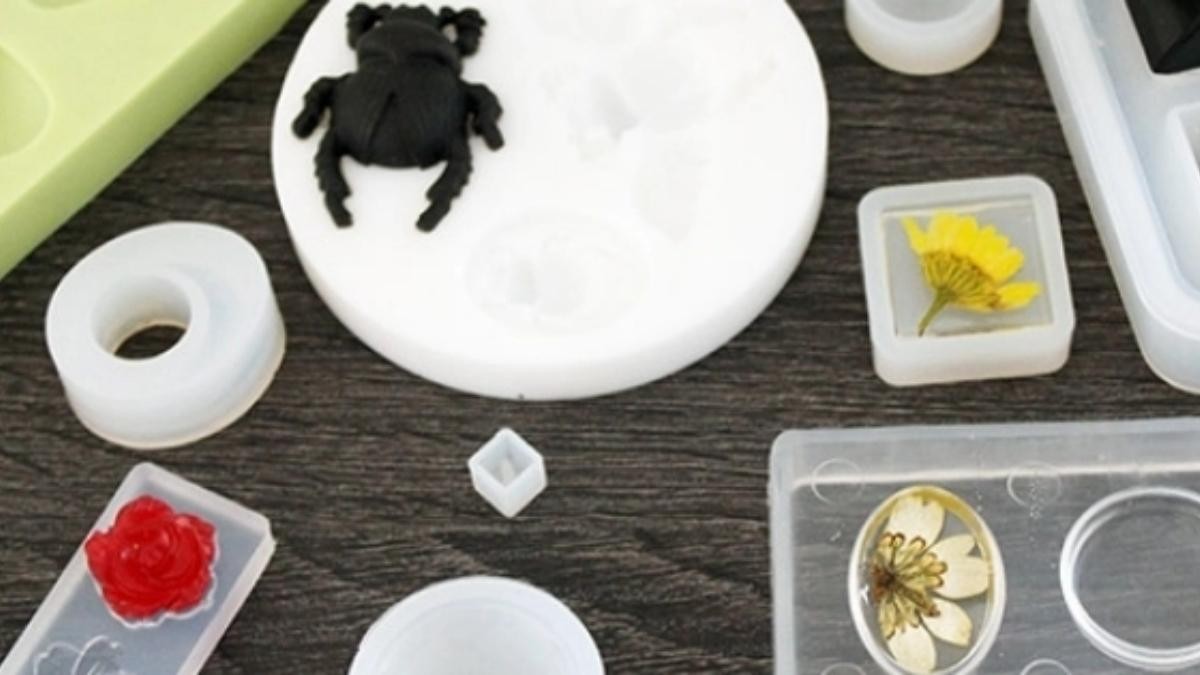
For those who have already taken their first steps in resin, you probably know that when you remove your pieces from the mold, the surface is often, if not almost always, irregular and imperfect. The edges have irregularities caused by excess resin and are sometimes protruding. It is therefore imperative to work on your piece to get a nice finish.

To do this, discover how to restore transparency and shine to your resin piece in three key steps: sanding, polishing and buffing.

  • Sanding is used to roughen and remove excess resin from your piece.
  • Polishing is used to remove the micro-scratches caused by sanding.
  • Finally, polishing, the last step, is used to give back shine and transparency to your small objects and resin jewelry.

These steps are valid whatever the resin used and whatever the shape of your piece. You will discover in the video that the sanding, polishing and shining steps are performed on pieces of various shapes.

To learn more about resins, we invite you to discover our other data sheets on the subject:

Tutorial steps

Step 1
How to sand resin? : Step 1

When demolding your resin piece, the edges are irregular.

Step 2
How to sand resin? : Step 2

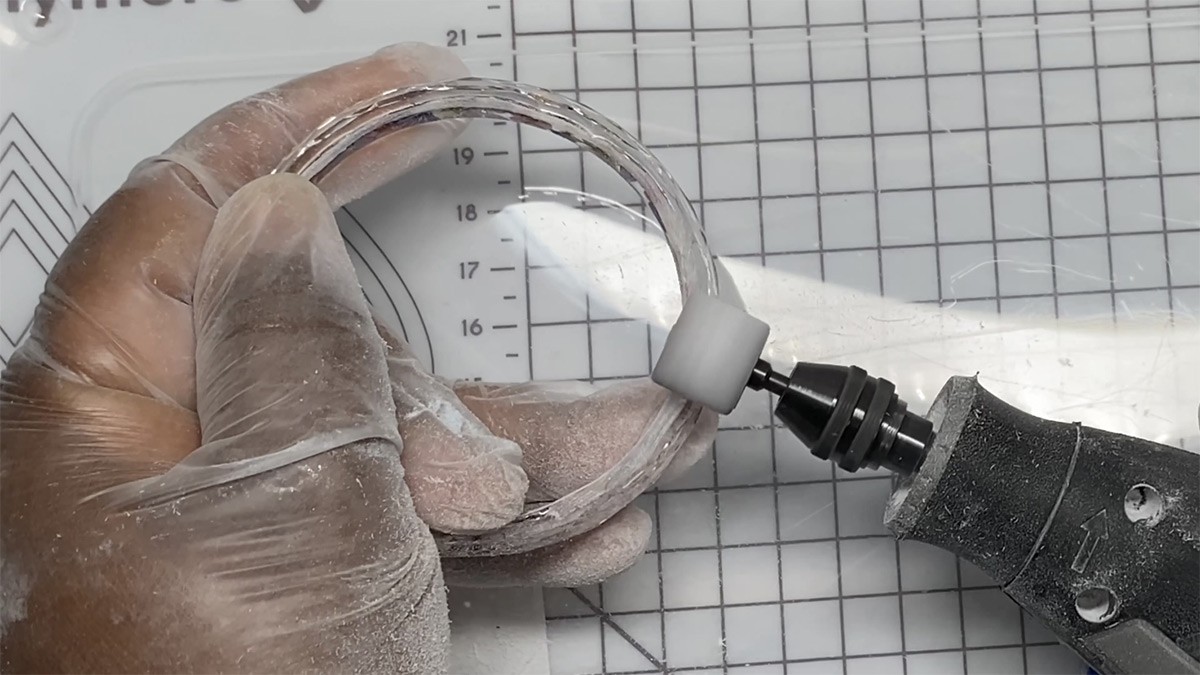
Start by roughing with the Dremel with the 120 grit sanding drum tip to remove excess resin.
Step 3
How to sand resin? : Step 3

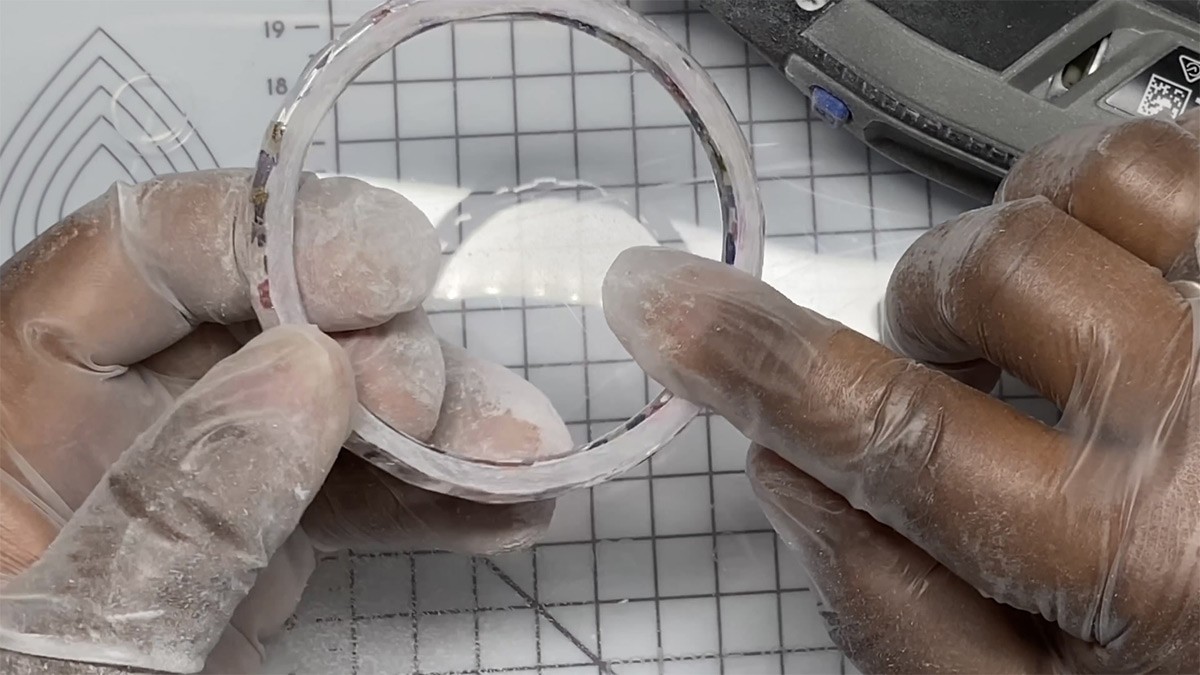
After this step, you can see by touch that the edges of your piece are regular. Scratches are visible and will disappear with the following steps. You can then proceed to wet sanding.

Step 4
How to sand resin? : Step 4

Prepare your different abrasive papers with the following grits: 220 / 400 / 600 / 800 / 1000 / 1500 / 2400 / 3200
Step 5
How to sand resin? : Step 5

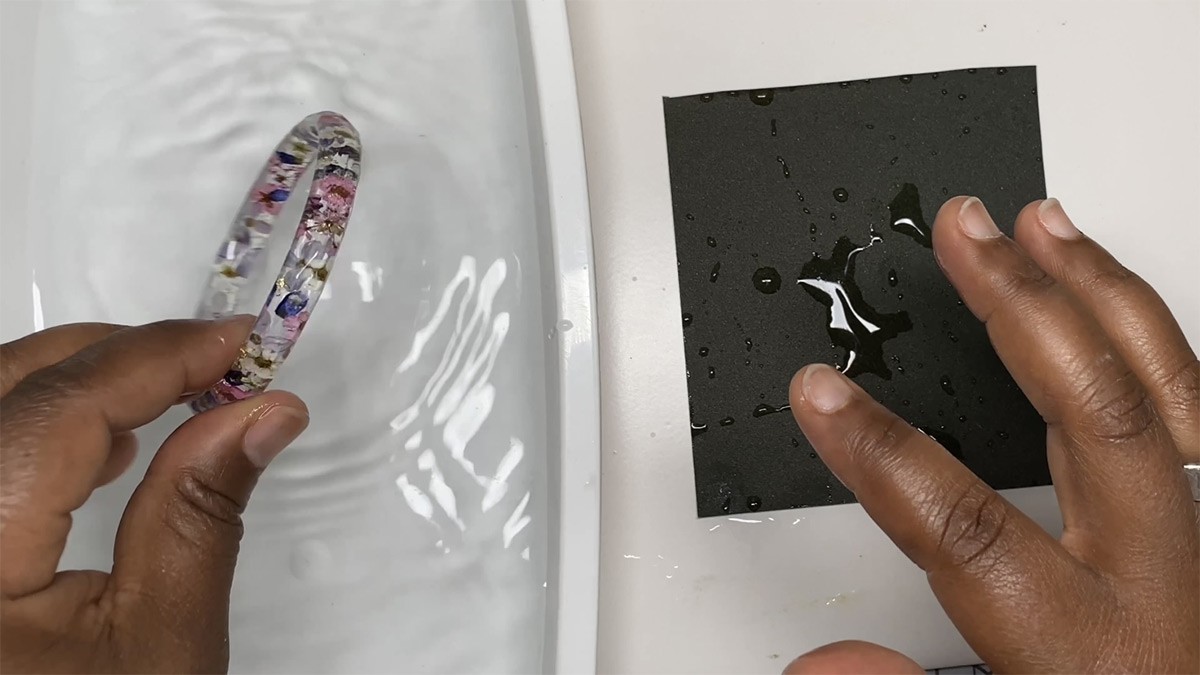
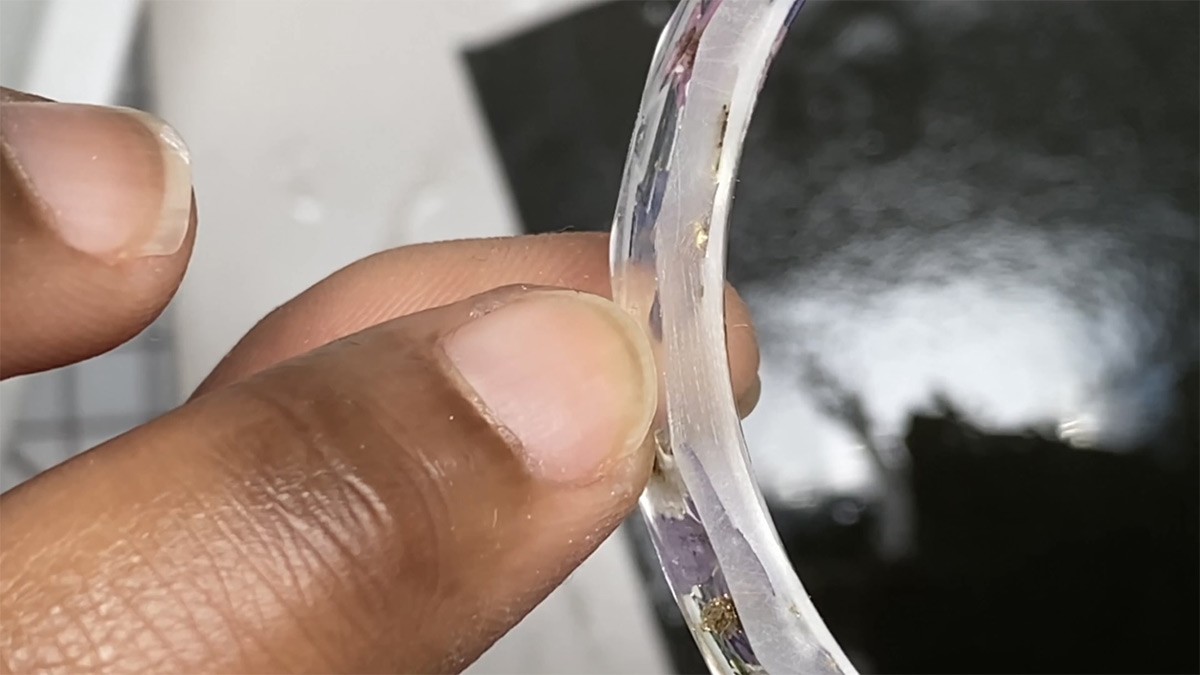
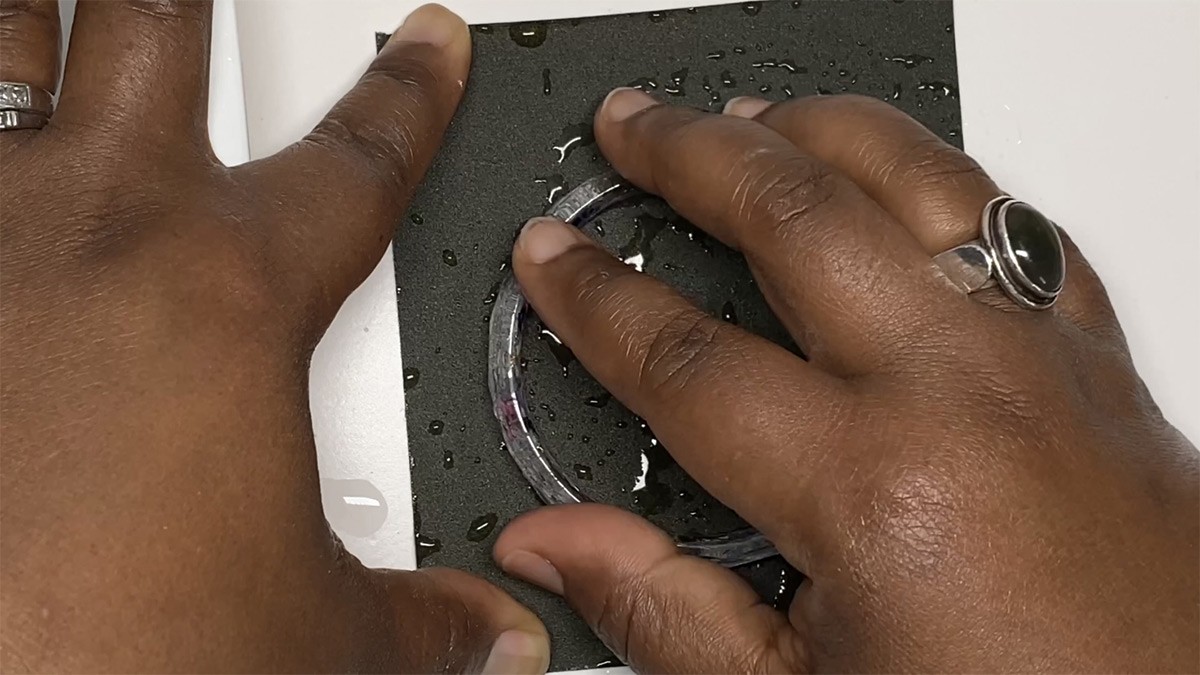
Wet the 220 grit sandpaper and place it on a flat surface. Sand with circular motions and medium pressure while rotating the piece regularly for an even sanding.

Don't hesitate to rinse the piece and the paper with clean water to get rid of any resin debris that could scratch the piece.
Step 6
How to sand resin? : Step 6

Rinse and dry the piece to check for any remaining scratches, if so, continue sanding to remove them.
Step 7
How to sand resin? : Step 7

Repeat this step for each of the sanding papers.
Step 8
How to sand resin? : Step 8

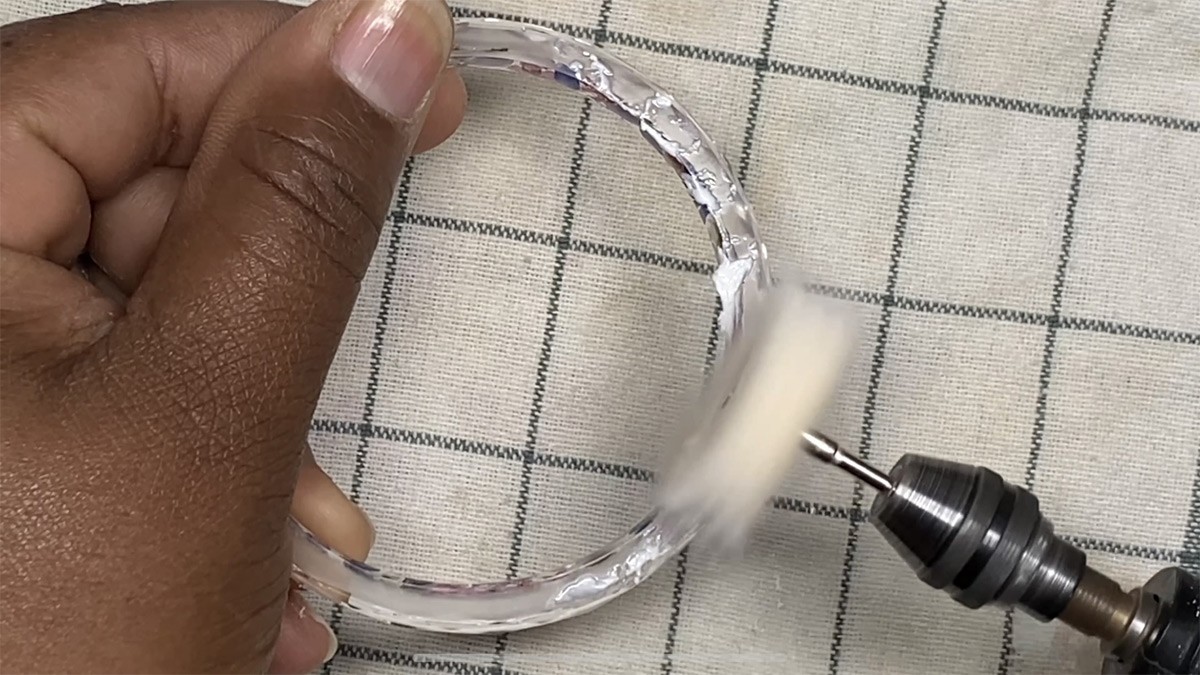
Proceed to the polishing step. To do this, apply the polishing compound to the piece. Polish with even strokes and medium pressure with a Dremel flannel or cotton tip until the desired shine is achieved.

Step 9
How to sand resin? : Step 9

Rinse and clean the piece to remove excess polishing compound. Your sanding is complete and your resin piece has regained its shine and transparency.

Step 10
How to sand resin? : Step 10

A before and after view of the sanded part

Oh la coquette !
 Oh la coquette ! - L’épanouissement par la création et le partage.
Créatrice de bijoux, d’accessoires et d’objets en polymère/résine avant tout, je suis passionnée de loisirs créatifs. Couture, Déco, scrap, bricolage... je suis toujours à la recherche de nouveaux projets et j’adore partager mon savoir faire car j’estime que rien n’a d’intérêt si on ne le partage pas.
Share with my friends
Which material to use ?
Supplies
Polishing paste x150g
OUTIL-246
Qty : 1
57 in stock
11,95€
230x280mm Waterproof flex abrasive sheet P400 x1
1,20€
230x280mm Waterproof flex abrasive sheets P600 x1
1,20€
Softflex waterproof sanding sheet P800 230x280 mm x1
1,20€
Softflex waterproof sanding sheet P1000 230x280 mm x1
1,20€
Subtotal : 29,85€
Tools
21x6mm Circular buffing brush in flannel x1
2,00€
DREMEL® : Universal multi-purpose set (687) x52
19,00€
22x3.5mm Cotton Circular buffing brush x1
2,40€
DREMEL® Kit (3000-15) Multifunction tool with 15 accessories x1
60,00€
Subtotal : 83,40€
Your questions (10)
You have a question about this sheet? Ask our team and the people who have already tested it. The Perles & Co community is here to help!
By Claudie (17/03/2025 16:47:18)
Bonjour,j'ai fait des boucles en Fimo j'ai cuit puis poncé avec de la toile 500,puis 800 et fini avec du 1000 j'ai mis de la résine Cléopâtre uv glass est ce que je dois poncer?
Les côtés de mes boucles sont ternes que faire merci
Translate the question
Please log in to use this feature
Our Tiffanie expert answers you (19/03/2025 09:18:24)
Bonjour, oui, vous pouvez poncer et polir ou appliquer de la résine sur les côtés. Vous pouvez tenir la pièce en main le temps de la catalyse sous la lampe.
Translate the answer
By Sylvie (25/02/2025 12:59:06)
Bonjour, peux ton faire poncer avec un kit à ongle comme je n'ai pas de dremel. merci
Translate the question
Please log in to use this feature
Our Tiffanie expert answers you (26/02/2025 16:14:27)
Bonjour, oui ça doit être possible dans une certaine mesure.
Translate the answer
By Celine (21/08/2024 10:54:56)
Bonjour est-ce que toutes ces étapes sont nécessaires pour des pendentifs ou boucles en résine? J'ai vu dans d'autres tutoriels qu'on ponçait un peu la pièce puis qu'on appliquait un vernis et c'était tout, pour éviter d'acheter tout le matériel si seulement quelques petites étapes suffisent pour les bijoux , merci d'avance,
Céline.
Translate the question
Please log in to use this feature
Our Tiffanie J. expert answers you (21/08/2024 12:05:33)
Bonjour, effectivement, je vois que ça a été utilisé par ma collègue dans un tuto boucles d'oreilles. Il sert peut-être à protéger la résine mais je lis que c'est aussi pour protéger le métal et cacher les bavures. Dans ce cas, difficile de poncer sans abîmer le métal, donc pourquoi pas.
Translate the answer
Answer from customer Celine M. (21/08/2024 11:55:42)
Merci Tiffanie, j'avais vu cette laque utilisée dans un tutoriel : OUT-607. Merci pour votre réponse, le tout est de tester !
Translate the answer
Our Tiffanie J. expert answers you (21/08/2024 11:47:32)
Bonjour, tout dépend du niveau de finition que vous souhaitez en vérité. J'ai vu que certaines personnes utilisent ce vernis : https://www.perlesandco.com/vernis-glassificateur-protecteur-cleopatre-100-ml-p-19311.html mais je n'ai pas testé. Personnellement, je ne vois pas tellement d'intérêt à ajouter un autre produit sur de la résine. La plupart du temps, la résine se suffit à elle-même. On ponce un peu les bords et on rajoute de la résine pour rendre plus brillantes ces parties si on ne souhaite pas polir.
Translate the answer
By mart2b (25/06/2024 23:01:52)
Bonjour
je ne sais comment j'ai fait, ma résine est devenue opaque et je n'arrive pas à lui redonner sa transparence.
Comment puis je faire ??
Merci
Translate the question
Please log in to use this feature
Our Tiffanie J. expert answers you (26/06/2024 08:39:28)
Bonjour, de quel type de résine s'agit il ?
Translate the answer
By laet (06/06/2024 16:09:11)
Bonjour, la pate a polir reste ensuite tout le temps ? cela ne s'enleve pas ? si la surface est plate peut on recouler une couche de resine au lieu de polir pou redonner la transparence ? merci
Translate the question
Please log in to use this feature
Our Tiffanie J. expert answers you (10/06/2024 09:32:57)
Bonjour ! Lorsque vous utilisez de la pâte à polir sur la résine, elle ne reste pas indéfiniment sur la surface. Le but de la pâte à polir est d'améliorer la finition en éliminant les petites rayures ou les marques de surface, puis elle est généralement essuyée ou nettoyée après application.
Si la surface de votre pièce en résine est plate et que vous souhaitez restaurer sa clarté et sa brillance, recouler une nouvelle couche de résine est effectivement une option. Cette méthode peut être plus simple pour obtenir une finition transparente sans avoir à polir, surtout si la surface est grande ou difficile à polir uniformément. Assurez-vous simplement que la surface est propre et exempte de poussière ou de graisse avant d'appliquer la nouvelle couche de résine pour assurer une bonne adhérence.
Translate the answer
Your reviews (0)
Notices subject to control
Please log in to use this feature

Credits

Perles & Co, Internet & E-Commerce company [01/06/2022] Any reproduction, representation, adaptation, in any form whatsoever, even partial, is prohibited, except for reproduction for private use not intended for collective use, representation in the family circle (art. L 122-5 CPI) and online publishing on condition that the source is mentioned and a link is included to the corresponding page of our site www.perlesandco.com.