Delivery unavailable to your country

We are sorry, we are currently unable to ship orders to your country. Thank you for your understanding.

Free shipping on orders over 50€ up to 500g
French Online shop for beads and accessories for the creation of DIY jewellery and other creative hobbies

Log-in

How to color resin?

Made by : Perles & Co
Published on the :04/11/2025
How to color resin?
In summary

Epoxy resin, a two-component material, is easily colored with stained-glass paints, acrylics or specific colorants, enabling the creation of a variety of decorative objects. UV resin, on the other hand, hardens under a UV lamp and requires suitable colorants, with alcohol inks to be avoided to avoid altering its catalysis. For optimum transparency, use colorants from the same brand as your resin.

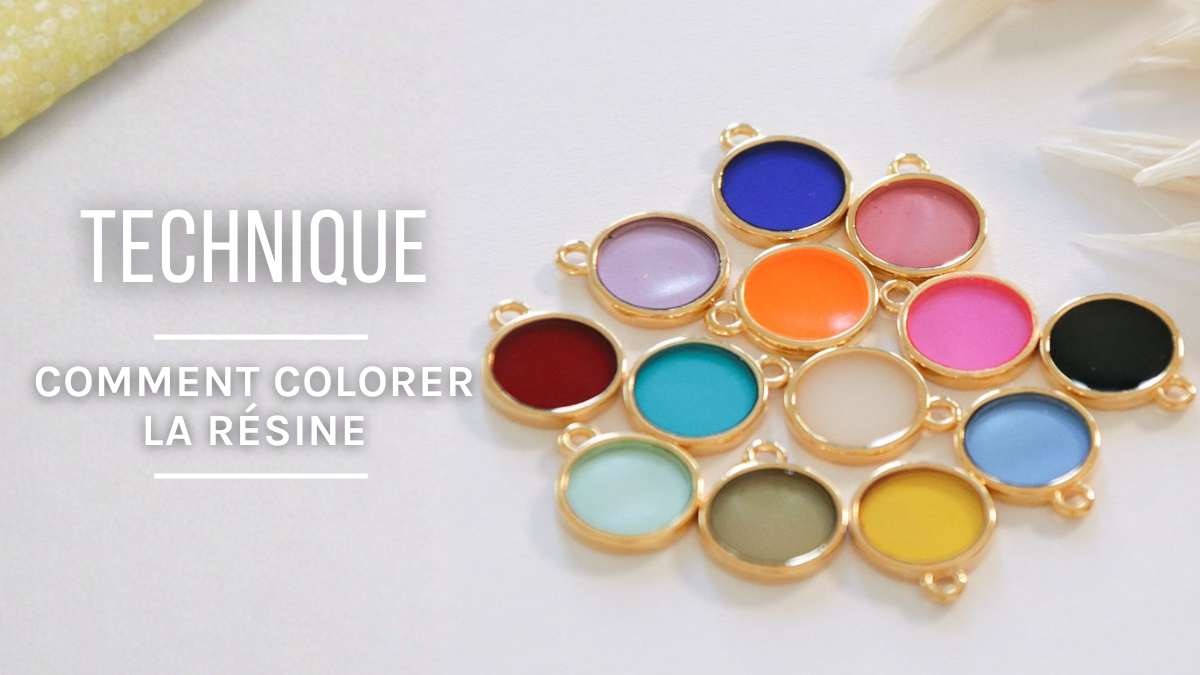
Resin is fascinating because of its transparency. But it’s also its ability to be colored that makes it so appealing: transparent, translucent, opaque, pastel, pearlescent… anything is possible! You still need to choose the right dye. This depends primarily on the type of resin: UV resin or epoxy—the two have different compositions. The wrong mixture can prevent the resin from curing.

This guide walks you through the process step by step, whether you’re just starting out or are already an experienced user.

Warning: Before handling the resin, be sure to wear safety goggles, a mask, and gloves. Don’t forget to protect your work surface to avoid any potential messes.

Which dye for which resin?

Dye

Epoxy Resin

UV Resin

Resin-specific dyes

✅ Suitable, according to the manufacturer’s instructions

✅ If compatible with UV resin

Alcohol-based inks

✅ Under certain conditions, in small quantities

⚠️ Avoid unless compatibility is confirmed

Stained-glass paint

⚠️ Depending on its composition, test first

⚠️ Not recommended without manufacturer approval

Acrylic paint

⚠️ Possible in very small quantities, but not recommended

⚠️ Not recommended; risk of improper curing

Powdered pigments

✅ Suitable, with controlled dosage

✅ Can be used in small quantities, depending on their opacity

1- How do you color epoxy resin?

Epoxy resin is a transparent two-component resin (resin and hardener). It’s used to create DIY costume jewelry and small decorative items. Coloring it is fairly simple:

  • Carefully mix the resin and hardener, following the ratio specified by the manufacturer.
  • Add the dye in very small amounts at first.
  • Mix until the mixture is uniform.
  • Adjust the shade drop by drop, then mix again.
  • Let any air bubbles rise to the surface and remove them.
  • Pour the resin into a silicone mold or onto a resin-casting surface. Now is the time to add an inclusion (dried flowers, glitter, etc.).

The more dye you add, the darker the color will become and the more opaque the resin will be. In general, the total amount of dye used should not exceed 5% of the finished product.

What kind of dye should you use for epoxy?

You can tint two-component epoxy resin with:

  • Stained-glass paints: when used in small quantities, they help preserve the resin’s transparency.
  • Acrylic paints to achieve an opaque effect: these can also be used for the resin pouring technique.
  • A specially formulated epoxy resin dye: just a few drops are needed to color the resin and achieve a beautiful shade.
  • Alcohol-based inks: just a few drops are enough, as they have high pigmentation and concentration. They help preserve the resin’s transparency. Plus, they’re miscible, allowing you to create stunning effects.
  • Powdered pigments: a small amount is enough for a satisfactory result. However, not all pigments are suitable; some are difficult to dissolve and result in a grainy finish. To be sure, it’s best to test them first.

Avoid using water- or oil-based products, such as oil paint, which could alter the outcome of your creation or prevent the resin from curing.

How do you use alcohol-based ink?

Alcohol-based inks, which are colored yet transparent, are ideal for tinting resin while preserving its transparency. It makes sense!
Here’s an example of coloring epoxy resin withPiñata ink:

  • Prepare the resin: follow the mixing ratios in the instructions and stir with a stick. Transfer to a second container and stir again to ensure a perfect mix.
  • Add the ink: one drop of Piñata ink is enough. The more you add, the more intense the color becomes—even neon.
  • Mix and wait: let the bubbles rise to the surface and disappear.
  • Pour into the mold. If any bubbles remain, pop them with a toothpick. Keep away from open flames: alcohol is flammable.

You can remove your piece from the mold after 48 hours of drying. For complete curing, let it dry for 15 days away from light.

Mix several inks to create new colors. Add white to make pastel shades or black to darken a color that’s too light. To achieve this orange-pink color, we mixedPiñata Magenta Señorita and Sun Yellowinks.
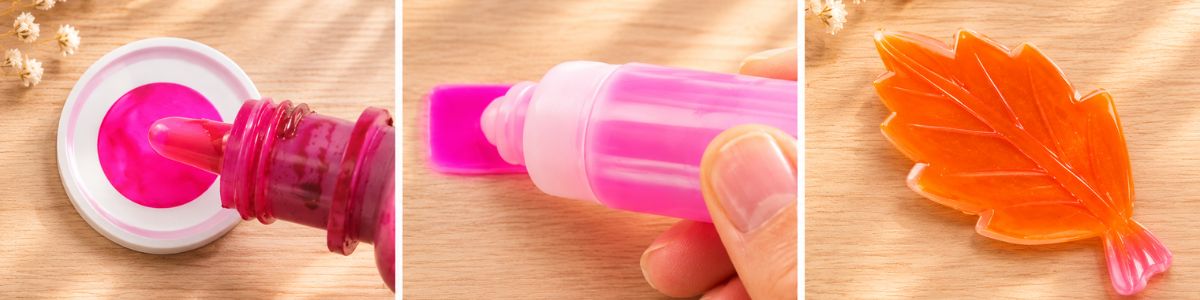
colorer la résine époxy avec encre à alcool

Want more spectacular patterns? Kamenskaya Petri-effect alcohol-based inks are formulated to create colorful filaments that sink into the epoxy resin, like cells viewed under a microscope. A classic ink tints or marbles the resin. Petri ink, on the other hand, creates intricate patterns deep within the resin. The secret lies in a duo: color and white. Always pair your translucent shades with a special white Petri paint. This “sinker” ink pulls the color toward the bottom of the resin and creates the effect of depth.

To create successful Petri art:

  • Place a drop of color, then a drop of white. Repeat as many times as you like.
  • Shake the bottle before each drop to ensure a uniform texture.
  • If your resin is very runny, wait 20 to 30 minutes before starting. A slightly thicker resin holds the pigments better.
  • Avoid placing drops near the silicone edges of the mold: they block the ink from flowing down.
  • Choose a resin with a curing time of no more than 24 hours.

Like all alcohol-based inks, these are intended for use with epoxy resin (not UV resin). Also, keep a safe distance from open flames: do not use a burner to remove bubbles!

2- How do you color UV resin?

UV resin is a thermosetting resin that cures only when exposed to the heat of a UV lamp (or a UV LED lamp for UV LED resin). Unlike epoxy resin, it’s ready to use. No need to mix it! It can be used as is for a transparent effect, or it can be colored.
Coloring UV resin and UV LED resin couldn’t be easier:

  • Slowly pour the desired amount of resin into a small bowl.
  • Add the colorant of your choice.
  • Mix thoroughly with a suitable spatula.
  • Your colored resin is ready to be poured into a mold. Add an inclusion before curing under the UV lamp, first on one side and then on the other.

What kind of dye should you use for UV resin?

This resin does not have the same components as epoxy resins, so the coloring process is slightly different.
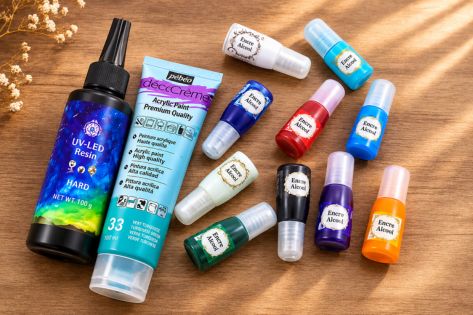
  • Do not use alcohol-based inks: they cause a reaction that prevents the resin from curing under UV light.
  • Do not use stained-glass paint, for the same reason.
  • Dyes from the same brand as the resin: this is the safest choice. See how to use Padico dyes with UV LED resin.
  • Acrylic paint: can be used in very small amounts to create an opaque finish.

Comment colorer la résine uv

What can you make with epoxy resin? How do you make resin rings? Check out all our DIY resin jewelry tutorials.

Result
Schema  How to color resin?

Can acrylic be used to color resin?

It's not recommended, although in small doses it may be suitable. But acrylics are water-based, which can affect resin catalysis.

What type of protection should I use when working with resin?

For resin coloring, we recommend the use of a disposable or cartridge mask, as well as nitrile or latex gloves and splash goggles.
Share with my friends
Which material to use ?
Please note that the quantities of the suggested equivalents are not necessarily exact. You can adjust them in your basket.
List of useful products
Padico liquid dye to colour resin - Red x10ml
7,50€
Padico liquid dye to colour resin - Yellow x10ml
7,50€
Padico liquid dye to colour resin - Green x10ml
7,50€
Padico liquid dye to colour resin - Black x10ml
7,50€
Padico liquid dye to colour resin Pearl Kisuka x5ml
8,00€
Padico liquid dye to colour resin Pearl Turquoise x5ml
8,00€
Padico liquid dye to colour resin Gold x5ml
TECH-704
Qty : 1
Only 2 in stock
8,00€
Metallic acrylic paint - Extreme Sheen - Rose Gold x59 ml
4,20€
Your questions (17)
You have a question about this sheet? Ask our team and the people who have already tested it. The Perles & Co community is here to help!
By Sophia (06/03/2026 01:09:09)
Bonjour, est-ce que les colorants Padico sont uniquement pour leur résine ou je peux les utiliser pour la résine époxy Cleopatra?
Merci d'avance
Translate the question
Please log in to use this feature
Our Manon expert answers you (09/03/2026 10:49:55)
Bonjour, oui c’est possible. Cependant, il est recommandé d’utiliser une très petite quantité de colorant : quelques gouttes suffisent. Une quantité excessive pourrait empêcher la résine de durcir correctement.
Translate the answer
By Delgado (23/02/2026 00:09:51)
Se puede usar la pintura para vitrales
Translate the question
Please log in to use this feature
Our Laurence expert answers you (23/02/2026 09:18:52)
Hola, sí, es posible utilizar pinturas para vidrieras para teñir la resina (utilizadas en pequeñas cantidades, permiten mantener la transparencia de la resina).
Translate the answer
By Marie (15/04/2025 10:42:16)
Bjs il paraît que l'acrylique n est pas conseillé pour colore la resine ?vrais ou faux
Translate the question
Please log in to use this feature
Our Tiffanie expert answers you (16/04/2025 09:38:43)
Bonjour, Vrai, ce n'est pas le mieux même si en petite dose, ça peut "passer". L'acrylique est à base d'eau et cela peut influer sur la catalyse de la résine s'il y en a une trop grande quantité.
Translate the answer
By Celine (31/07/2024 16:58:33)
Bonjour quel type de masque, gants et lunettes conseillez-vous ?
Translate the question
Please log in to use this feature
Our Laurence T. expert answers you (01/08/2024 10:05:02)
Bonjour,
Nous vous conseillons un masque de protection jetable (réf. : ATT-496) ou un masque à cartouche, des gants de protection en nitrile ou en latex, et des lunettes anti-éclaboussures (réf. : OTL-536).
Translate the answer
By Carinne (29/06/2024 19:55:53)
Bonjour! J'aimerais faire effet pourring dans ma résine epoxy. Est ce que si j'utilise l'huile de silicone, ma résine va quand même durcir ou je dois utliser un autre médium? MERCI !!!!
Translate the question
Please log in to use this feature
Our Tiffanie J. expert answers you (02/07/2024 08:48:18)
Bonjour, non ça ne va pas durcir. L'huile de silicone va interférer avec la résine. Dans ce tutoriel, le pourring est fait avant de couler la résine : https://www.perlesandco.com/tutoriels/t11381-dessous-de-verre-avec-la-technique-du-pouring-en-acrylique-et-resine.html
 
Translate the answer
Your reviews (0)
Notices subject to control
Please log in to use this feature

Credits

Perles & Co, Internet & E-Commerce company [04/11/2025] Any reproduction, representation, adaptation, in any form whatsoever, even partial, is prohibited, except for reproduction for private use not intended for collective use, representation in the family circle (art. L 122-5 CPI) and online publishing on condition that the source is mentioned and a link is included to the corresponding page of our site www.perlesandco.com.