
Jesmonite
Wondering where to find jesmonite? You've come to the right place! In this category, you'll find all the materials you need to create with Jesmonite: colorants, molds, varnishes, liquid and powder bases. And even complete jesmonite kits for beginners.






What is Jesmonite? Jesmonite is a non-toxic material made from gypsum (plaster stone) and a solvent-free acrylic component. It's an environmentally-friendly alternative to epoxy resin, thanks to a number of features.
Easy to use, Jesmonite AC100 liquid is mixed with the powder base. It can then be molded to create a wide variety of shapes and textures, making it a highly adaptable material for DIY projects in decoration or jewelry.
Jesmonite is highly appreciated in many fields, including jewelry and decoration:
- For its lightness, which makes it pleasant to wear in jewelry.
- For its ability to be easily personalized in a wide range of colors, thanks to pigments.
- For its resistance to water and humidity, as well as todaily wear and tear. It is also compatible with food contact thanks to the application of a varnish, making it possible to create plates, bowls, dishes... in complete safety.
- For its ability to imitate other materials such as marble.
Which colorants for Jesmonite?
There are many ways to tint Jesmonite. We recommend water-based, solvent-free pigments to be added directly to the Jesmonite preparation. You'll obtain bright, even colors, or you can create a marbled effect, as in this tutorial.
There are several types of pigments (glitter, liquid pigments, powders...) and even alternatives! You'll find it all in our dedicated Jesmonite pigment sheet!
Which molds for Jesmonite?
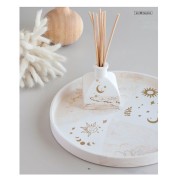
Silicone molds are widely used for Jesmonite. They are flexible, making them easy to remove once hardened. Silicone molds are available in a variety of shapes and sizes. You'll be able to create a tray, a candlestick, a soap dish, a coaster, a style holder, jewelry such as earrings, or a small shell.
How to clean Jesmonite?
To prevent stains when preparing Jesmonite, we recommend protecting your work surface.
If an accidental spill occurs, act quickly:
- Use a spatula, spoon or other tool to remove as much uncured liquid Jesmonite as possible. Scrape gently and try to collect the liquid Jesmonite in a small area.
- Use absorbent paper, paper towels or a clean cloth. Place the absorbent material over the affected area and dab gently to absorb excess liquid Jesmonite.
- Once you've removed most of the uncured liquid Jesmonite, you can clean the area with warm water and mild soap. Finally, rinse with clean water.
Once the Jesmonite has hardened, it can be cleaned. This depends on the type of stain or dirt you need to remove. It's important to use gentle cleaning products and methods to avoid damaging the surface:
- To remove light stains, gently wipe the surface with a soft, clean, slightly damp cloth.
- If dirt remains, soak a clean cloth in a soapy solution (mild non-abrasive soap + lukewarm water), wring it out and clean the Jesmonite. Rinse with a damp cloth.
- For stubborn stains, try baking soda mixed with water. Apply this clay to the stain and leave to work. Rub gently with a damp cloth, then rinse.
Is Jesmonite water-resistant?
Jesmonite is naturally moisture-resistant, but not totally waterproof. As it stands, it can be used in slightly damp environments (such as a bathroom), but is not suitable for prolonged immersion without protection.
For outdoor use, or in areas regularly and directly exposed to water, we recommend the application of a water-repellent varnish.
Does the Jesmonite break?
Yes, Jesmonite can break if subjected to heavy impact or mishandled. But it remains a material renowned for its strength, lightness and resistance to moderate impact.
How to calculate the right quantities of Jesmonite?
To dose your Jesmonitecorrectly, it is essential to follow the proportions recommended by the manufacturer and to know the volume of your mold. Jesmonite is made up of 2 components: an acrylic liquid and a mineral powder.
The standard mixing formula for Jesmonite AC100 (the most widely used) is 2.5 parts powder to 1 part liquid, by weight.
Example: 100 g of liquid + 250 g of powder = 350 g of Jesmonite ready to pour.
For quantities according to your mold volume, please refer to our Jesmonite calculator.
Can I add water to Jesmonite?
No, never add pure water to Jesmonite. This would seriously compromise its mechanical properties. Use only Jesmonite liquid.
How long does Jesmonite keep?
The powder has a shelf life of 12 months in its original sealed packaging, protected from humidity. The liquid has a shelf-life of 6 months after opening.
What's the difference between Jesmonite AC100 and AC730?
Jesmonite AC100 is the standard version, ideal for interior design and decorative objects. AC730 offers superior strength and is better suited to applications requiring high durability or large-scale pieces. See our technical data sheet for full details.
How can I avoid air bubbles in my Jesmonite?
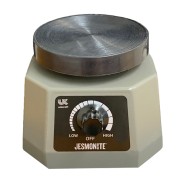
Mix slowly and evenly, tapping the mold after pouring, and possibly using a vibrating table for larger projects. Work at a stable room temperature.