
Average Grades
In summary
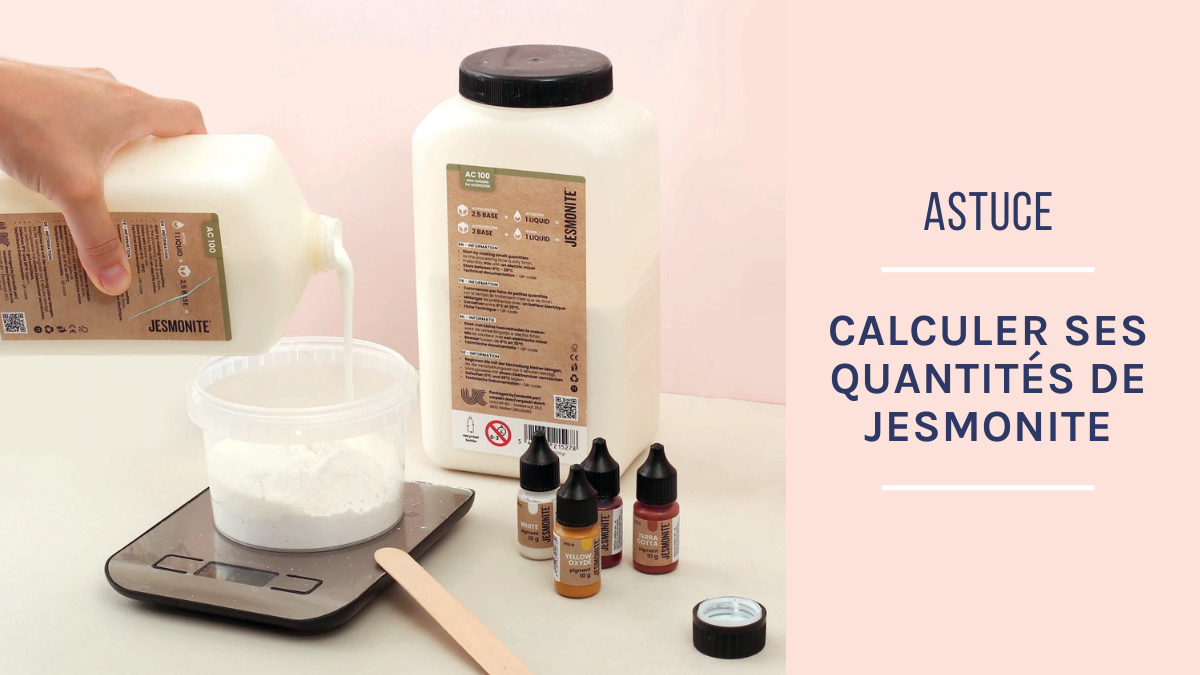
For your creative projects with Jesmonite, it's crucial to calculate the quantities you need to avoid waste and optimize your budget. Use the ratio table to choose between Jesmonite types AC100 and AC730/AC84, depending on your specific needs for decorative or high-strength objects.
Are you embarking on a creative project with Jesmonite and wondering how much to order? This article is here to guide you.
Gone are the days when you had to guess the quantities needed for your creations. Whether you're making decorative objects, architectural elements or artistic pieces, calculating the right quantity of Jesmonite is essential. It helps you avoid waste and optimize your budget.
Your Jesmonite quantity calculator
To calculate the quantities required, fill your mold with water and measure the amount of water used, then refer to this table :
| Jesmonite AC100 | Jesmonite AC730/AC84 | |||
| Quantity of water to fill your mold | Quantity of powder | Quantity of liquid | Quantity of powder | Quantity of liquid |
| 10 mL | 15 g | 6 g | 16.25 g | 3.25 g |
| 25 mL | 35 g | 15 g | 41 g | 8 g |
| 30 mL | 45 g | 18 g | 49 g | 10 g |
| 50 mL | 75 g | 30 g | 81.25 g | 16.25 g |
| 60 mL | 90 g | 36 g | 97.5 g | 19.5 g |
| 75 mL | 105 g | 40 g | 122 g | 25 g |
| 100 mL | 150 g | 60 g | 162.5 g | 32.5 g |
| 110 mL | 165 g | 66 g | 178.75 g | 38.75 g |
| 125 mL | 180 g | 72 g | 205 g | 41 g |
| 150 mL | 215 g | 86 g | 243.75 g | 48.75 g |
| 175 mL | 250 g | 100 g | 284 g | 57 g |
| 200 mL | 287.5 g | 115 g | 325 g | 65 g |
If you buy a ready-to-use Jesmonite kit, simply refer to the quantities indicated on the instructions. Also check the packaging of your molds to see if the recommended doses are indicated.
The benefits of precise calculation
Using a Jesmonite calculator transforms your creative approach, bringing you a host of tangible benefits.
- Save materials and money: by calculating your needs, you avoid over-ordering, which can add unnecessary costs to your projects.
- Reduced waste: Jesmonite has a limited shelf life once opened. Accurate calculation enables you to use up all your purchases.
- Better project planning: knowing your material requirements in advance allows you to efficiently organize your working time and anticipate your creation.
- More professional results: exact quantities guarantee compliance with ratios, a prerequisite for obtaining the optimum mechanical properties of Jesmonite.
The powder/liquid ratio: the key to beautiful Jesmonite
Respecting the right mixing ratio is crucial to achieving the optimum mechanical and aesthetic properties of Jesmonite. Each type of Jesmonite has its own specific ratio.
Table of common ratios :
| Jesmonite type | Ratio Powder:Liquid | Main application | Example |
|---|---|---|---|
| Jesmonite AC100 | 2,5:1 | General use, decorative objects | For 2.5 volumes of powder base, you need 1 volume of liquid base. Or for 250g of powder, 100g of liquid. |
| Jesmonite AC300 | 2,5:1 | Exterior applications | For 2.5 volumes of powder base, 1 volume of liquid base is required. Or 250g of powder requires 100g of liquid. |
| Jesmonite AC730 | 5:1 | High resistance | For 5 parts powder base, 1 part liquid base. Or for 500g of powder, you'll need 100g of liquid. |
Important: always check the manufacturer's recommendations on the packaging, as formulations may change.
Tips for successful mixing and pouring
Mastering the Jesmonite mixing technique is essential to achieving professional results. Here are our tips for successful creations:
- Weigh the componentsprecisely with a precision balance.
- Pour the liquid into the powder gradually (never the other way round).
- Mix gently for 2-3 minutes to avoid incorporating air.
- Respect working time (5-8 minutes depending on temperature)
- Pour immediately into your prepared mold
- Wait 30-45 minutes before unmolding
To avoid air bubbles :
- Use a flexible spatula to mix
- Lightly tap the silicone mold after pouring
- Work in a stable temperature environment (18-22°C)
- Avoid over-energetic mixing
Tips for adding pigments:
Jesmonite pigments should represent a maximum of 5% of the total weight of the mixture. Add them to the liquid before incorporating the powder for a homogeneous dispersion.
If you add too much pigment, it may harm your creation (difficulty setting, brittle finish, etc.).
Result


Score of the sheet (0)
0/5
Be the first to write a review!
To go further
Tips & techniques
View the sheet


Tips & techniques
View the sheet
Tips & techniques
View the sheet
Tips & techniques
View the sheet
Which material to use ?


Questions (0)
You have a question about this sheet?
Ask our team and the people who have already tested it. The Perles & Co community is here to help!
Reviews (0)
Reviews are moderated before publication.
Credits
Perles & Co, Internet & E-Commerce company [10/10/2025] Any reproduction, representation, adaptation, in any form whatsoever, even partial, is prohibited, except for reproduction for private use not intended for collective use, representation in the family circle (art. L 122-5 CPI) and online publishing on condition that the source is mentioned and a link is included to the corresponding page of our site www.perlesandco.com.