Average Grades
Mix the two Jesmonite components in the correct volumes (2.5 parts powder to 1 part liquid).

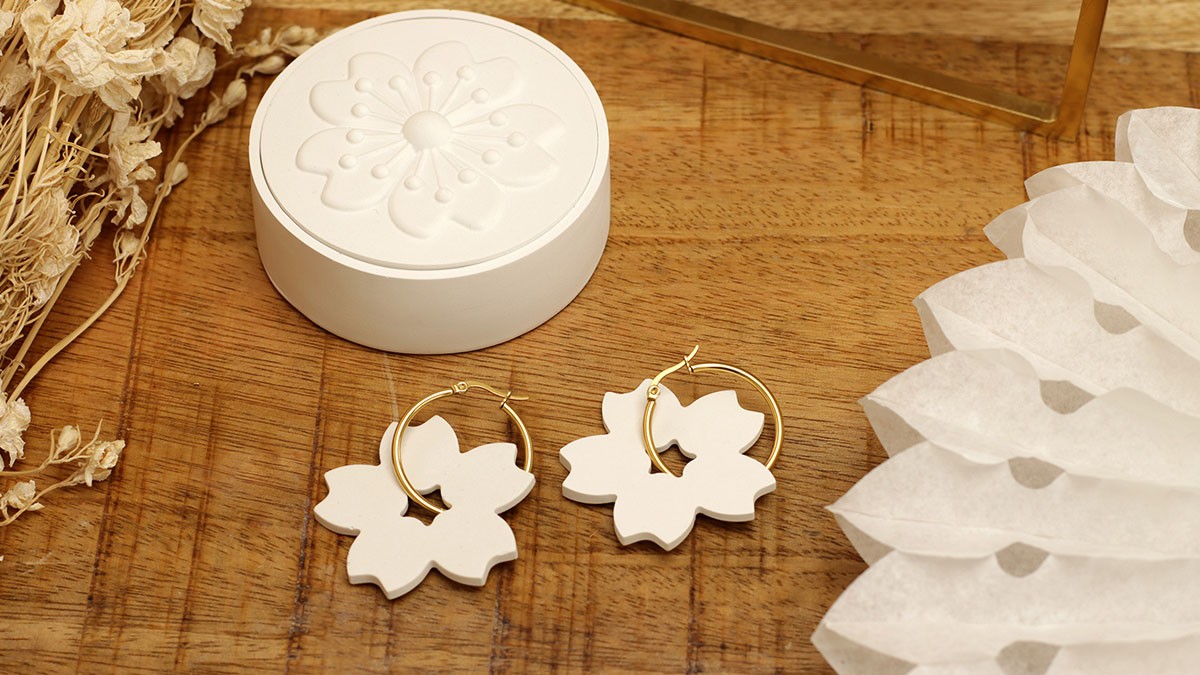
Through our tutorials, we explore the world of jewelry creation, highlighting diverse techniques and materials. Today, we're focusing on the creation of four pairs of Jesmonite earrings, each featuring modern, abstract shapes such as bridges, waves and flower charms. You'll find plenty of other silicone molds to create jewelry if these shapes don't inspire you.
Jesmonite AC100 is chosen for its versatility. It's the most versatile and affordable version of Jesmonite: you can use it to make decorative objects for the home, but you can also use it to create jewelry. There are other forms of Jesmonite dedicated to other uses, such as creating models for industry or outdoor objects. The one we use today is the most common in the DIY world. This material is composed of water-based acrylic resin and gypsum, the stone used to create plaster. It is renowned for its ability to imitate various textures and materials, making it ideal for the Terrazzo effect. What's more, it's environmentally friendly. Be careful not to pour Jesmonite down your sink, as you'll clog it. Wipe up your utensils with paper towels and dispose of in the household rubbish.
We colored our earrings with special Jesmonite dyes, which are highly pigmented. Note, however, that as they dry, the earrings will lighten. Don't use too much dye, as this will cause a demarcation on the piece. The colorant will rise to the surface.
To accentuate the color and durability of our creations, a glossy Jesmonite filler is applied. This finish not only protects the earrings, but also gives them a shine that may or may not be desired. Satin varnish is also available. The filler is applied in at least two coats: a first coat diluted in 20-50% water, and a second undiluted coat once the first has dried. Brush on very thin coats and allow to dry for a few hours before applying the second coat. Jesmonite parts must be completely dry. Ideally, they should be left to dry for a week or a few days on a radiator or in a warm room if it's winter.
For these four pairs, we have opted for golden stainless steel primers. This alloy is chosen for its longevity and perfectly complements the earrings' sleek, modern design. Stainless steel, as its name suggests, does not oxidize and is hypoallergenic.
NB: Jesmonite is more resistant than plaster, but less so than epoxy resin. Don't make your pieces too thin. You can solidify your curls by adding a layer of lacquer resin or UV LED resin.
Mix the two Jesmonite components in the correct volumes (2.5 parts powder to 1 part liquid).
Fill your mold. This needs to be done fairly quickly, as Jesmonite sets quite quickly.
To make sure there are no bubbles, tap the mold, trying not to get any everywhere.
Leave to air dry.
Once dry, lightly sand the edges to round them off with very fine emery paper.
Proceed in the same way for the terrazzo version.
Assemble the various elements into earrings.




You have a question about this tutorial? Ask it to our team and the people who have already tested it. The Perles & Co community is here to help you!
Credits
Perles & Co, Internet & E-Commerce company [22/12/2023] Any reproduction, representation, adaptation, in any form whatsoever, even partial, is prohibited, except for reproduction for private use not intended for collective use, representation in the family circle (art. L 122-5 CPI) and online publishing on condition that the source is mentioned and a link is included to the corresponding page of our site www.perlesandco.com.