Free shipping on orders over 50€ up to 500g
French Online shop for beads and accessories for the creation of DIY jewellery and other creative hobbies

Log-in

How to weave Peyote Circulaire?

Made by :Tiffanie Perles Co
Published on the :19/12/2024

Peyote is a needle-based bead-weaving technique that doesn't require a loom. All you need is a needle, weaving thread and pearls. In previous episodes of Needlework Bead Weaving Training, we looked at Brick Stitch, Peyote Pair and Peyote Impair. There are many variants of these techniques, including Circular Peyote, which itself comes in hundreds of variations. It would be complicated to list all these versions, but broadly speaking, they can be grouped into the following categories:

What is the Circular Peyote?

It's a variation on the simple Peyote. Instead of weaving a strip of beads, the beads are woven in a spiral, starting from a loop of beads. The number of beads in the starting loop will influence the desired result. Similarly, one or two pearls can be added to each hole in the weave, allowing you to create different shapes, to create a 3D model or, on the contrary, to maintain a flat weave. You can also change bead sizes during weaving to achieve even more different results.

Tubular Circular Peyote: Bangle Miyuki

Tubular circular peyote is a weaving technique that creates tube-shaped structures. It is commonly used to make semi-rigid bracelets, known as Miyuki bangles or beaded bangles.

bracelet bangle miyuki

The first step is to create a loop of pearls corresponding to a diameter slightly larger than your hand's circumference, so that you can thread your bangle once finished. As you can see, these are bracelets without clasps. This loop of pearls is always an even number and corresponds to the first two rows of the weave, as in classic peyote. The empty spaces are then created with the third row of beads. Each hole is then filled with a pearl, as in classic peyote. But to start each new row, you must pass through the first bead of the previous round and the first bead of the completed round. The weave is spiral, increasing the width of the bracelet as you go. In the case of Peyote Classique, the length of the bracelet is increased as you weave.

Rings can also be made, simply by reducing the number of beads on the starting loop.

Bague Miyuki en peyote tubulaire

Tubular Circular Peyote is also the basis for the technique of setting cabochons with pearls. To shrink the setting and include the stone, we reduce the size of the pearls as we go along, and we can also use no pearls at all - every other pearl, for example.

cabochon serti avec des perles

3D circular peyote: the basis of 3D pearl weaving

When pearls are woven in concentric circles, the weave will often tend to curl or bulge. This is most noticeable when trying to weave squares with a starting loop of four beads and following the principle of circular peyote weaving: to form angles and thus achieve different geometric shapes, two beads are usually placed at these angles on each turn. Applying this technique to our base of four beads, we obtain warped squares. However, these squares can be used to create 3D stars. Assemble 5 to form a Miyuki 3D star.

étoile 3D miyuki

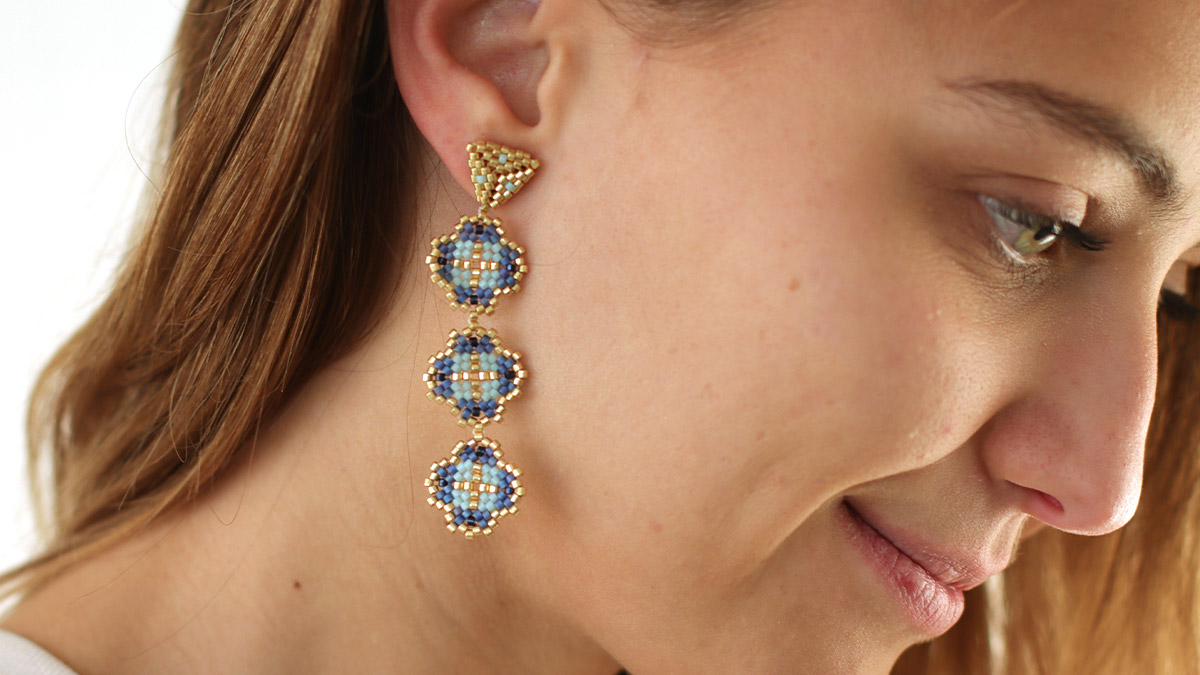
Similarly, with a base of three beads, you can create 3D triangles like the stud earrings shown in the tutorial, or even 3D beaded Christmas ornaments. The possibilities are endless.

Boule de Noël Miyuki

Flat circular peyote: weaving concentric circles

This technique creates flat or slightly concave shapes from a loop of beads. Examples include flat Miyuki stars and flowers. As explained above, when beads are woven in a circle using this technique, the shape naturally becomes more and more voluminous as the weaving progresses. To compensate for this, at certain key points in the weave, we'll add a single bead instead of two, or two beads instead of one, or even change the size of the beads. This requires a lot of testing if you don't follow a tutorial, as the weave is not totally predictable and depends on the shape and size of the beads. For example, in our star example below, stars made with delica 8/0 are flat, whereas with the same pattern, stars made with delica 11/0 or 15/0 are slightly concave.

etoile japonaise en perles miyuki

In the video tutorial example, the blue flowers are almost flat. You should have continued to use a single bead for the Gold Tone beads instead of two blue beads.

Hollow shapes in Circular Peyote

You thought you'd finally seen and understood everything there was to know about Circular Peyote? Well, no... There are so many possibilities, it'll probably take you decades to go through them all! 3D Peyote creations also include hollowed-out volume shapes. Here are just a few examples:
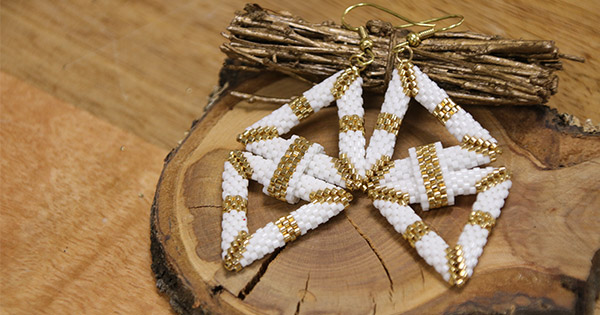
Boucles triangles évidésHollowed pearl triangle earrings

pendentif triangle

Hollowed pearl triangle pendant

Fermoir en perles

Learn how to make a pearl clasp
Tutorial steps

Step 1

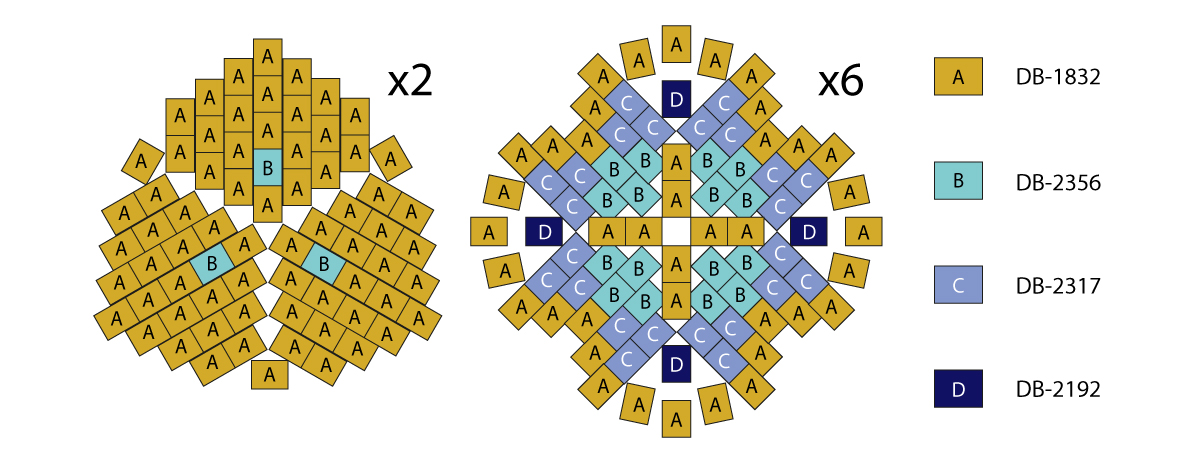
Lettered chart triangle ear tags :

Round 1: A, A, A

Round 2: 2A, 2A, 2A

Round 3: 2A, B, 2A, B, 2A, B

Round 4: 2A, A, A, 2A, A, A, 2A, A, A

Round 5: A (top), A, A, A, A (top), A, A, A, A (top), A, A, A

Round 6: Beginning Decrease. Pass through the single bead of the vertex each time, without adding a bead = *. *, A, A, A, A, *, A, A, A, A, A, *, A, A, A, A. Pass through the vertex bead one last time, then through the first bead added this round to start the next round.

Round 7: Skip the top bead and go directly to the next bead = *. A, A, A, *, A, A, A, *, A, A, A, *. Pass through the first bead threaded on this turn to start turn 8. Glue the nail in place and allow the glue to dry.

Turn 8: On the edges, pass through the last two beads to bring them together on the same principle as the previous turn = *. A, A, *, A, A, *, A, A, *.

Round 9: Same principle. A, *, A, *, A, *.

Tighten the turn by ironing in the three beads, then clamp your thread in the weave and don't cut it off just yet.

Step 2

Square flower lettered chart :

Round 1: A, A, A, A

Round 2: B, B, B, B

Round 3: A, A, A, A

Round 4: B, B, B, B, B, B, B, B

Round 5: B, 2C, B, 2C, B, 2C, B, 2C

Round 6: C, D, C, C, D, C, C, D, C, C, D, C

Round 7: C, C, A, C, C, A, C, C, A, C, C, A

Round 8: 2A, A, A, 2A, A, A, 2A, A, A, 2A, A, A

Round 9: A, A, *, A, A, A, *, A, A, A, *, A, A, A, *, A

Wedge the wires and cut them. Attach this flower to the ear stud with the remaining ear stud wire. Make 2 more flowers and join them in a row. Repeat all steps to make the second loop.

Result
Schema  How to weave Peyote Circulaire?
Tiffanie Perles Co
 Tiffanie Perles Co - Les tutos de Tiffanie
Bonjour, moi c'est Tiffanie. J'étais créatrice et designer produit chez Perles & Co. J'adore tester de nouveaux DIY et vous faire profiter de mes expériences. Vous pouvez toujours consulter les tutoriels que je vous avais concocté sur le site !
Share with my friends
Which material to use ?
Supplies
Miyuki Delica Duracoat 11/0 DB1832 - Galvanized Gold
4,80€
Miyuki Delica 11/0 DB2317 - Opaque Glazed Bayberry Mat AB x8g
4,30€
Fireline Thread - Fused Braid 0.10 mm (4LB) Crystal x50 m
7,50€
6mm Stainless steel 303L Disc earstuds - Gold x2
0,90€
Subtotal : 25,20€
Tools
Jewel Glue Hasulith 30ml
OUTIL-007
Qty : 1
5503 in stock
2,40€
Miyuki Beading needles x6
OAC-162
Qty : 1
6941 in stock
1,50€
Worked embroidery scissors 9 cm by Perles& Co - Gold x1
4,20€
Subtotal : 8,10€
Equivalent product
Miyuki Nylon Beading thread B 0.25 mm White x50 m
3,30€
Miyuki Delica Duracoat 11/0 DB1831 - Galvanized Silver
3,60€
Set of 6 polyamide flat brushes Pébéo
PEINT-104
Qty : 1
6 in stock
8,00€
Flat pad earstuds  6mm 304 Stainless Steel x10
1,40€
Decopatch Food Contact Varnish - Satin x180ml
13,50€
Your questions (2)
You have a question about this sheet? Ask our team and the people who have already tested it. The Perles & Co community is here to help!
By giraldo (16/09/2025 21:15:46)
hola! en que programa realizan los esquemas
Translate the question
Please log in to use this feature
Our Margaux expert answers you (29/09/2025 15:20:16)
Bonjour, le site beadographer.com permet de réaliser plusieurs types de diagrammes en peyote circulaire : triangle (base 3 perles), carré (base 4 perles), étoile 3D. Il y a aussi des techniques plus classiques : Peyote (simple, double triple), Brick stitch (simple, double triple), métier à tisser ect... L'abonnement gratuit ne permet pas d'exporter ses créations et est limité mais vous pouvez tout de même le tester gratuitement. C'est un abonnement annuel d'un peu moins de 15 dollars par an je crois.
Translate the answer
By Marie-Paule MATHY (01/05/2024 15:14:51)
Bonjour! Comment savoir quand il faut mettre une perle ou deux perles en plus par rapport au rang précédent? Je galère depuis des jours pour réaliser un schéma mais en le suivant à la lettre, il gondole, or j’ai respecté une bonne tension du fil. C’est certainement dû au nombre de perles qu’ils me font rajouter aux différents tours mais comment le savoir?
Merci si vous pouvez m’aider.
Translate the question
Please log in to use this feature
Our Tiffanie J. expert answers you (03/05/2024 08:35:10)
Bonjour, ça dépend du schéma, auriez-vous une photo ou un lien ? Après, je ne sais pas ce que vous entendez par gondoler mais il est rare d'obtenir un tissage en peyote circulaire plat. Généralement, ils sont un peu bombés.
Translate the answer
Your reviews (0)
Notices subject to control
Please log in to use this feature

Credits

Perles & Co, Internet & E-Commerce company [19/12/2024] Any reproduction, representation, adaptation, in any form whatsoever, even partial, is prohibited, except for reproduction for private use not intended for collective use, representation in the family circle (art. L 122-5 CPI) and online publishing on condition that the source is mentioned and a link is included to the corresponding page of our site www.perlesandco.com.