Average Grades

Puedo combinar piedra de ojo de tigre con piedra volcánica en una pulsera?
1 Answer
Show answers

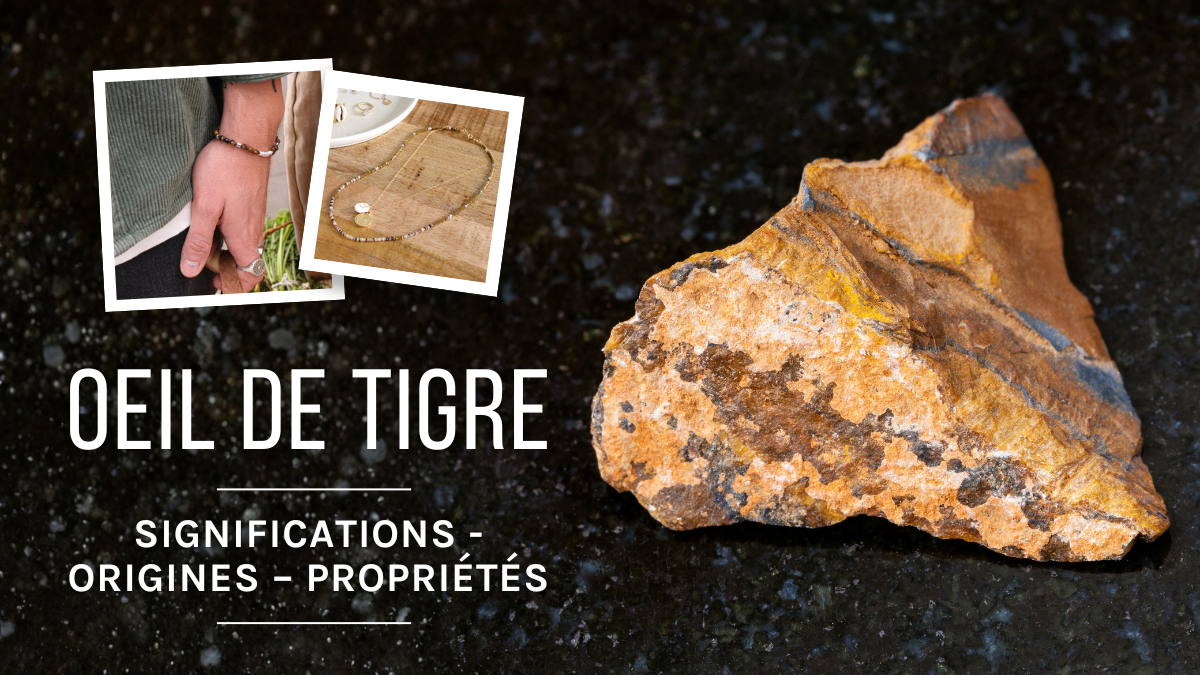
Tiger's eye is a yellow-brown gemstone prized for its unique beauty and varied origins, notably in South Africa and Australia. This stone, often used in jewelry, is ideal for those seeking a natural aesthetic while benefiting from its symbolic history, linked to protection and good luck.
Tiger's eye is a gemstone (formerly known as a "semi-precious stone") that is prized in both jewelry and crystal healing. Whether set in a bracelet, ring, or necklace, its unique yellow-brown color appeals to both men and women.
Discover all our tiger’s eye jewelry components to create beautiful pieces featuring natural stones.
Tiger’s eye is a yellow-brown gemstone that owes its name to its resemblance to the eyes… of a tiger. But it hasn’t always been called that. The Mesopotamian people called it Oculus Belus, which can be translated as “the eye of Belus.” This name refers to Belus-Marduk, the god of fortune and the most powerful of the Babylonian gods.
Known since ancient times for its use in creating ornamental objects and jewelry, the tiger’s eye has stood the test of time. During the Roman Empire, this gemstone was used by warriors as a talisman to protect them in battle and to give them courage. In the Middle Ages, it was worn as a pendant because it was believed to ward off spells and thus ward off the evil eye.
Among Native Americans, this natural stone is considered a very powerful sacred stone. According to their beliefs, the tiger’s eye stone possesses magical powers capable of protecting against curses, evil spirits, and negative energies. It was also a great aid for meditation and for connecting with nature.
Among the Chinese, the stone is considered a good-luck charm. When ideally placed in a home designed according to feng shui principles, it is said to bring positive energy. The Chinese also regard it as a stone of good fortune, attracting wealth and prosperity.
In the 19th century, deposits were discovered in South Africa. Believed to be an extremely rare stone, it was then classified as a gemstone and commanded a very high price.
However, additional deposits were discovered in North Africa during the 20th century. Tiger’s eye was no longer a rare stone. Consequently, its value declined, and it was reclassified as a semiprecious stone according to the terminology of the time.


This gemstone belongs to the quartz family. It has a hardness of 7 on the Mohs scale and a density of 2.68.
It forms in igneous, metamorphic, and sedimentary rocks. It is primarily composed of silicon dioxide.
Tiger’s eye belongs to the family of so-called “eye” stones, such as cat’s eye, falcon’s eye, serpent’s eye, and bull’s eye, which were highly prized in the Middle Ages...
This opaque gemstone is yellow-brown in color with darker brown lines.
There are rare reddish, blue-gray, or green varieties.
When tiger’s eye is simply heated and turns red, it is called bull’s eye. If it takes on a bluish hue, it is called falcon’s eye. This is a natural phenomenon; the stone is not dyed.
The main deposits are located in Western Australia, Burma, South Africa, Brazil, the United States, China, Namibia, India, Sri Lanka, Madagascar, and Russia.
In crystal healing, tiger’s eye is considered a very powerful protective stone. It is said to protect against black magic, spells, and curses.
It is said to be able to refocus energies and thoughts and to promote perseverance in achieving goals. It is believed to harmonize yin and yang.
When placed in a room of the house, it acts as a barrier, warding off negativity from the space.
Linked to the solar plexus chakra (third chakra), this natural stone is said to encourage decision-making and self-esteem. Placed on the root chakra (first chakra), it is said to help achieve greater emotional stability and improved self-confidence.
Tiger’s eye is often used as a meditation stone.
Please note: Our gemstones are not sold for the purpose of crystal healing. Natural stones are in no way a substitute for medical expertise or medical treatment.
Like all stones used in crystal healing, tiger’s eye should be cleaned and recharged regularly to preserve its beauty and all its benefits.
To purify it, simply clean it by soaking it in a container of distilled salt water for a few hours (avoid tap water, as the lime scale could damage your stone). Rinse it thoroughly and dry it with a soft cloth.
You can also pass it through incense smoke or bury it in the ground for a few hours.
If you want to recharge your tiger’s eye stone, place it in sunlight or moonlight for a few hours. Tiger’s eye is resistant to heat and light.
To enhance this ritual, you can place your stone on a cluster of quartz.
This gemstone pairs just as well with the cool tones of925 Sterling Silver andstainless steel as it does with the warm tones of gold-plated and Gold Filled metals. This opens up endless possibilities for creating handmade jewelry!
In crystal healing, it’s recommended to wear this stone on its own because it’s so powerful that it could negate the benefits of other gemstones. However, to enhance its protective properties, you can pair it withblack tourmaline, black onyx, or obsidian. To enhance its protection against negative energies, pair it with pyrite. To boost self-confidence, try the carnelian-tiger’s eye combination.
Which stones should not be paired with tiger’s eye? It is a dynamic stone, so it is not recommended to pair it with calming stones such as amethyst, howlite, or rose quartz.


Several natural stones are associated with the sign of Leo: tiger's eye, citrine, carnelian, jasper and amber.





Credits
Perles & Co, Internet & E-Commerce company [27/01/2026] Any reproduction, representation, adaptation, in any form whatsoever, even partial, is prohibited, except for reproduction for private use not intended for collective use, representation in the family circle (art. L 122-5 CPI) and online publishing on condition that the source is mentioned and a link is included to the corresponding page of our site www.perlesandco.com.