How to make a necklace with pearls?
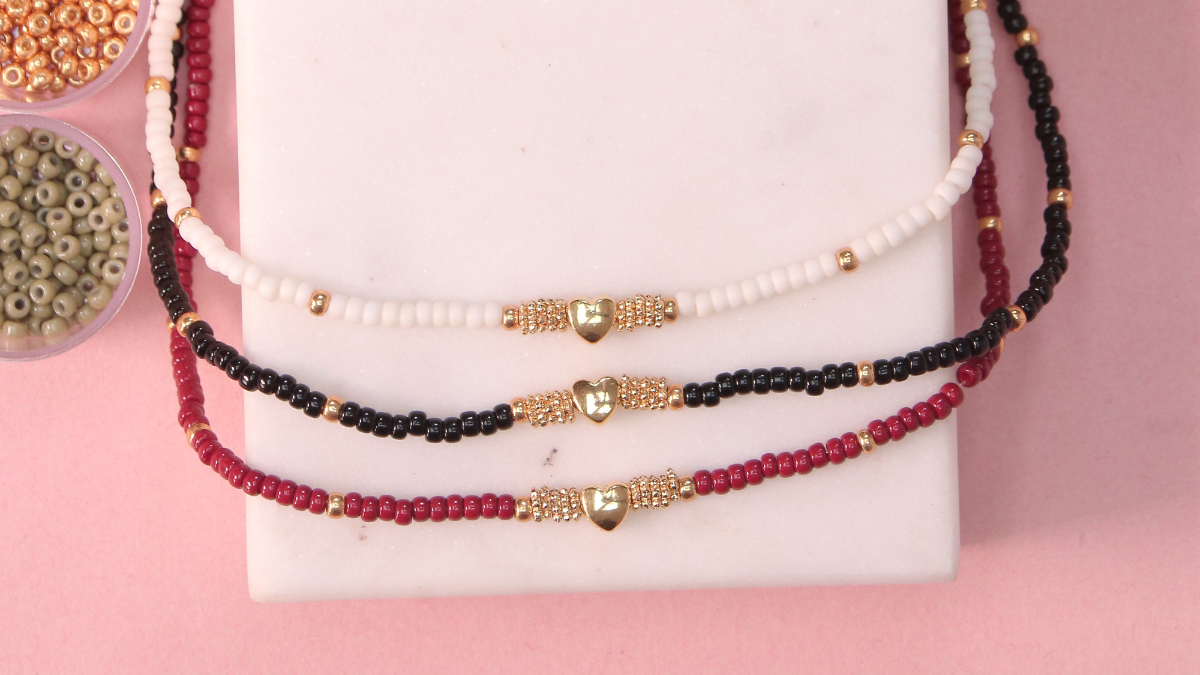
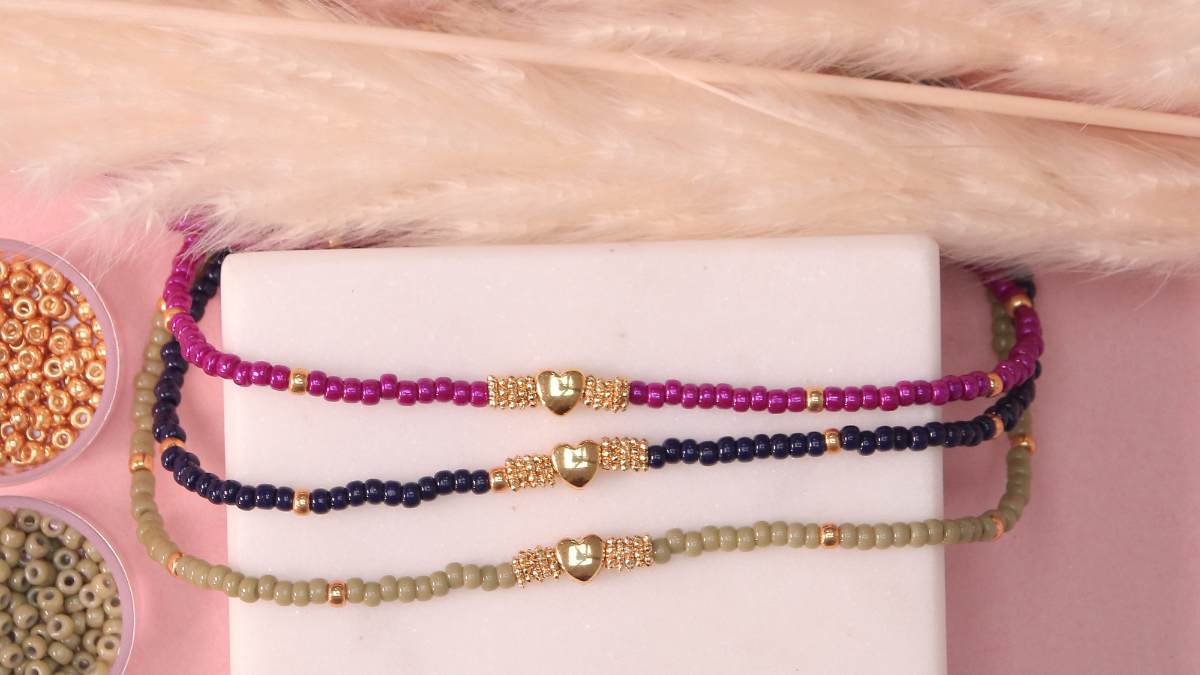
Welcome to lesson 3 of our beginners jewelry training. This training course is designed to teach you step by step how to make your own fashion jewelry. As the course progresses, you will learn different techniques to create jewelry easily. You will see, it is not complicated at all! To practice, each lesson is accompanied by a piece of jewelry to create. The products and tools used in the previous lessons will be reused in the following lessons so that you can equip yourself at low cost and not waste.
Lesson 1 was about creating elastic jewelry and lesson 2 showed you how to use the 3 basic jewelry making pliers to form pearl earrings. For lesson 3, we will create seed bead necklaces, using a crush bead pliers.
1- Why use crush pearl pliers instead of flat pliers?
The crush beads are soft metal beads in which we will pass the wire twice, while hanging a closed ring or directly the clasp of the jewel. Then, we crush them. They will then deform and block the wire. This method is much better than a knot that will not necessarily hold. To crush a bead properly requires a little practice. It is also important to check that the bead will hold the thread once it is flattened. If it is not the case, you have to start again.
Crush bead pliers are not essential, but they do allow you to create durable and strong finishes for your necklaces. Some people simply use flat pliers. This is also possible, but with this method the wire is crushed and a bit weakened. Also, the flat pliers will only flatten the bead to be crushed, so it will form a sort of metal bar across the wire. This is even more unsightly if the pearl is large. There are pearl covers to crush. These are open beads that are closed over the bead to be crushed (or over a knot) to hide it. The larger the crushed pearl, the larger the pearl cover.
The advantage of the crush pearl clamp is that it will not just flatten the pearl, it will also make a notch to pre-fold it in half. Most crushers have a second notch to fold the bead in half. This means that it will be half the width of the wire and you can take a smaller, nicer bead cover. On the other hand, the pliers correspond to a certain diameter of pearls to crush. For example, from 1.5 to 2 mm. Therefore, you need to buy a new pair of pliers if you decide to use beads to crush, and wires of different diameters too.
2- Choosing the beads to crush
The wire must be able to pass easily twice in the hole of the bead to crush. So, if you have a 0.30 mm wire, choose crushable beads with a 1 mm hole. If your wire is 0.5 mm, use a crush bead with a 1.5 mm hole instead.
Another point to consider is the material. If you decide to hide your crush bead with a bead cover, the nobility of the metal will not matter. You can take brass. It is a soft metal and perfect for this purpose. If the pearl to be crushed will remain visible, then take a metal more worked and resistant in time like gold filled. Stainless steel is also a durable option, but this metal is very hard to deform and sometimes the beads break. Silver 925 is a good option in silver.
3- Why use nylon wire for a necklace?
The choice of thread for a project depends on many different parameters. There are hundreds of different types of threads, materials and sizes. Each one has its advantages and disadvantages. That's why, when a customer asks us which thread to use to make a necklace, we always ask them to specify what they want to do. Several threads are possible depending on the project.
So why did we choose nylon fishing line for our seed bead necklaces?
Seed beads are fairly light so we don't need an extremely strong and expensive wire like cabled wire. Weaving wires like Miyuki wire or cotton wires will be too thin and fragile. Micro macramé yarns may not fall well on the neck or take false folds because the beads are not heavy enough. As long as you take care of it, hang your necklaces on a rack instead of storing them in a box with other jewelry, the nylon thread used here will give a strong necklace with a nice fall on the neck because it is naturally slightly curved.
The Miyuki beads size 8/0 that we used have a 1.1mm diameter hole. To get a nice finish on the clasp, you have to pass through the beads again, the piece of wire remaining on both sides. The wire must be able to pass twice in the beads. We could have used 0.50 mm wire. But in this situation we took the 0.30 mm turtle wire, because with the weight of the beads, it falls better. Also, this will eventually allow you to make other necklaces with finer beads if you wish. You can make up to 180 small necklaces with a 100m spool of wire.
Planning to make a gemstone necklace? The most resistant wire to the weight and roughness of the beads will be a 49-strand stranded wire. Want to learn more about theuse of stranded wire and how to choose it? Go to our technical data sheet.