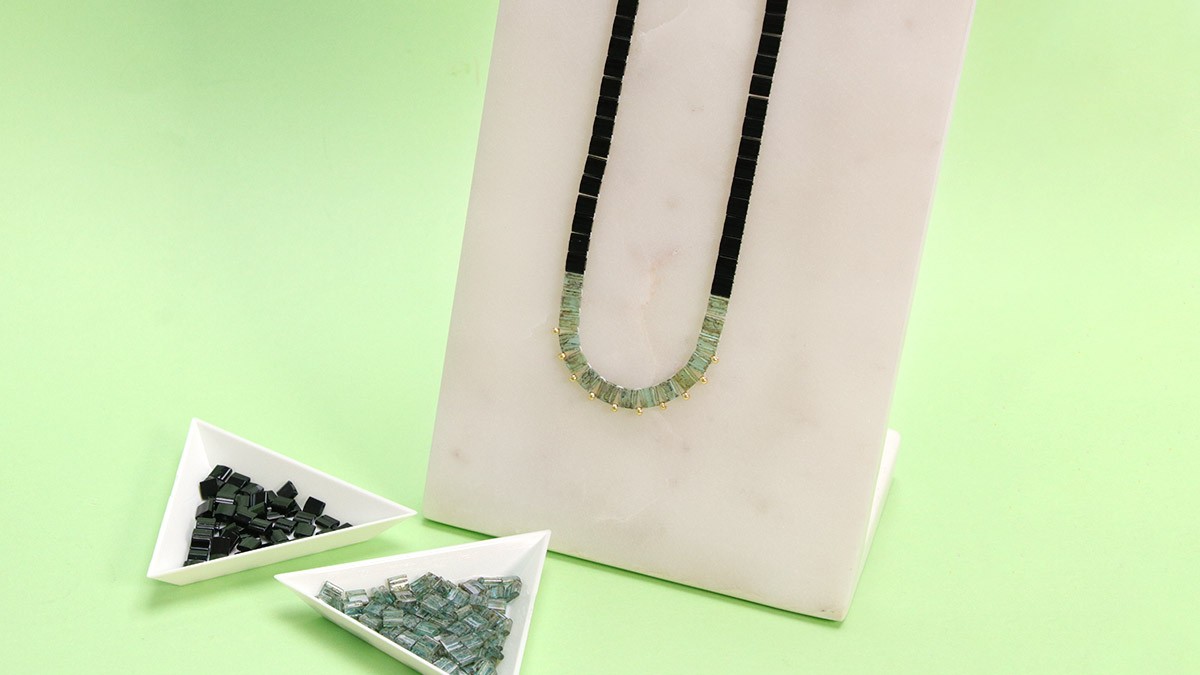
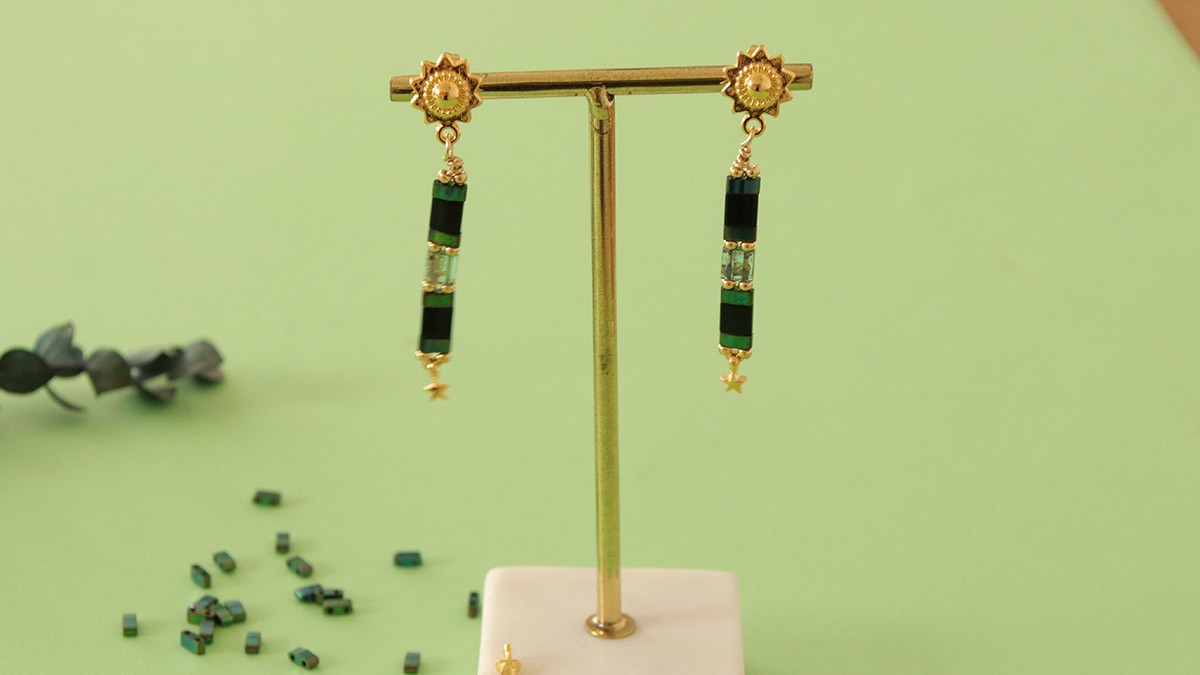
Welcome to our Learn to create jewelry with gemstones training course. This training course will introduce you to the art of creating costume jewelry through 5 fun and creative videos. In each lesson, you'll learn the basics of jewelry-making by following a simple, accessible tutorial.
1- Nail names for costume jewelry making
When it comes to making dangling earrings with gemstone beads, selecting the right studs is a crucial aspect. These metal components are used to transform pearls into charms or pendants, while others are used to make spacers with pearls for insertion into jewelry. Here's an overview of the types of nails most commonly used in costume jewelry:
Eye rods or round-head nails: These rods end in a small loop or "eye". They are ideal for composite creations. The loop at the end of the nail makes it easy to attach another nail or other element, such as a charm. With these nails, you can, for example, create pearl chains or jewelry with complex assemblies. They can also be used to insert pearls into the center of a chain to create a bracelet or necklace. To use them, it is usually necessary to create a loop at the other end with jewelry pliers.
Flat-headed rodsor flat-head nails: These rods have a flat or rounded head at one end. The head acts as a stop, preventing beads from slipping off the rod. They are perfect for dangling earrings with a single bead or a set of dangling beads. Unlike the ball head stud, the flat head stud is designed to be inconspicuous.
Pin-head or ball-headstuds: Similar to flat-head studs, these studs end in a small ball. They add a decorative element to the base of the bead and are often used in creations where the bottom of the stem is visible. Sometimes, these nails take on an even more decorative appearance and come in a variety of designs, such as three little balls or leaf shapes.
It's important to choose the type of shank according to the style and functionality of the jewel you wish to create.
2- Choose your nail according to the size of the pearl hole
The diameter of the shank must be smaller than the pearl hole. Here are a few tips to help you make the right choice:
First of all, determine the hole diameter of your pearls. Gemstone beads can have different hole sizes. Just because a pearl measures 8 mm doesn't mean its hole will necessarily be 1 mm in diameter. This depends on the stone and the manufacturer's choice. To find out the size of the pearl's hole, refer to what is indicated on the product page on our site. If the hole is 1 mm, use a slightly thinner nail, e.g. a nail with a 0.8 mm shank. Be sure to check the hole size of all your pearls, and use the smallest hole diameter as a guide.
If you don't know the source of your pearls, you'll need to buy several nails with shanks of different diameters to find out the hole size. If in doubt, you can use a thin nail, e.g. 0.6 mm, but there's no guarantee that this will be the right size.
If the diameter of the hole for the smallest pearl forces you to use a very thin nail, it's possible that the ball or disc of the nail is too small to stop the largest pearl. This information should also be provided on the product page. If this is not the case, ask for it as a comment on the product page. In this case, either don't thread the large bead first, or take a small bead, such as a seed bead, which will be blocked by the ball or disk and block the large bead.
3- Bead mounting techniques and the use of basic clamps
Mounting gemstone beads to create dangling earrings requiresthe use of basic costume jewelrypliers. There are three basic types of pliers: cutting pliers, round pliers and flat pliers.
- Cutting pliers are used to cut stems to the desired length. They are indispensable for adjusting the length of nails or metal wires. Measure and mark the required length on the rod, starting from the last bead threaded, then use the cutting pliers to make a clean cut.
- Round pliers are used to create loops and curves on metal wires. They are perfect for forming eyelets or loops at the top of stems, enabling beads to be attached to ear hooks or other elements. After threading the beads onto the stem, use the round or flat pliers to form the stem over the last bead, creating a right angle. Create the loop by turning the stem around the jaw of the round pliers in the opposite direction to the angle. The size of the loop will vary according to where you hold the rod in relation to the pivot point of the pliers: the closer you hold the rod to the pivot point, the larger the loop will be, and the further you hold it from this point, the smaller the loop will be.
- Flat-nose pliers are used to hold and adjust metal parts. They are ideal for flattening, holding and adjusting components without damaging them. Use these pliers to grip the stem or loop when reopening and closing the loop to attach your charm or earring to the chain. They are also useful for shaping wires and adjusting the finish of crush beads, as a complement to crush bead pliers.