Average Grades
Est ce que vos cours sont offerts via la plateforme Zoom? Acceptez vous les clients du Canada?
1 Answer
Show answers

This lesson in the beginner's jewelry course teaches you how to make an elastic ring with a gemstone cabochon. You'll use surgeon's knot and claw setting techniques, while equipping yourself at a lower cost thanks to reusable materials. Opt for a multi-strand elastic wire, ideal for lightweight beads, and choose an opaque cabochon like Lapis Lazuli for optimal aesthetic results.
Welcome to the last lesson of our Fall season beginner jewelry course. If you don't already know the principle, the goal is to offer you 5 lessons to learn the basic techniques to make costume jewelry. These lessons are accompanied by a project. The materials and tools purchased for one lesson can be reused for the other lessons so that you can equip yourself at a lower cost while making 5 pieces of jewelry. In this lesson, we will make an elastic ring with a gemstone cabochon. We will look at two essential techniques: the surgeon's knot and the use of cabochon claw settings.
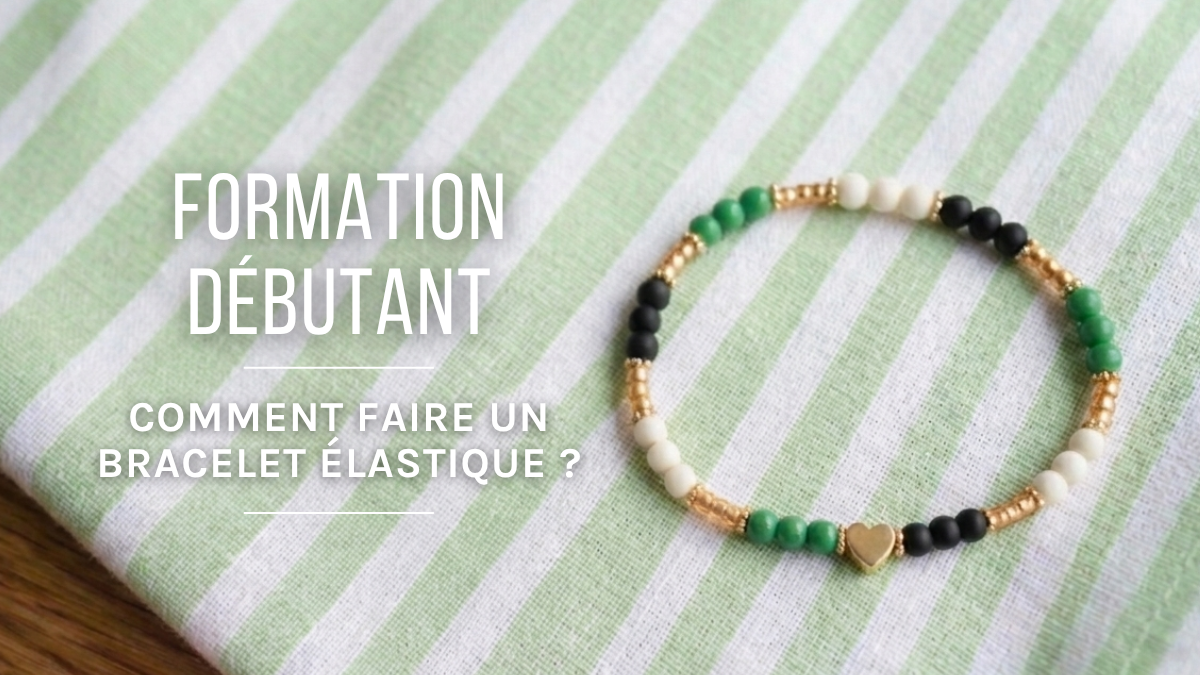
The surgeon's knot has already been presented in episode 1 of the summer season beginner jewelry course: How to make an elastic bracelet?
An elastic beaded ring is normally made of small and light beads to make a fine and comfortable ring. It is important that the wire is stretchable and does not squeeze the finger too much. Also, if the beads are small, it usually means that the bead hole is also small. In conclusion, you need a stretchy and thin elastic thread. The most suitable wire will be multi-strand elastic wire. It is a bit more fragile than silicone wire, but it is very stretchy and suitable for light beads.
For our project, this wire will be doubled as we will be using Tila beads with two holes. Since this wire is thin, we will be able to attach it to the setting. Once the cabochon is placed inside it, the elastic threads will be invisible. Be careful, as said before, this wire is more fragile. The ring will not last a decade, but if you take care of it, it will remain intact for at least two years.
Elastic threads are weakened by different things:
Therefore, avoid wearing the ring when you go in the water and do not store it in direct sunlight all day or in your car in the middle of summer. The setting is also subject to oxidation and does not like humidity. As you can see, water is not your ring's friend.
The claws are sort of metal legs or extensions that will block the cabochon in the setting. They are first of all slightly oriented towards the outside of the setting. The cabochon is placed inside the setting, then, with a flat pliers in the case of costume jewelry, we fold the claws on the cabochon to block it. In professional jewelry, other tools are used, because the claws do not have the same malleability. Those for costume jewelry, although the setting can be silver 925 or gold plated, are designed to be used by beginners. In professional jewelry, so in the case where you make the jewelry from scratch, you can use tools called jeweler's stalls. But of course, you can also use a jeweler's tool for folding the prongs of fancy seams instead of pliers!
Most of the crimps we sell are made of 4 prongs. In this case, remember to fold down the prongs in a certain order.


For this project, we chose a setting that is made up of lots of claws with baroque designs. These claws form a pattern around the cabochon. We will have to apply the same logic but on several claws at the same time.
To avoid leaving marks on the metal, you can use flat pliers with nylon tips. These pliers are less precise, but they allow you to flatten the metal without scratching it.
In addition to aesthetics and personal preference, remember that a transparent stone will show through the back of the setting. So choose an opaque or semi-opaque stone. You can choose, for example, Lapis Lazuli, Carnelian, Tiger's Eye, Amethyst, etc. Avoid moonstone and rock crystal. Also pay attention to the size of the cabochon. Make sure the setting matches. In the case of this setting, your cabochon must have a flat bottom and a domed top. Avoid cabochons with a groove around them, as they are generally higher. When there is a groove around it, it means that it is a micro-macramé crimped cabochon.


Elastic rings with small beads

Accumulation of fine beaded rings




Credits
Perles & Co, Internet & E-Commerce company [11/12/2022] Any reproduction, representation, adaptation, in any form whatsoever, even partial, is prohibited, except for reproduction for private use not intended for collective use, representation in the family circle (art. L 122-5 CPI) and online publishing on condition that the source is mentioned and a link is included to the corresponding page of our site www.perlesandco.com.