How to make a fine bracelet with small gemstone beads?
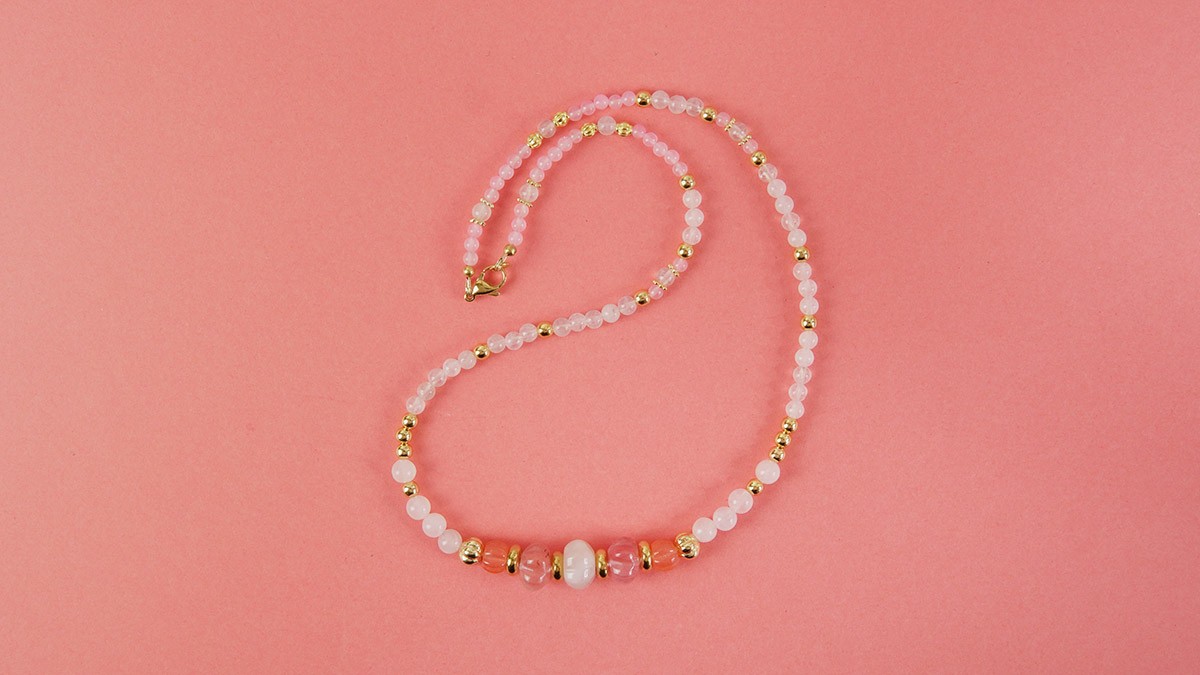
Welcome to our Learn to create jewelry with gemstones training course. This training course will introduce you to the art of creating costume jewelry through five fun and creative videos. In each lesson, you'll learn the basics of jewelry-making by following a simple, accessible tutorial. In previous lessons, we created an elastic bracelet with 8 mm gemstone beads, a pair of dangling earrings and a chain necklace with gemstone beads in the center.
Today, we're going to learn how to make fine bracelets with gemstones. This article will guide you through the essential steps: choosing the right wire, choosing between two methods for making a sliding clasp, using stopper beads, and ensuring compatibility between wire size and stopper beads.
1- Choosing the right wire for the beads
The first step in creating your bracelet is to choose the right type of wire. The wire must be fine enough to pass through the pearl holes. Transparent nylon wires such as fishing line or cabled wire are often recommended for their strength and non-fraying properties. With these wires, you'll need to finish your bracelet with a clasp. To find out more about clasps, go to the previous lesson and these articles:
For our thin bracelet with adjustable clasp project, we'll need to choose a very soft wire, preferably a synthetic one. That's why we're going to use braided nylon thread or jade thread. It's a synthetic thread, usually colored, but white and black are also available. As it's a very flexible thread, it will be easier to use a needle to thread the thread through the hole in the beads. Use a flexible or split eye needle. If a needle is used, then the chosen thread must be able to pass through the bead hole twice. Our thread can flatten out, so we managed to pass 0.5 mm doubled thread through a 0.5 mm bead hole with a little force. But if you choose other products, it's best to keep a little more margin and use a wire with a diameter half that of the pearl hole. If you're not sure about compatibility, take a look at the tutorials on our site.
2- Making a sliding clasp
Using our jade wire, we're going to make a sliding clasp. There are several techniques for making a bracelet adjustable to wrist size. Here are the two best known:
- Make a macramé slip knot: This is a macramé overhand knot that we add to the two ends of the bracelet wire, using another piece of wire. The trick is to ensure that the knot is tight enough to hold the wires together and not come undone, while allowing the bracelet to slide to fit the wrist. This method has been demonstrated in several tutorials, including "lesson 1 - DIY pearl bracelet Miyuki Tila sliding knot" and "lesson 5 - Which wire for pearl bracelet Miyuki?" in previous beginner jewelry training courses.
- Using a stopper bead: Stopper beads are beads with a rubber or silicone washer inside. They can be used to lock beads in place, non-permanently, on a wire or earring. They can also be used as a sliding clasp by passing the two wire ends of the bracelet through them. This is the method we're going to use for our bracelet.
3- Bead / wire compatibility
It's rather difficult to give a perfect rule for which stopper beads are compatible with which wires. Indeed, between a rigid wire and a soft one, the bead's ability to stay blocked will be different. What's more, some wires only have an approximate or rounded dimension given by the manufacturer. It's best to go by what has already been tested in our tutorials. You can also use the table below with a few examples. "Stop Perles" means that the stopper bead passes over a single wire and blocks the beads. "Clasp" means that the wire can pass through twice and the bead can be used as a clasp.