Average Grades
Bonjour j’aimerai bien avoir la référence du fil avec aiguille soudée, qui est sur cartonnerie et mesure 2m.Merci beaucoup pour votre réponse.
1 Answer
Show answers

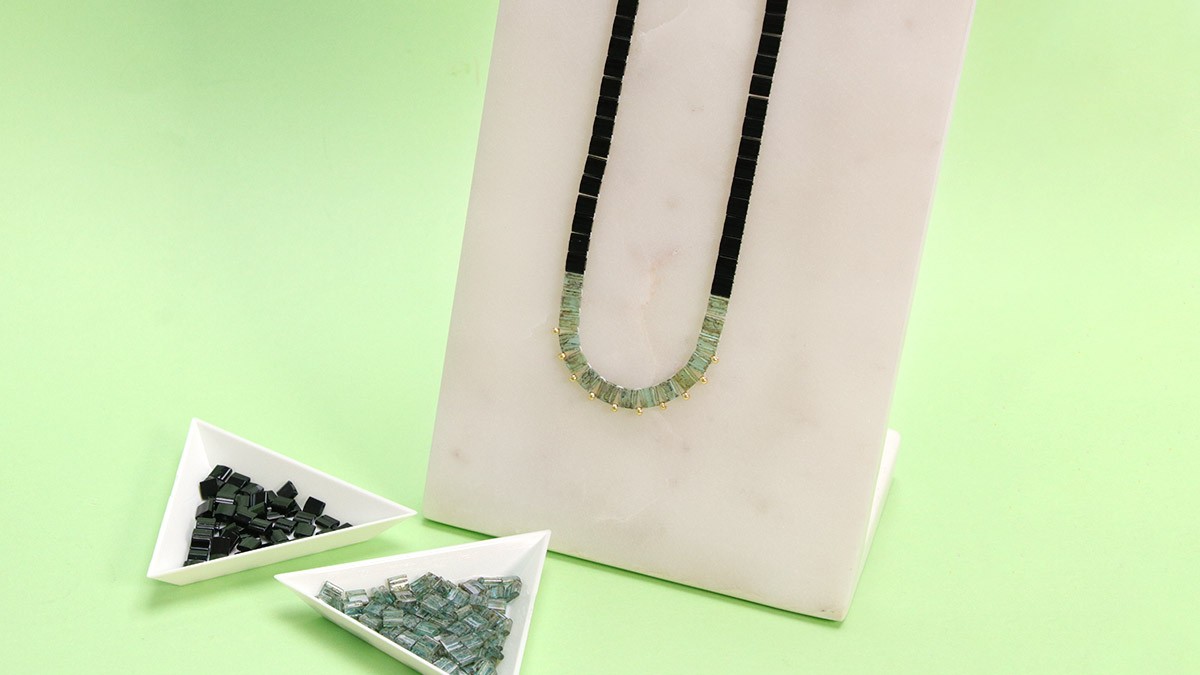
In this first episode of the autumn season of our beginner's jewelry course, you'll learn how to make two bracelets using Japanese flat Tila, Half Tila and Quarter Tila beads. These beads, available in three sizes, require braided nylon wire for solid, easy assembly, while allowing you to create several pieces of jewelry by reusing the material over the course of the lessons.
This episode is the first one of our fall season jewelry training. We presented 5 other episodes during the previous summer and you enjoyed them very much. If you haven't already watched them, don't hesitate to check them out! The goal of these hobby projects is to offer you easy jewelry lessons associated with a DIY jewelry project. The 5 lessons of the season are linked. The material purchased in the first episode will be reused in the following episodes. This way, you will be able to equip yourself little by little without breaking the bank and make 5 pieces of jewelry while learning the basic techniques of costume jewelry making.
In this first episode of our fall season, we will make two bracelets with flat Japanese beads. These are rectangle shaped beads. They come in 3 sizes: Les Tila, Half Tila, Quarter Tila. The Half Tila is half the size of the Tila and the Quarter Tila is a quarter of the size of the Tila. These beads have two through holes, which can be a problem for beginners in jewelry making. In this video we show you how to make Tila bracelets with a slip knot.
It is possible to make elastic bracelets with Tila beads. We already have a tutorial on this subject: Elastic bracelet with rectangular beads. Tila beads can also be woven. Some of these bead weaving tutorials are more complicated than others. For today's lesson, we're going to make a bracelet with a slip knot.
For this, you will need a rubbing resistant wire. We don't recommend natural fiber yarns, which tend to wear out faster, or gold or silver yarns, which are not specifically designed for micro-macramé. The ideal thread for this project is braided nylon thread.
You need to be able to thread the wire through the beads easily. Braided nylon threads are often very soft which makes it difficult to thread through the holes in the beads. It is also difficult to find a needle with an eye large enough for this type of thread and which will be able to pass through the hole in the beads. This is why we chose a thread that is sold with a needle welded to the thread. This fine needle is no wider than the wire itself. No need to double thread the beads either.
This thread is sold by 2 m on a small cardboard box. You will need to unwind the entire thread and remove it from the cardboard box to use the end of the thread first. This way, you will keep the needle on the thread until you have finished the thread.
The advantage of synthetic yarn such as nylon is that it can be melted with a lighter, a thread burner or a gas lighter. This allows you to gather the strands of the thread when they split. In addition, you can also merge the strands at the knots. If this is done properly, the piece of wire will melt with the knot so that the knot cannot come apart. The disadvantages of this technique are the risk of burns and the unpleasant smell of the burnt thread. The smoke is not very good for your health either.
Glue is an alternative, both for gathering the strands of yarn and for fixing the knots. However, with wear and tear, water and solvents, it can come off. It's up to you to choose what works best for you. Burning the thread plus putting glue on will be even better. But the glue can leave traces.
Several types of slipknots exist. In this tutorial, we are going to make a macramé overhand knot or square knot.


This knot also exists in a twisted slip knot version. This version is available here: Simple Miyuki Bracelet tutorial.
Want to try other jewelry designs waiting for the next lesson? Here are several tila beginner tutorials.
 Elastic bracelet tila and PureCrystal


Terracotta woven tila bracelet




Credits
Perles & Co, Internet & E-Commerce company [16/10/2022] Any reproduction, representation, adaptation, in any form whatsoever, even partial, is prohibited, except for reproduction for private use not intended for collective use, representation in the family circle (art. L 122-5 CPI) and online publishing on condition that the source is mentioned and a link is included to the corresponding page of our site www.perlesandco.com.