Average Grades
Free shipping on orders over 50€ up to 500g
French Online shop for beads and accessories for the creation of DIY jewellery and other creative hobbies
Log-in
0
Shopping cart
Shopping cart
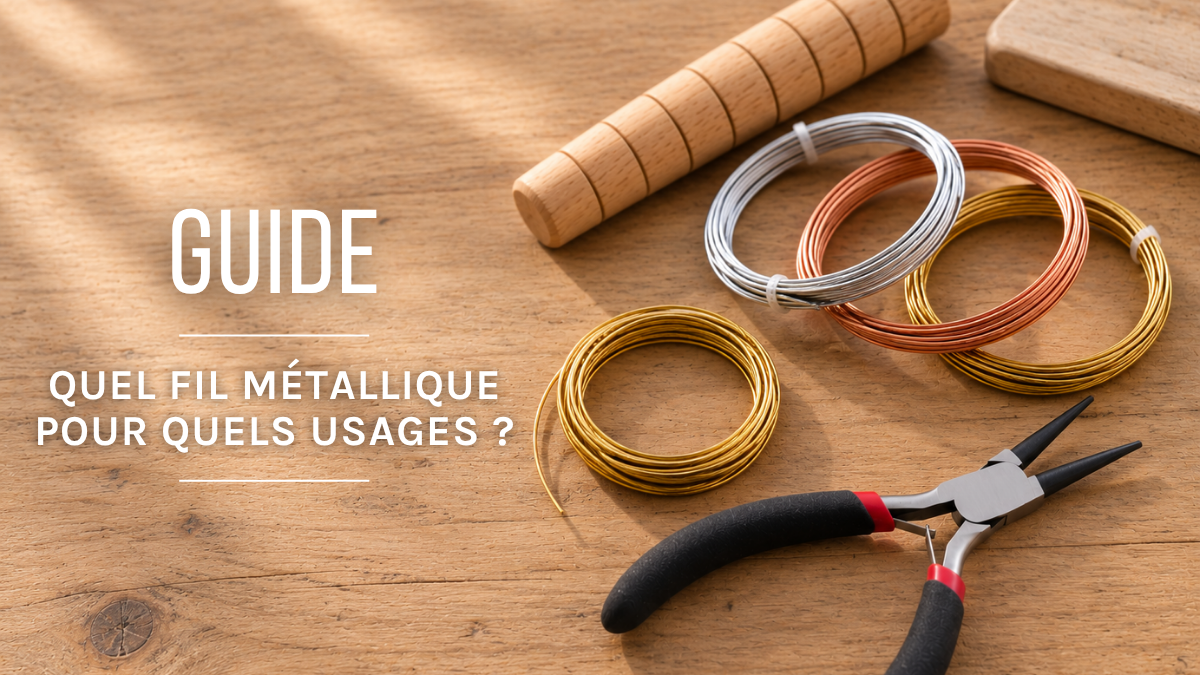
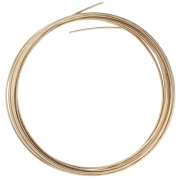
To choose the right metal wire, three criteria are essential: diameter, material, and hardness. A soft wire is suitable for ligatures and coiling, while a semi-hard or hard wire is preferable for rings, hooks, and rods. Copper is ideal for beginners, stainless steel offers excellent durability, and aluminum remains the best choice for large, lightweight forms.
Which metal wire should you choose to make a bangle, form a ring, or set a stone? Diameter is important, but it’s not the only factor.
Two 0.8 mm wires can behave very differently. A flexible copper wire is easy to shape, while a stainless steel wire of the same diameter will generally be much harder to bend.
To make the right choice, always consider three criteria: the wire’s diameter, its material, and its hardness. The weight of the jewelry and the diameter of the beads’ holes should also be taken into account.
Here are some simple guidelines to get you started. The wire diameters should then be adjusted based on the material and stiffness of the wire.
Use | Recommended Diameter | Recommended Hardness | Recommended Materials |
Ligatures and small coils | 0.20 to 0.40 mm | Soft | Copper, 925 Sterling Silver, Gold Filled |
Wire wrapping around a stone | Structure: 0.60 to 1 mm / ligatures: 0.20 to 0.40 mm | Soft to semi-hard | Copper, brass, 925 Sterling Silver, Gold Filled |
Ear wires, studs, and posts | 0.50 to 0.80 mm | Soft to semi-hard | Copper, 925 Sterling Silver, Gold Filled, brass |
Earring hooks | 0.70 to 0.80 mm | Semi-hard | 925 Sterling Silver, Gold Filled, stainless steel |
Jump rings | 0.80 to 1.20 mm | Semi-hard | Stainless steel, brass, semi-hard 925 Sterling Silver, semi-hard Gold Filled |
Links and connectors | 0.80 to 1.20 mm | Semi-hard to hard | Stainless steel, brass, 925 Sterling Silver, Gold Filled |
Rigs and rigid structures | Approximately 1 to 2 mm | Semi-hard to hard | Brass, stainless steel, Gold Filled, 925 Sterling Silver; aluminum for large sections |
Lettering and large shapes | 1 to 3 mm | Soft to semi-hard | Aluminum, copper |
Assembly / Stringing | 0.25 to 1 mm depending on the load | Stranded wire |
These values are not standards. For example, a 1 mm aluminum wire remains very flexible, whereas a stainless steel wire of the same diameter may already require specialized tools.
For finewire wrapping, it’s often best to use two different wire diameters.
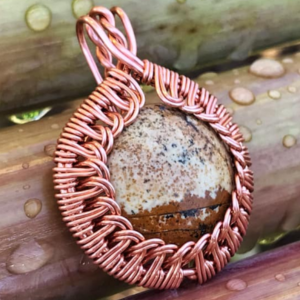
A wire measuring 0.60 to 1 mm can be used to create the framework of a pendant or to secure a stone. A wire measuring 0.20 to 0.40 mm can then be used to make ligatures, spirals, and small coils.
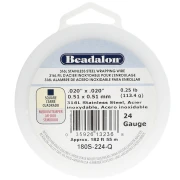
For beginners, copper is a particularly good choice: it’s easy to shape and allows you to practice without immediately using a precious metal. Brass can provide greater structural integrity. 925 Sterling Silver and Gold Filled are suitable for more luxurious pieces. Stainless steel can also be used, but its stiffness makes it less comfortable for learning complex coiling techniques.
To take your skills further, check out 5 things to know before getting started with wire wrapping.
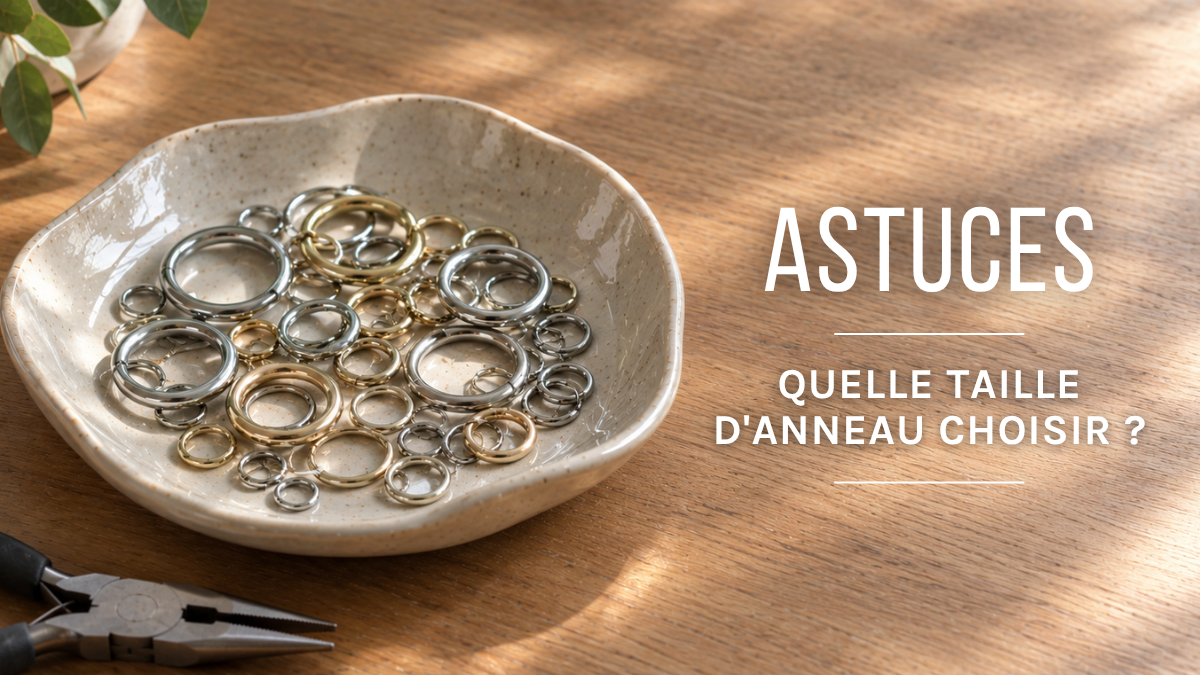
To make jump rings, a diameter of around 0.8 mm is best suited for lightweight jewelry. At around 1 mm, the ring becomes stronger and can be used for many bracelets, necklaces, and pendants. For heavier components or larger rings, 1.2 mm or more may be preferable.
Note: The inner diameter of the ring also matters. With the same wire thickness, a large ring generally deforms more easily than a small one.
For a functional ring, it’s best to choose a semi-hard wire or one that’s stiff enough to hold its shape.
You can also learn how to make your own rings using the cannetille technique.
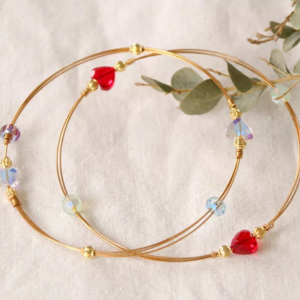
A bangle must retain its shape while being worn. The hardness of the metal is therefore just as important as its diameter:
For ear hooks, a diameter of about 0.70 to 0.80 mm is a good guideline. A semi-hard wire helps the hook retain its shape.
The end that goes through the earlobe must always be perfectly smooth and free of sharp edges.
To make a chain link or connector, you’ll want more rigidity. A diameter between 0.80 and 1.20 mm is common, but it must be suited to the weight of the piece of jewelry.
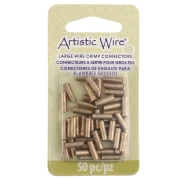
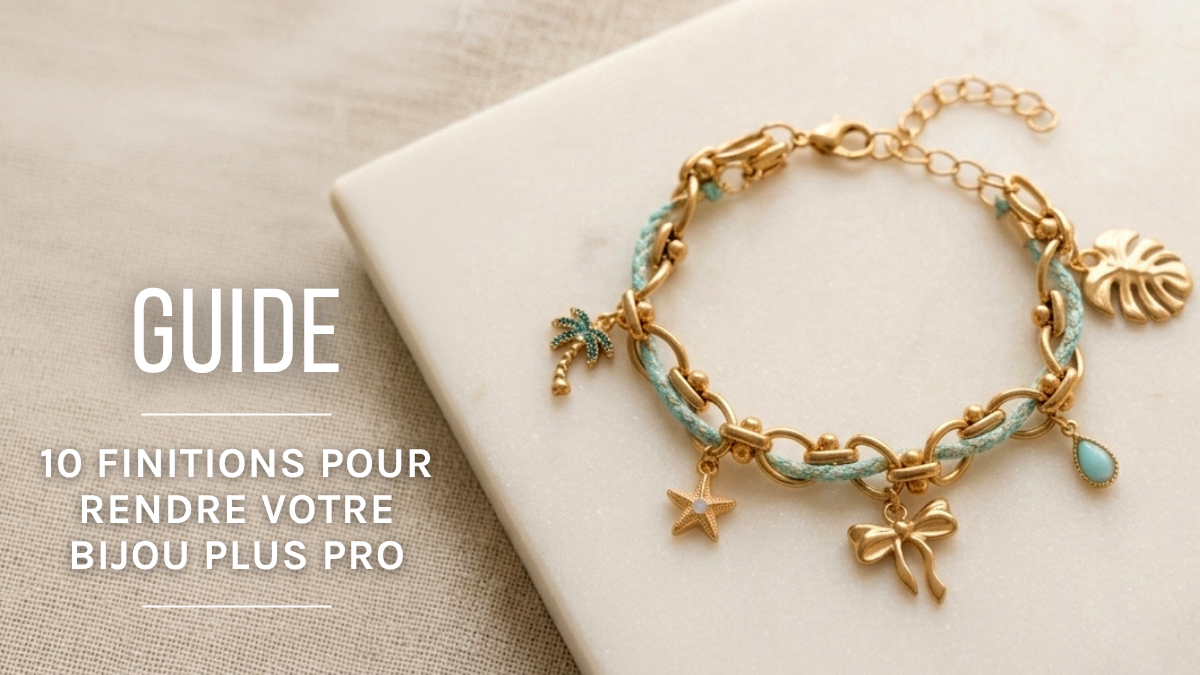
Wire can therefore also be used to make your own findings: rings, hooks, posts, eye pins, connectors, links, or clasps.
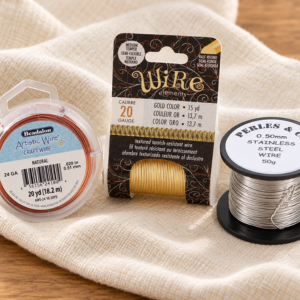
Hardness completely changes how a wire is used.
Working with metal can also gradually harden it. Repeated bending in the same spot can eventually weaken the wire.
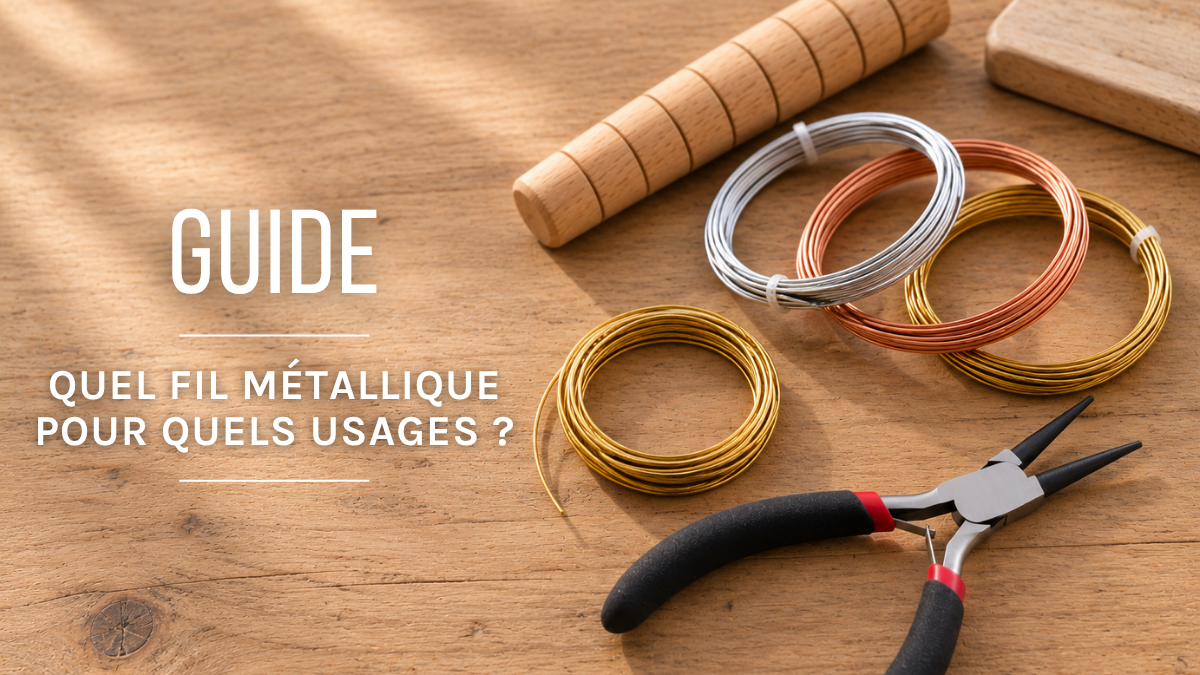
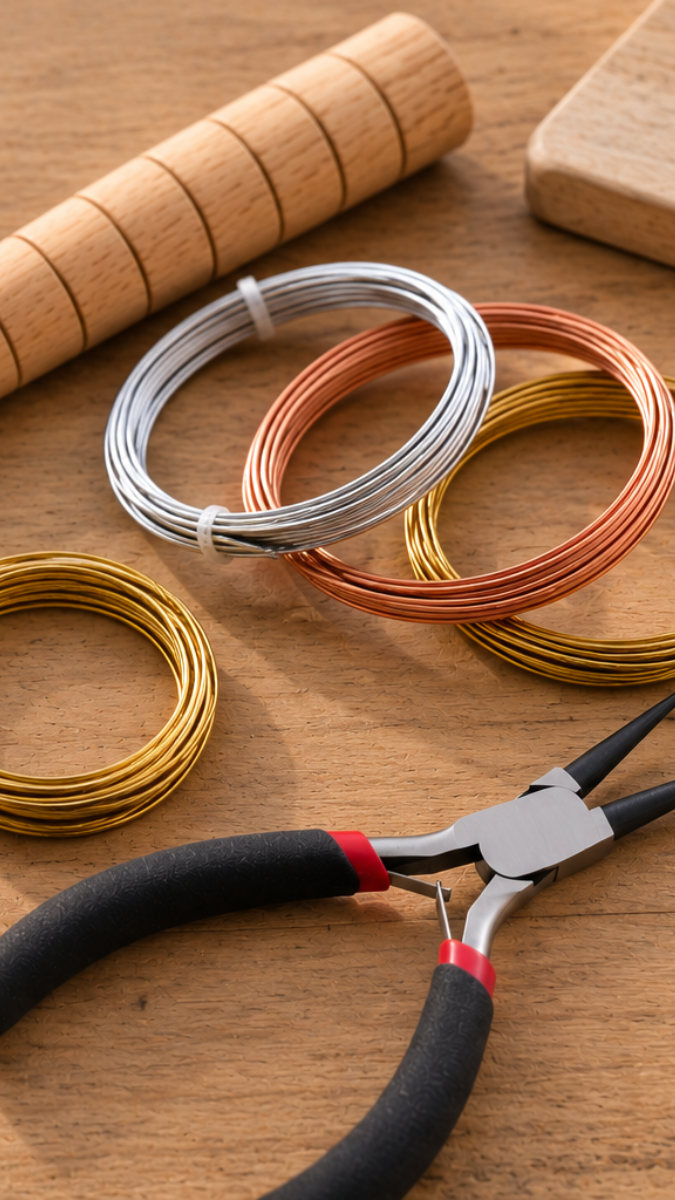

To start, you can use about 0.8 mm to create the structure and 0.3 to 0.4 mm for the ligatures. Flexible copper wire is particularly easy to work with when practicing.
A semi-stiff wire measuring 0.8 to 1.2 mm is a good starting point. The larger the ring is, or the heavier the object it must support, the greater its strength must be—which can be achieved by adjusting its thickness, material, and hardness.
There is no universal diameter. For many types of jewelry wire, 1 to 2 mm is a common range. A very malleable metal like aluminum generally requires a larger cross-section to achieve a rigid structure.
Highly malleablealuminum is not the best choice for a small ring subjected to high tension. It is better suited for decorative shapes, lettering, spirals, and three-dimensional designs.
Credits
Perles & Co, Internet & E-Commerce company [08/10/2026] Any reproduction, representation, adaptation, in any form whatsoever, even partial, is prohibited, except for reproduction for private use not intended for collective use, representation in the family circle (art. L 122-5 CPI) and online publishing on condition that the source is mentioned and a link is included to the corresponding page of our site www.perlesandco.com.