Average Grades
Free shipping on orders over 50€ up to 500g
French Online shop for beads and accessories for the creation of DIY jewellery and other creative hobbies
Log-in
0
Shopping cart
Shopping cart
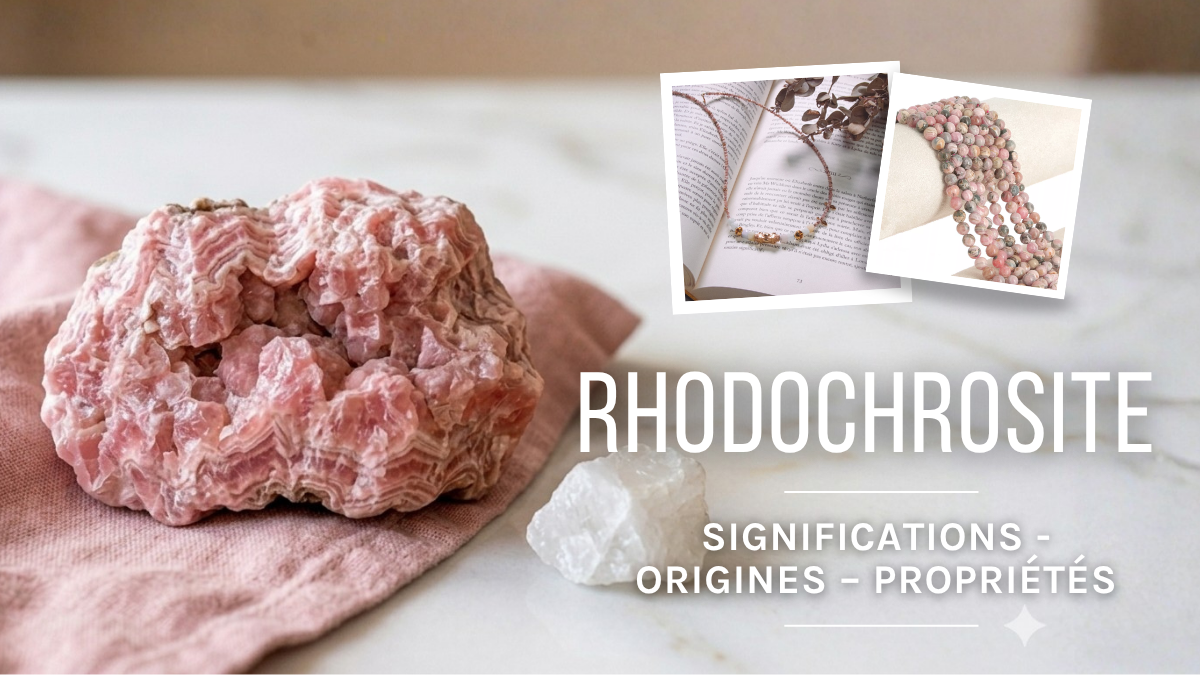
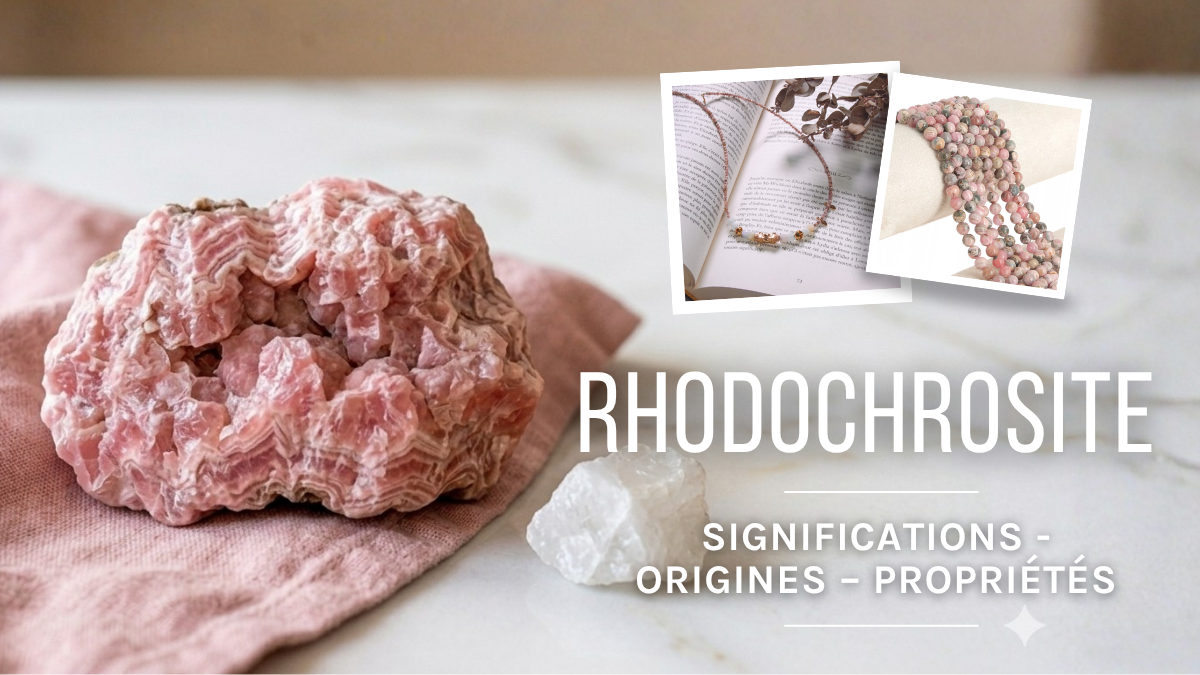
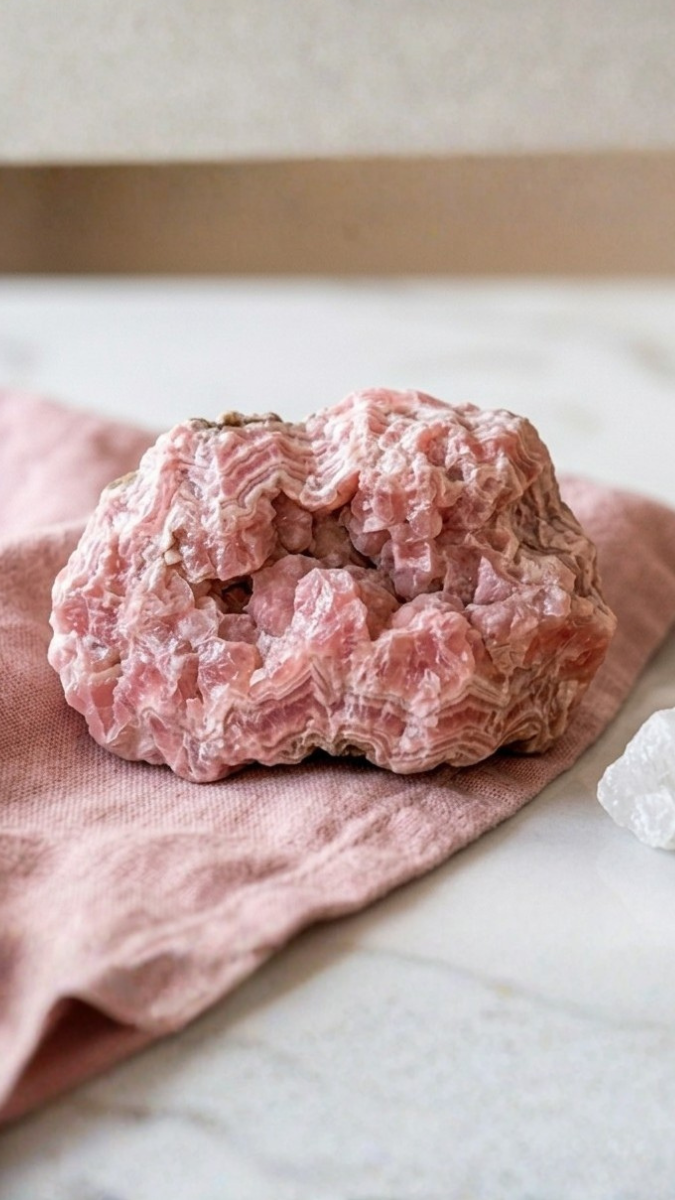
Rhodochrosite, with its beautiful pink color ranging from pale to bright red, is mainly mined in Argentina and other countries such as Peru and the USA. It is highly prized for jewelry-making thanks to its comforting charm, and is often associated with symbolism of love and compassion.
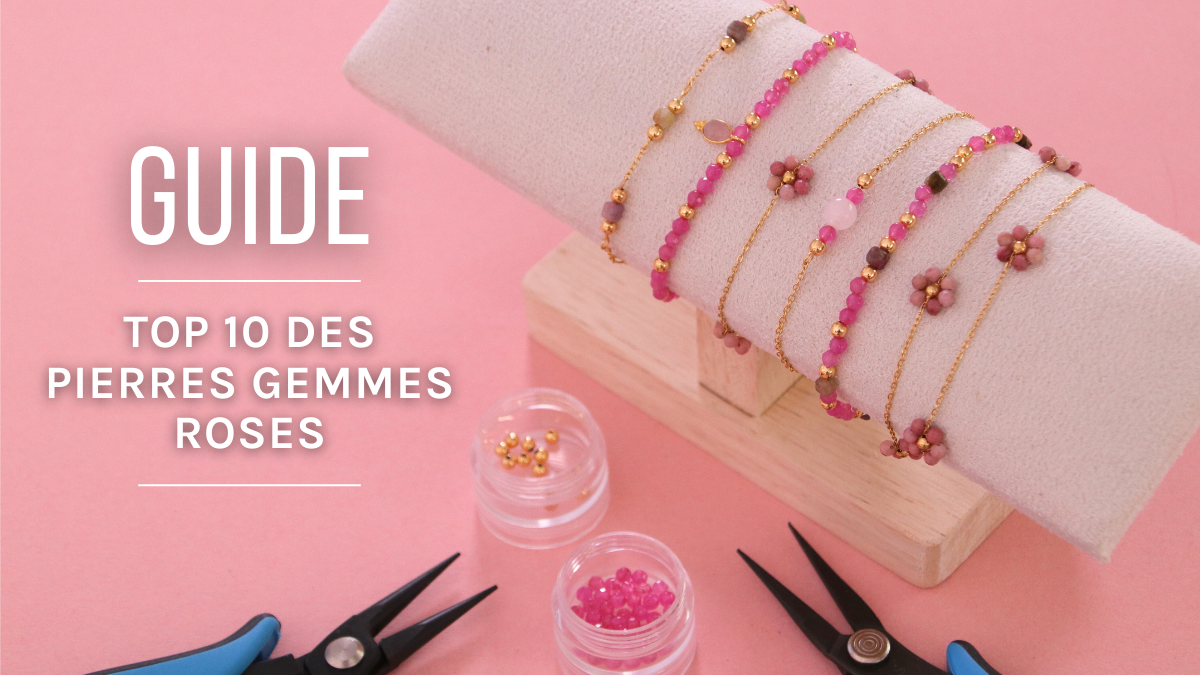
We love rhodochrosite for its legend with deep meaning, but also for its pretty pink color. Highly prized in jewelry-making, it’s perfect for crafting beautiful DIY costume jewelry in a soft, comforting shade. It’s no wonder that crystal healers consider it a soothing stone associated with love. You, too, can create natural stone jewelry using beads and jewelry components made from rhodochrosite and other pink natural stones. Get inspired by our tutorials!
Rhodochrosite gets its name from the ancient Greek “rhodon,” meaning “rose,” and “khroma,” meaning “color.” It can therefore be translated as “rose-colored.” This refers to its lovely color.
Legend has it that on the shores of Lake Titicaca stood a temple dedicated to Inti, the Inca sun god. One day, Canqui Tupac, a brave and courageous warrior, crossed the sacred lake and reached the temple. There he met the priestess Nusta Ajlla, and they fell in love instantly. Since their love was forbidden, they were forced to flee. The Inca emperor ordered his men to pursue them relentlessly. The lovers lived in hiding for many years and had numerous children.
Upon Nusta’s death, the warrior Canqui Tupac buried his beloved at the foot of a mountain. Consumed by grief, he turned to stone. Years later, a shepherd discovered that the stones had transformed into a multitude of blood-red rose petals. The shepherd picked up one of them and brought it to the Inca emperor. Deeply moved, the emperor forgave the two lovers. Rhodochrosite was renamed the “Rosa del Inca.”
It is said that this natural stone was discovered in the 12th century (pre-Columbian era) in copper and silver mines in Argentina. For the Incas, this pink stone held special cultural and religious significance. They used it for ornamental, ritual, and funerary purposes. They carved it to create beads, figurines, pendants, necklaces, and clothing ornaments. Archaeologists have found this gemstone in the form of jewelry in some royal and noble Inca tombs.
After the fall of the Inca Empire, this natural stone fell into obscurity. It wasn’t until the 18th century that it was rediscovered. The German mineralogist Johann Friedrich Ludwig Hausmann restored its original name, rhodochrosite.
In the 1830s, it was brought back into fashion thanks to an exhibition by the German Franz Mansfeld.
Today, this pink stone has become the national gemstone of Argentina and the official gemstone of the state of Colorado in the United States.

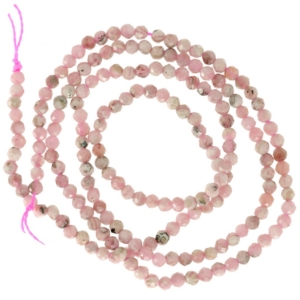

This pink stone has a hardness of 4 onthe Mohs scale, making it a relatively soft stone. Its density ranges from 3.5 to 3.7 g/cm³.
The color of this gemstone ranges from pink to red. It can vary in intensity, ranging from pale pink to bright red. It has a vitreous luster.
Because of its color, it is often confused with rhodonite.
The main deposits are found in Argentina, Peru, France, Gabon, South Africa, China, Mexico, and the United States.
Like most pink stones, rhodochrosite is associated with love and compassion. It is also a soothing stone said to bring calm and serenity.
Crystal healers recommend it for meditation because it is said to promote the renewal of energy.
Which chakra is rhodochrosite associated with? This gemstone is said to help balance the solar plexus chakra by combating stress and the heart chakra by addressing emotional issues.
Please note: Our gemstones are not sold for use in crystal healing. The effects of gemstones have not been scientifically proven. Natural gemstones are in no way a substitute for medical expertise or medical treatment.
According to crystal healers, it is important to purify rhodochrosite to rid it of the negative energies it has accumulated and to recharge it with positive energy so that it can restore all its beneficial properties.
To purify it, you can soak it in a container filled withdemineralized waterfor a few hours or smudge it with sage.
To recharge it, simply expose it to sunlight for several hours. To enhance this effect, place it on a cluster of quartz.
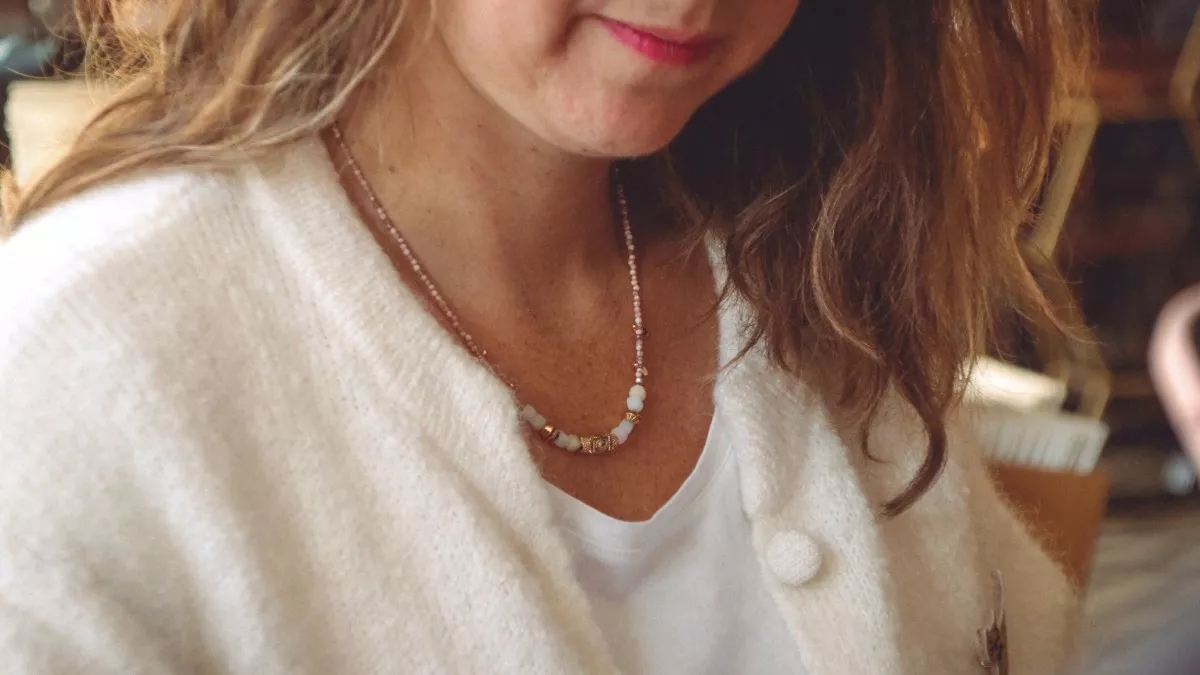
Rhodochrosite’s soft color pairs equally well with gold and silver. Stainless steel or 925 Sterling Silverfindings will highlight its delicate hue, while Gold Filled or gold-platedfindings will lend it a chic and refined charm.
Which stones pair well with rhodochrosite?According to practitioners of crystal healing, combining rhodochrosite with stones that have complementary properties can be beneficial. Here are a few examples:
Which stones should not be paired with rhodochrosite?


Credits
Perles & Co, Internet & E-Commerce company [18/03/2026] Any reproduction, representation, adaptation, in any form whatsoever, even partial, is prohibited, except for reproduction for private use not intended for collective use, representation in the family circle (art. L 122-5 CPI) and online publishing on condition that the source is mentioned and a link is included to the corresponding page of our site www.perlesandco.com.