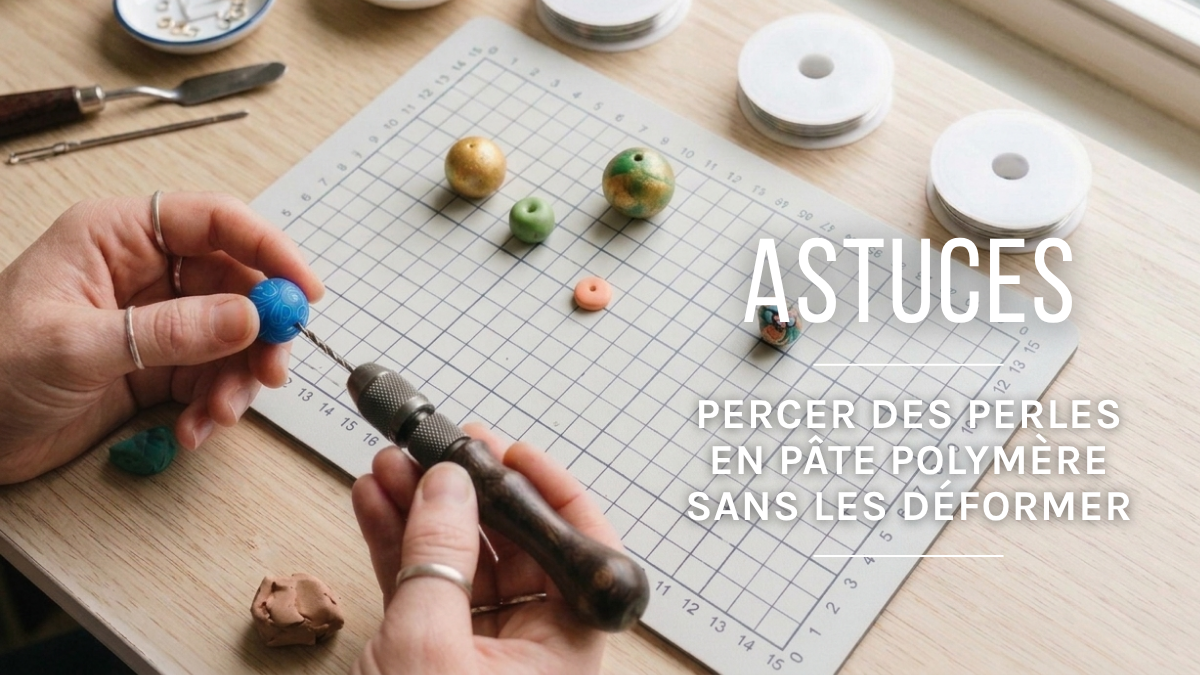
How to sand Fimo?How to smooth polymer clay? How to make Fimo clay shine? In this video, you'll learn the 3 technical steps required to give your polymer clay a mirror-like shine, starting with sanding, polishing and buffing.
Why sand, polish and buff instead of varnish? Varnish is a quick and easy way to add shine to your polymer clay jewelry. It's often used by beginners or children, because it's so easy to apply. However, over time and depending on the brand, it can behave in unexpected ways. After a few years, it can chip, yellow or even disappear altogether, which for professionals is a real problem that can lead to customers returning your jewelry.
Once you've got your bearings for the material and the right gestures, this step will be an integral part of your work as a polymerist.
Step 1: Sanding Fimo
Prepare a container with warm or hot water and a drop of soap. The temperature of the water is important, as polymer clay is heat-sensitive and will expand slightly with heat, enabling deeper sanding than with cold water. The soap is there to trap all the polymer particles in the water, so you don't inhale them.
You can use a sanding block to make sanding easier.
Sanding is done with fine-grain abrasives, such as the 1000-grit abrasive used here. There are coarser grits for sanding, but it all depends on the surface of your workpiece. If you have worked with the mosaic technique and filled a textured clay with a mixture of hard and liquid polymers, after firing you will need to use a coarser grit like the 600 or 800 abrasive and then go up to the 1000 or 1200 grit.
The gesture to adopt is circular or criss-cross, once in one direction, once in the other. Don't force it or you'll scratch the polymer. At the end of this step, your polymer part will be slightly white, as if it had an opaque film on it.
Step 2: Polishing the fimo
This polishing step cannot be performed without sanding. You don't need to go through all the different polishing grits - three or four are enough. Unlike sanding paper, which wears out quickly, micro-meshes are made of cloth and can last a really long time. You'll find several types on the site, all of which perform very well. Grit sizes range from 1200 to 12000.
The procedure is exactly the same as for sanding, but you should never sand in just one direction, remembering to sand the edges and underside of the parts. At the end of this step, your part is soft, clean and matte. It can also stay that way.
Step 3: Polishing the clay
Polishing is by far the most satisfying step: you can see the transformation of the piece towards a shine, the colors are revived and the jewelry catches the light.
The tools used are the Dremel drill with its flexible shaft, which means you work with less weight than the drill itself, the other tool is a polishing disc that fits this flexible shaft. You don't need polishing products for polymer, as this is reserved for metals or other hard surfaces. The speed required is in the first few notches, so there's no need to go as fast as possible, as this can be dangerous. It's important to protect yourself by tying up your hair and wearing a mask, so as not to breathe in all the flannel fibres that will fly away.
The gesture should always be in a criss-cross pattern, and you should skim over the material.