How to close a seed bead bracelet?
There are many ways to finish a beaded bracelet woven on a loom. However, it is best to decide how to finish your bracelet before making the bracelet because depending on the size of your bracelet or whether you want a bracelet with an adjustable clasp or not, not everything will be possible and in some cases there are steps to prepare before you start weaving the bracelet.
Please note that we are talking about loom weaving here and not needle bead weaving like Peyote or Brick Stitch.
Special tips and clasps exist, but not in all sizes! It's even more complicated to find when you make a very wide cuff. The wider the bracelet, the more difficult it will be to find a clasp. So think about it before you start.
To find out how wide your beaded bracelet will be, multiply the height of a single bead by the number of beads in the width of the bracelet. For example for a Miyuki delicas 11/0 bead bracelet with 11 rows in the width, we will make 1,27 mm x 11 because the delicas 11/0 are about 1,27 mm high. So we get 13.97 mm or about 14 mm. But we must also take into account the thickness of the wire between the beads and the vagaries of sizes and spaces between the beads. If you use classic wire like Miyuki, Ko or C-LON AA, we add 1 to 4 mm depending on the width of the bracelet. The ideal size of the tip for a Miyuki delicas 11/0 bracelet with 11 beads wide is 14 + 2 = 16 mm. If you use a thicker wire please add it to the calculation. For 11 beads you need 12 wires.
If you are looking for a way to install the threads on a loom to make a classic finish later on, we invite you to consult our technical sheet.
Without further ado here are the different ways to finish a woven bracelet with seed beads or miyuki delicas.
1 - Woven bracelet with special weaving tips
There are special tips that allow you to finish your weaving in a clean way. They have a ring to attach a lobster clasp or a spring clasp. This is one of the most common finishes. However, the bracelet must be the same width as the clasp or smaller. See our calculation above to estimate the width of your bracelet. They also come in different diameters for different sizes of beads, but the most classic is for 11/0 delicas. Think to check. Please note that these tips are sold individually on our website. Of course you will need two for a bracelet.
To use this type of tips, the assembly of the threads is classic. Once the bracelet is finished, cut the wires as close as possible to the nail to keep the maximum length. If your bracelet is less than 10 beads you can insert the wires 1 by 1 into the weaving beads and block them by making several passes. Avoid passing the wire on the outside of the bracelet. Prefer the passages inside the bracelet itself. Then put a little glue on the edges of the bracelet to make sure that the wires you have tucked in there do not come out while you are wearing it.
If your bracelet is more than 10 beads, tie all the wires 2 by 2 with a double knot. Cut to 1mm and put enough glue on the knots so they don't come apart.
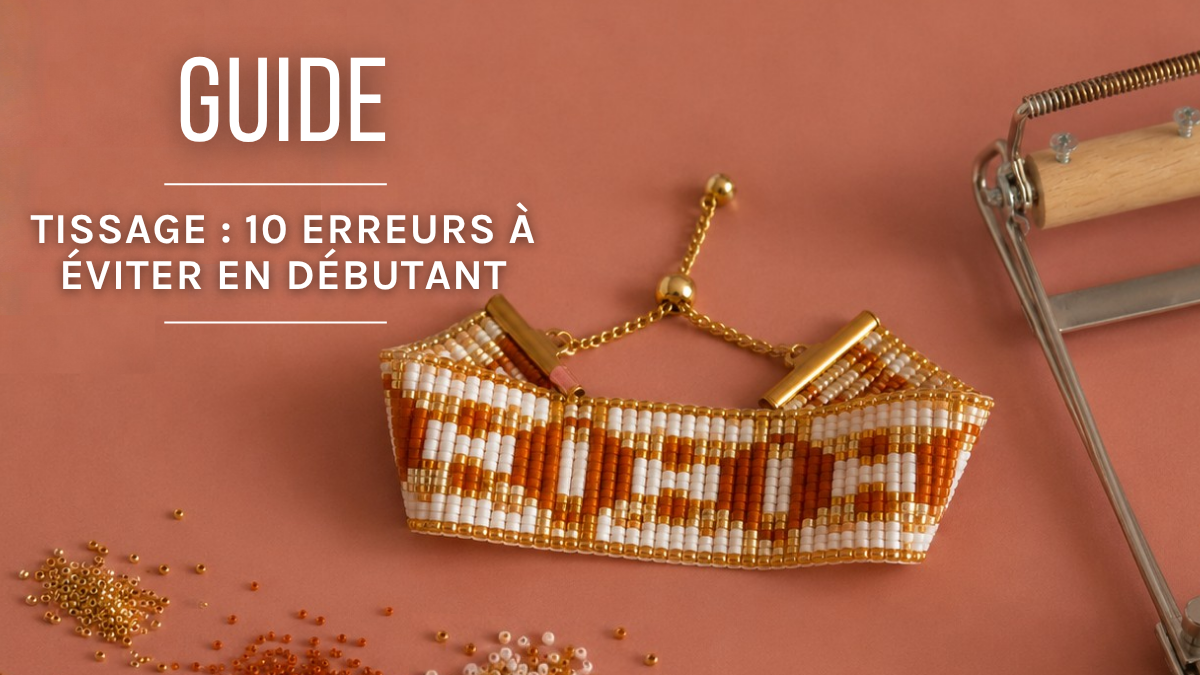
Open the slot in the end caps a little more to make it easier to pass the beads through by sliding in 2 clips, at least one of the two round ones. Spread the slot slightly. Fold back one of the legs of the end cap with flat tongs or on the edge of the table. Slide the weave in with a little more glue. Close the other tab. Add a clasp and an extension chain with open rings. Example: Christmas Miyuki Bracelet tutorial .

2 - Special weaving clasps and magnetic clasps
There are clasps that work in the same way as the tips but be careful you must be sure of the length of your bracelet. The bracelet will fit on one wrist only. Measure the size of your wrist and add 1.5 cm of ease so that the bracelet does not serve you. Then take into account the width of the clasp to calculate the length of your pearl bracelet.
There are many different sizes of clasps so be sure to check the width of your bracelet.
The method for finishing the bracelet is the same as for the special weaving tips.
Be aware that you can also use classic magnetic clasps and glue the weave directly into them but check the height of the clasp hole too.
Example: Tuto Miyuki bracelet knot and gold beadslide clasp.

3 - Hiilos interchangeable clasps
These are magnetic interchangeable clasps in ABS with a nice finish. You slip inside compatible tips that look like the weaving tips but without the ring. These tips are attached to the weave and can be slid in and out of the clasp over and over again. This means that the same clasp can be reused and the weave changed as desired. These clasps allow you to make multi-row bracelets, for example by adding small thin bracelets to your weave.
The finish is the same as for the special weaving clasps.
Example: DIY Multi-row bracelet with Hiilos magnetic clasp and Miyuki weaving.

4 - Weaving tips with 925 silver clasp
These are unusual clasps but we have a few available in the store. Moreover, they are made of 925 silver, ideal if you want a bracelet with more refined materials. They are quite small so they are meant for thin bracelets in 4, 5 or 6 delicas beads 11/0 wide. These tips are hollow and have 2 "stilts" on the front that are invisible from above.
Wedge the threads into the weave as explained in 1. However, keep the longest thread on each side. Use this thread to go behind the clasp stilts, go back into the last row of beads and make at least two more turns. Then wedge these wires into the weave.
Example: Miyuki 4 row loom bracelet

5 - Fancy shaped cymbal beads
Manufacturers are competing with ingenuity in recent years and we see the emergence of other types of tips. They are often created for a particular type of bead and size, but with a little imagination they can be used in many different ways. You can find them among the "cymbal beads". Don't hesitate to go and have a look at them, you might just fall in love!
Basically, the principle is that these beads have holes and that they weave as if these holes were beads. When you have finished weaving your bracelet, you place this end cap between the weaving wires on the loom, you go through the first hole from the bottom, under the warp wires, you thread the number of beads you need until you get to the next hole which you thread in the same way. Once the row is threaded you go back through the holes and beads over the warp threads as if it were another row of the weave. Repeat the operation 2 times to make sure that the tip holds well and then wedge all the threads in the weave.
Example: Miyuki weaving bracelet with 15 and 8 seed beads and scale tips

6 - Using metal chain as a warp thread
You don't have to use the same wires as warp threads all the time. In this tutorial we use gold metal chain as warp thread on the edge directly on the loom. Then we finish the weave in point by removing one more bead from each row and wedge the wires into the weave. Finally, simply connect the chains to a clasp.
Example: miyuki beads cuff bracelet brick colors tutorial

7 - Finishing with a macramé slip knot
For this finish you will need to make sure that the warp yarn is much longer than usual from the start, either by using a very large loom or by using the trick given in this tutorial to lengthen the yarn. This time replace all the warp threads with a thicker thread like C-LON micro cord. Finish the bracelet with a point and then make a braid with the wires. Tie a knot at the end and cross the braids. Tie a macramé knot also called an overhand knot for 5 to 10 mm. Cut the ends of the threads to finish the knot. You will obtain a bracelet with a sliding knot.
Example: Video Miyuki woven bracelet with sliding knot.

8 - Making beaded bracelet ends with leather or suede
In this tutorial we show you how to make your own leather or fabric end caps. It is very easy but you will need to use enough glue. To finish, weave the threads into the weave or knot them 2 by 2 depending on the width of the bracelet, don't forget the glue. Cut a rectangle of leather or suede, make a hole for a cord or a ring, glue the end to the weave. Make a slip knot for the cords or add a clasp and extension chain.
Example: Miyuki bead weave bracelet video with leather clasp and slip knot.

9 - Glue or sew a weave on a cuff or a bangle
You can also not put end caps or clasp to a loom woven bracelet. Pin and cut all the threads in the bead weave as explained in example 1. Then glue the weave to a rush bracelet. Pay close attention to the width of the bracelet so that it fits as well as possible. On this example tuto the weaving has been sewn to the bracelet through holes. There are also rush bracelets especially for 11/0 miyuki weaving that have a rim, which protects the beads if the bracelet falls.
Be careful with this type of design though! Even if the bracelet is flexible and you are tempted to adjust it to your wrist when you wear it, once the weave is glued on don't deform the bracelet! At best you will unglue the weave, at worst you will break the beads because of the pressure exerted on them.
Example : Miyuki delicas woven rush bracelet with golden sequins

To avoid: The flat lace clips and teeth or alligator clips. Although used regularly, these pliers are intended for laces and ribbons and not for beads. To close them, you have to flatten them, but when you press on a glass bead with these pliers there is a big chance that they will break the bead.
That's it! Now you know how to finish your bracelets! Of course there are other methods and don't hesitate to invent your own! Maybe you will start a new fashion among weavers!
Don't hesitate to show your creations on our Facebook page, in the group Super club of Perles & Co customers or on Instagram by quoting us with @perlesandco or with the #perlesandco.