Free shipping on orders over 50€ up to 500g
French Online shop for beads and accessories for the creation of DIY jewellery and other creative hobbies

Log-in

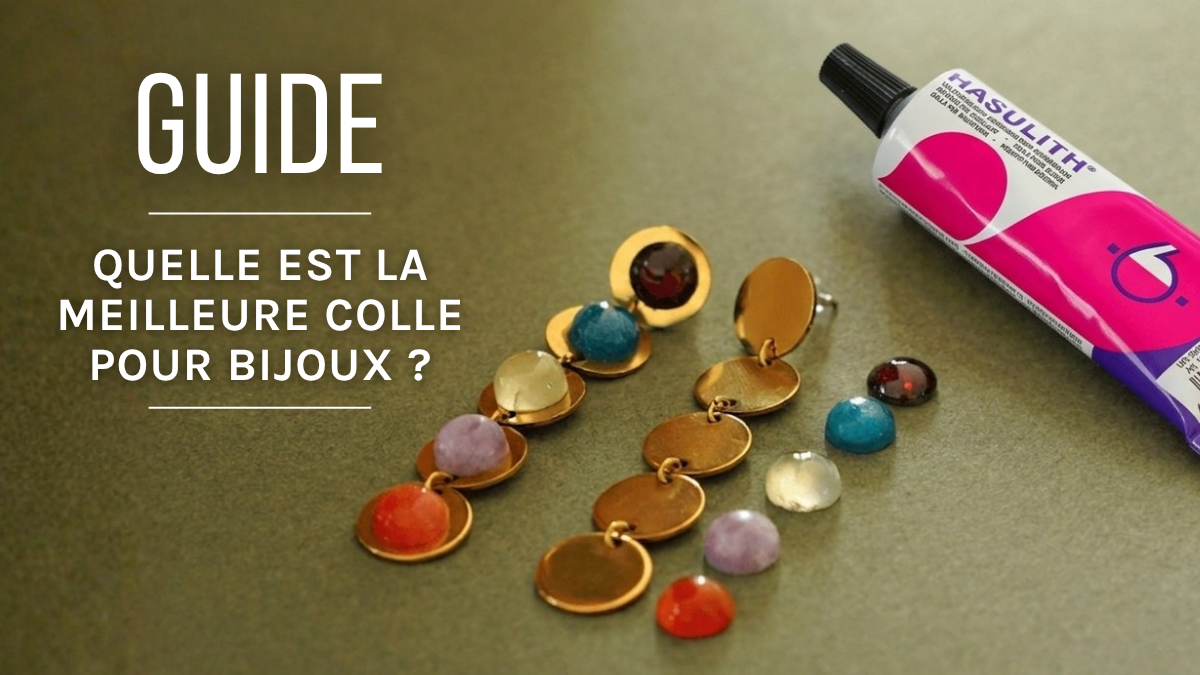
2026 complete guide: what's the best glue for jewelry?

Made by :Pauline Perles Co
Published on the :16/04/2026
2026 complete guide: what's the best glue for jewelry?
In summary

The choice of jewelry glue is essential to guarantee the durability of your creations. Hasulith glue is ideal for its versatility, while Cyanolit Ultra Unick stands out for its precision and speed. For more complex projects, E6000 Plus offers optimum adhesion, while Araldite and UHU Epoxy are recommended for solid assemblies.

The 5 best jewelry glues for your purpose

Do you need glue to create your DIY costume jewelry? Here comes the fateful question: which glue should you use to make it really stick? Because there isn't just one universal jewelry glue, but several formulas adapted to specific materials and uses. We'll help you see clearly so you never screw up your gluing again!

3 questions to ask before you buy

A poor choice of glue means a rhinestone that comes off after two days, a stone that falls out of its setting or an elastic bracelet knot that comes loose on the first try. The strength of your DIY jewelry depends directly on the suitability of the glue and the materials you assemble.

Three questions to ask yourself before buying:
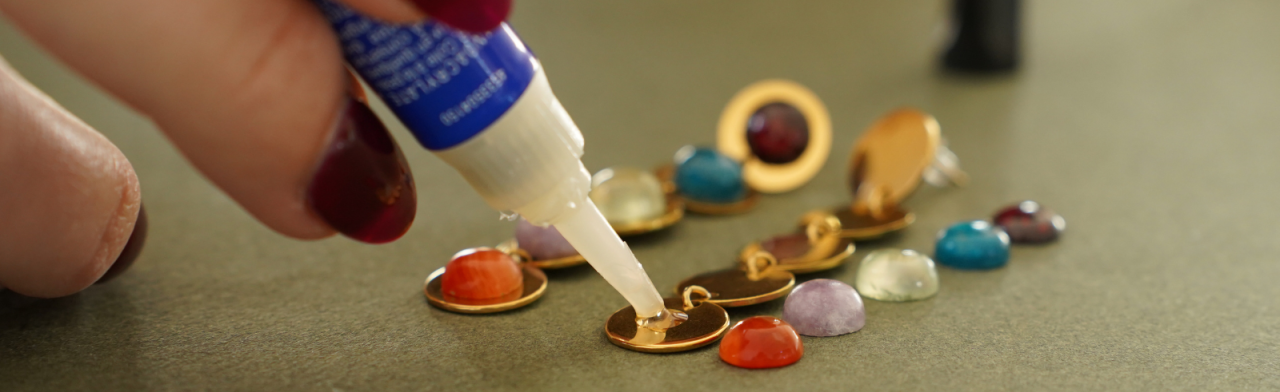
  • What materials am I assembling? (metal, glass, stone, fabric, plastic...)
  • How much time do I have to reposition the pieces?
  • Does the glue have to be transparent when dry?

colle pour bijoux comparatif

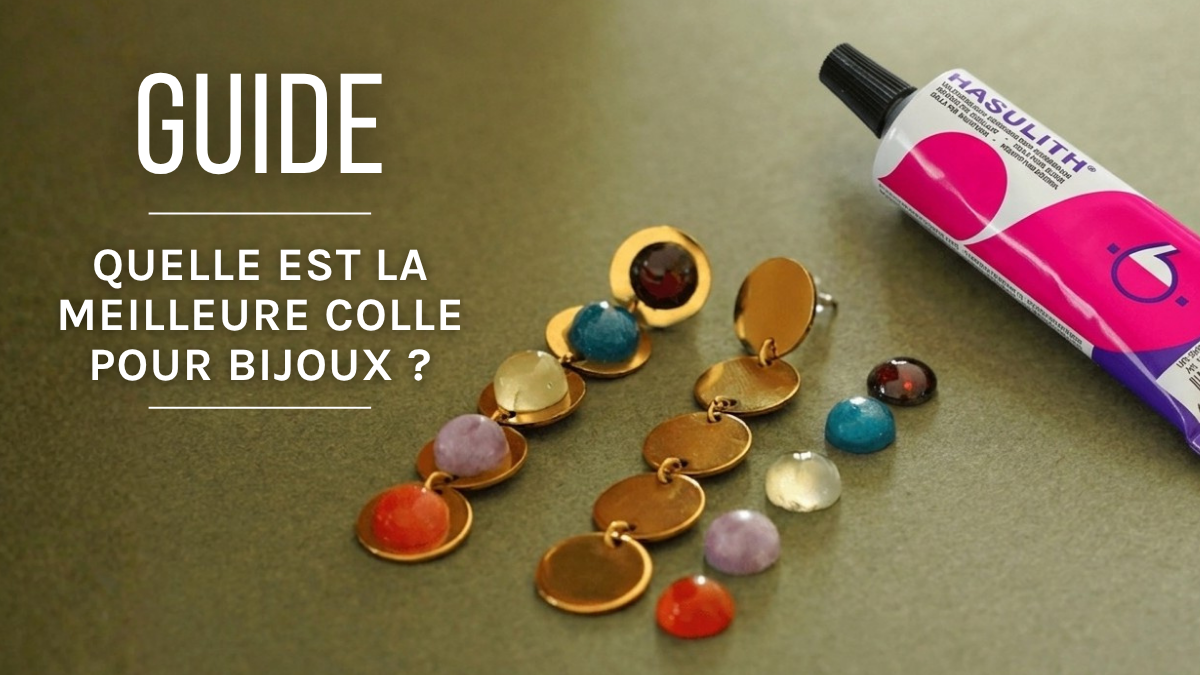
1. Hasulith jewelry glue: an essential all-rounder

colle hasulith pour bijoux

Hasulith is undoubtedly the most popular jewelry glue among DIY designers, and for good reason: it glues a very wide range of materials. Glass, crystal, ceramics, metals, paper, wood, leather, polymer clay... it adapts to almost any project.

Its other advantage: it's ideal for solidifying an elastic bracelet knot and gluing rhinestones to canvas. It dries on the surface in 1 hour, and reaches total solidity in 12 to 24 hours.

To remember:

  • Choose it if you're new to DIY jewelry design, work on a variety of projects with different materials, or want a glue that's versatile and easy to apply on a daily basis.
  • Avoid it if your jewelry is subject to heavy mechanical stress, if it will be in regular contact with water or perspiration, or if you need an ultra-fast setting.

Ideal for: varied creations, beginners who want an all-terrain glue.
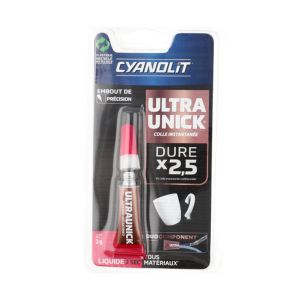
2. Cyanolit Ultra Unick glue: for precision

colle Cyanolit pour bijoux

Need an ultra-fast setting? Cyanolit is a precision super glue with a fine tip for millimetric positioning. It sets in 10 to 120 seconds, depending on the material, with a 10-second repositioning window. Suitable for crystal, glass, ceramics, natural stone, metals, wood, hard plastics and resin.

It's the glue of choice for bonding a stone to a ring or repairing an existing piece of jewelry quickly.

To remember :

  • Choose it if you need to glue a small surface with precision (a stone on a ring, a rhinestone on a setting), quickly repair an existing piece of jewelry, or work on smooth, non-porous materials like glass, ceramics or polished metals.
  • Avoid it if you need to reposition your pieces after setting (the repositioning window is only 10 seconds). Also avoid on textiles, leather or highly porous surfaces.

Ideal for: small surfaces, precision, rapid jewelry repair.
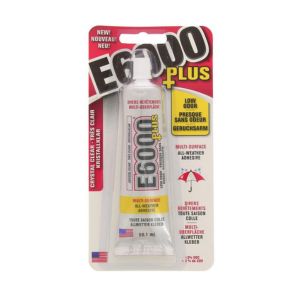
3. E6000 Plus glue - New formula: a designer's benchmark

colle E6000+ pour bijoux

E6000 is an institution in the world of DIY jewelry. Its new formula offers maximum adhesion to a list of materials including crystal, glass, ceramics, natural stones, metals, paper, wood, textiles, PVC and rubber.

It is particularly recommended for gluing bead weaves to metal, and for securing an elastic bracelet knot. Allow 24 hours drying time, with optimum adhesion achieved between 48 and 72 hours.

To remember:

  • Choose it if you're assembling mixed materials (metal + fabric, beads + metal), creating jewelry with bead weaves, or looking for a glue that's both flexible and impact-resistant once dry.
  • Avoid it if you're in a hurry: it takes 24 hours to dry completely, and maximum adhesion is only reached between 48 and 72 hours. Also avoid if your workspace is poorly ventilated, as the formula gives off fumes during drying.

Ideal for: experienced designers, mixed metal/textile/bead projects.
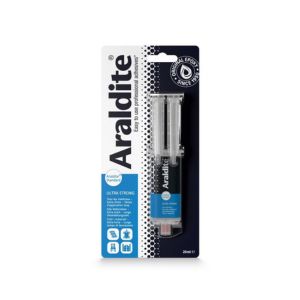
4. Araldite Standard two-component adhesive: the progressive-setting epoxy

colle araldite pour bijoux

Araldite is a robust two-component epoxy adhesive. Its standard formula is progressive-setting: you have 80 minutes to reposition your elements, 8 hours to handle the assembled parts, and 14 hours to reach final solidity.

It adheres to ceramics, natural stone, metals, wood, leather and hard plastics. Its strong point: mechanical and thermal resistance superior to simple adhesives.

To remember:

  • Choose it if you need superior mechanical and thermal resistance, are assembling heavy parts or difficult materials such as brass or natural stone, and have the time to allow it to set properly.
  • Avoid it if you're a beginner or unfamiliar with two-component adhesives, which require you to mix two compounds before application. Also avoid for small, delicate surfaces where precision application is difficult to master.

Ideal for: solid metal/stone assemblies.
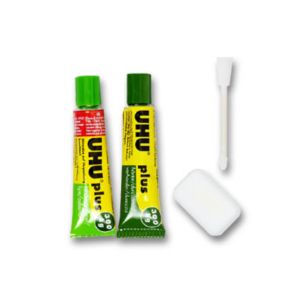
5. UHU Plus Endfest 300 epoxy adhesive

colle UHU pour bijoux

UHU Plus is a two-component epoxy adhesive with excellent adhesion. It is suitable for crystal, glass, ceramics, natural stone, metals, some plastics, wood and polymer clay. Its surface dries in just a few minutes, and it takes 12 hours to dry completely.

Like E6000, it's a preferred choice for bonding bead weaves to metal. Its two-component formulation guarantees a long-lasting bond, even on difficult surfaces.

To remember:

  • Choose it if you're creating mechanically stressed jewelry (brooches, rings worn daily), gluing bead weaves to metal, or working on surfaces that are particularly difficult to bond.
  • Avoid it if you're not comfortable with two-component adhesives, or if you're looking for a flexible finish after drying: UHU Epoxy hardens rigidly, which can be a problem on surfaces that move, such as leather or fabric.

Ideal for: technical assemblies, mechanically stressed jewelry.

Summary table: which jewelry glue for which materials?

Glue

Materials

Drying time

Adhesion

Price

Appearance after drying

Hasulith

Glass, crystal, ceramics, metal, wood, leather, paper, polymer clay

Surface: 1h / Complete: 12-24h

⭐⭐⭐
Good general adhesion, everyday use

2.40 € (30 ml

Transparent, flexible

Cyanolit Ultra Unick

Glass, crystal, ceramics, natural stone, metal, wood, hard plastics, resin, PVC

Instant: 10-120 sec

⭐⭐⭐⭐
Very strong on smooth, non-porous surfaces

5,00 € (3 g)

Transparent, rigid

E6000 Plus

Glass, crystal, ceramics, natural stone, metal, wood, paper, textiles, PVC, rubber

Surface : 24h / Optimal : 48-72h

⭐⭐⭐⭐⭐
Excellent, impact and flexion resistant

9.90 € (56 ml)

Transparent, flexible when dry

Araldite Standard

Ceramics, natural stone, metal, wood, leather, hard plastics

Repositionable: 80 min / Permanent: 14h

⭐⭐⭐⭐⭐
Very high mechanical and thermal resistance

12.50 € (24 ml)

Slightly amber, very rigid

UHU Epoxy Plus

Glass, crystal, ceramics, natural stone, metal, some plastics, wood, polymer clay

Surface: a few minutes / Complete: 12h

⭐⭐⭐⭐⭐
Excellent, long-lasting bond on difficult surfaces

11,50 € (33 g)

Transparent, rigid

Our tips for a glue that lasts

Good bonding doesn't just depend on the glue you choose. Here are a few best practices to adopt systematically:
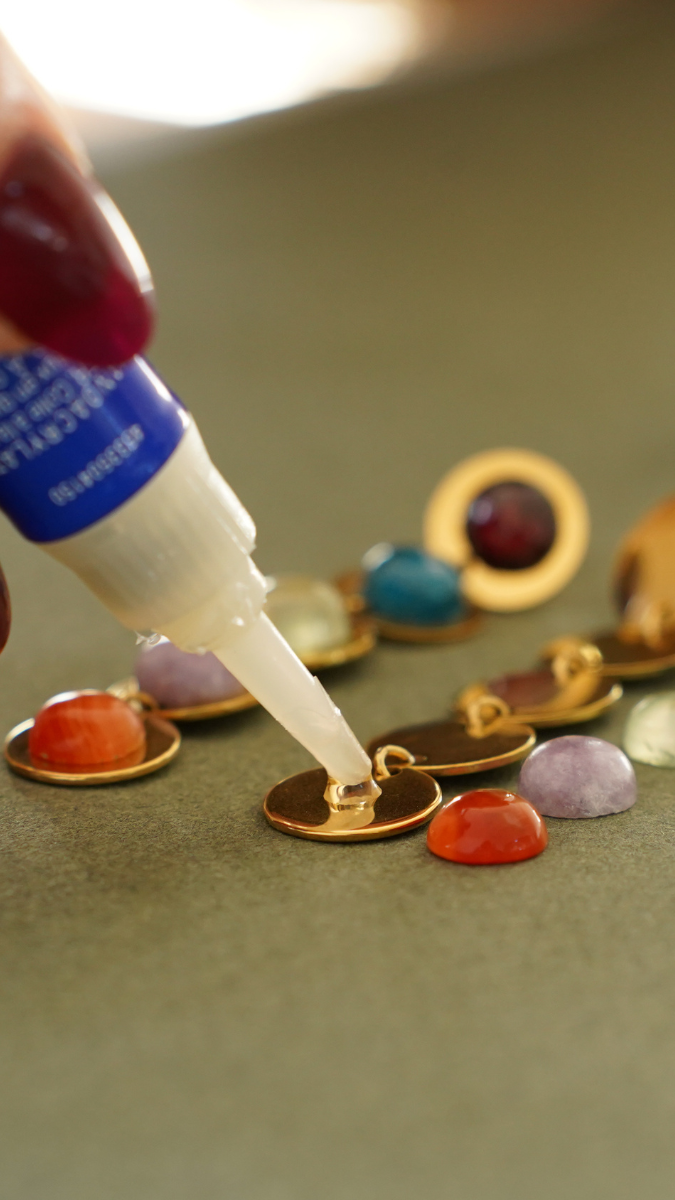
  • Always degrease surfaces to be glued with isopropyl alcohol before application.
  • Apply glue in thin layers: more is not necessarily better.
  • Respect the indicated drying time before handling or wearing your jewelry.
  • On difficult metals such as brass, lightly sand the surface to create a grip.
  • Store your glues away from heat and humidity to preserve their effectiveness.
Result
Schema  2026 complete guide: what's the best glue for jewelry?
Pauline Perles Co
 Pauline Perles Co - Pauline Perles&Co
Moi, c'est Pauline, je suis assistante SEO chez Perles & Co et depuis mon arrivée, je me découvre une passion pour les bijoux DIY ! Quel plaisir de dénicher la nouveauté qui nous fait craquer et de confectionner des pièces personnalisées..! J'en apprends davantage chaque jour et je partage ça avec vous.

What's the best jewelry glue for beginners?

Hasulith jewelry glueis ideal for beginners: it glues a wide variety of materials, is easy to apply thanks to its measuring bottle, and offers a comfortable drying time. It's the most versatile glue when it comes to creating costume jewelry.

What kind of glue should I use to attach a stone to a ring?

To glue a stone to a metal ring, use Cyanolit glue (fast-setting, transparent). Clean surfaces well before application to maximize adhesion.

Which jewelry glue should I choose for gluing pearls to metal?

E6000 Plus adhesive is the benchmark for assembling bead weaves on metal substrates. UHU 2-component epoxy glue is also highly effective for this type of assembly.

Is Hasulith jewelry glue waterproof?

Hasulith glue stands up well to normal use, but is not designed for prolonged immersion. For jewelry regularly in contact with water, a two-component epoxy glue such as Araldite or UHU offers better resistance.

How do I remove jewelry glue from a piece of jewelry?

To remove cyanoacrylate glue, acetone (nail polish remover) is often effective. For epoxy glues, mechanical sanding or specific solvents are required. Always test on an inconspicuous area to avoid damaging the metal or finish.
Share with my friends
To go further
What is gold filled?
Howto
Cleaning the Gold Filled
Howto
What is gold filled?
Howto
Cleaning the Gold Filled
Howto
What is gold filled?
Howto
Cleaning the Gold Filled
Howto
What is gold filled?
Howto
Cleaning the Gold Filled
Howto
What is gold filled?
Howto
Cleaning the Gold Filled
Howto
What is gold filled?
Howto
Cleaning the Gold Filled
Howto
What is gold filled?
Howto
Cleaning the Gold Filled
Howto
What is gold filled?
Howto
Cleaning the Gold Filled
Howto
What is gold filled?
Howto
Cleaning the Gold Filled
Howto
What is gold filled?
Howto
Cleaning the Gold Filled
Howto
Which material to use ?
Varnish/Glue
Varnish/Glue
Your questions (1)
You have a question about this sheet? Ask our team and the people who have already tested it. The Perles & Co community is here to help!
By Sergine (27/04/2026 21:47:33)
Bonjour,
Je suis artisan dans la création de bijoux fantaisie.
Je travaille avec l’acier inoxydable.
Le doré ne tient pas dans le temps. Je souhaiterais utiliser un vernis protecteur.
J’ai essayé le vernis à ongles incolore sur un conseil. Non concluant.
Quel produit pourriez vous me conseiller ?
Par avance, merci de votre retour.
Translate the question
Please log in to use this feature
Our Lucie expert answers you (28/04/2026 08:13:03)
Bonjour, vous pouvez utiliser ce vernis Isoclip TECH-034. Avez vous testé nos produits en acier inoxydable doré placage PVD ? Le placage PVD tient très bien dans le temps. 
Translate the answer
Your reviews (0)
Notices subject to control
Please log in to use this feature

Credits

Perles & Co, Internet & E-Commerce company [16/04/2026] Any reproduction, representation, adaptation, in any form whatsoever, even partial, is prohibited, except for reproduction for private use not intended for collective use, representation in the family circle (art. L 122-5 CPI) and online publishing on condition that the source is mentioned and a link is included to the corresponding page of our site www.perlesandco.com.