Free shipping on orders over 50€ up to 500g
French Online shop for beads and accessories for the creation of DIY jewellery and other creative hobbies

Log-in

Which wire to use for micro macrame jewelry?

Made by :Tiffanie Perles Co
Published on the :31/12/2020
Which wire to use for micro macrame jewelry?

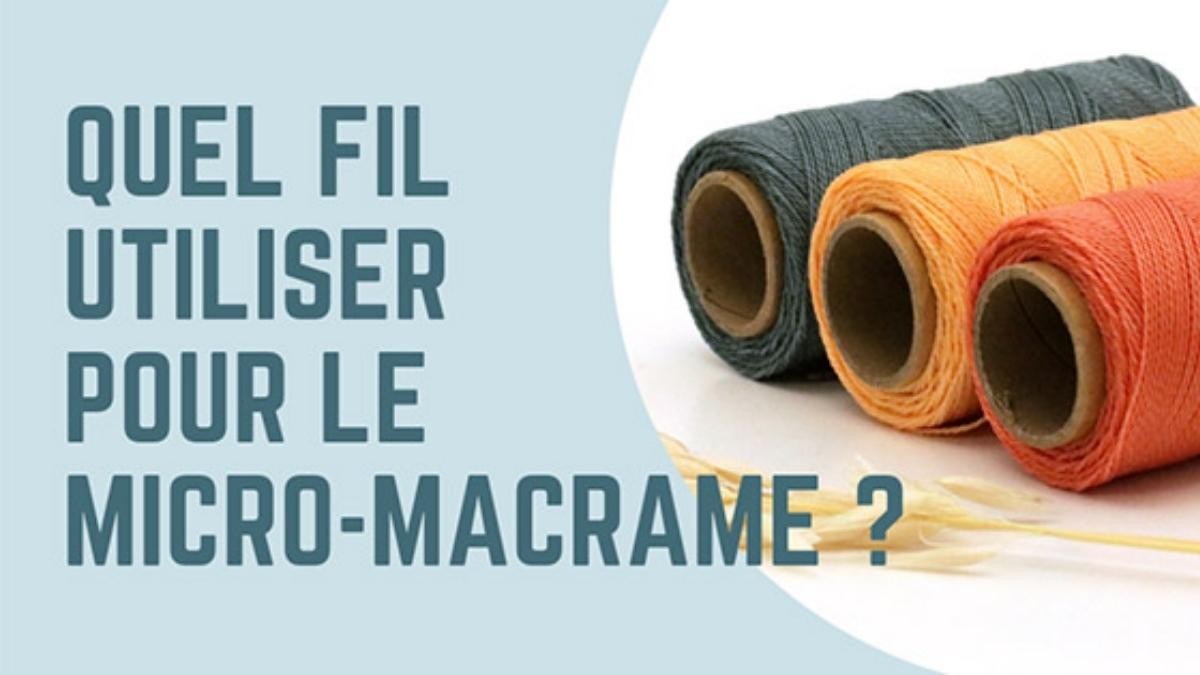
If you're new to micro-macramé and don't know what materials to buy to get started, you've come to the right place. We're going to talk about the different wires you can use to make micro-macramé jewelry, their specific features and the tools that can help you.

Click on the photos to access the corresponding tutorials.

What is micro-macramé jewelry?

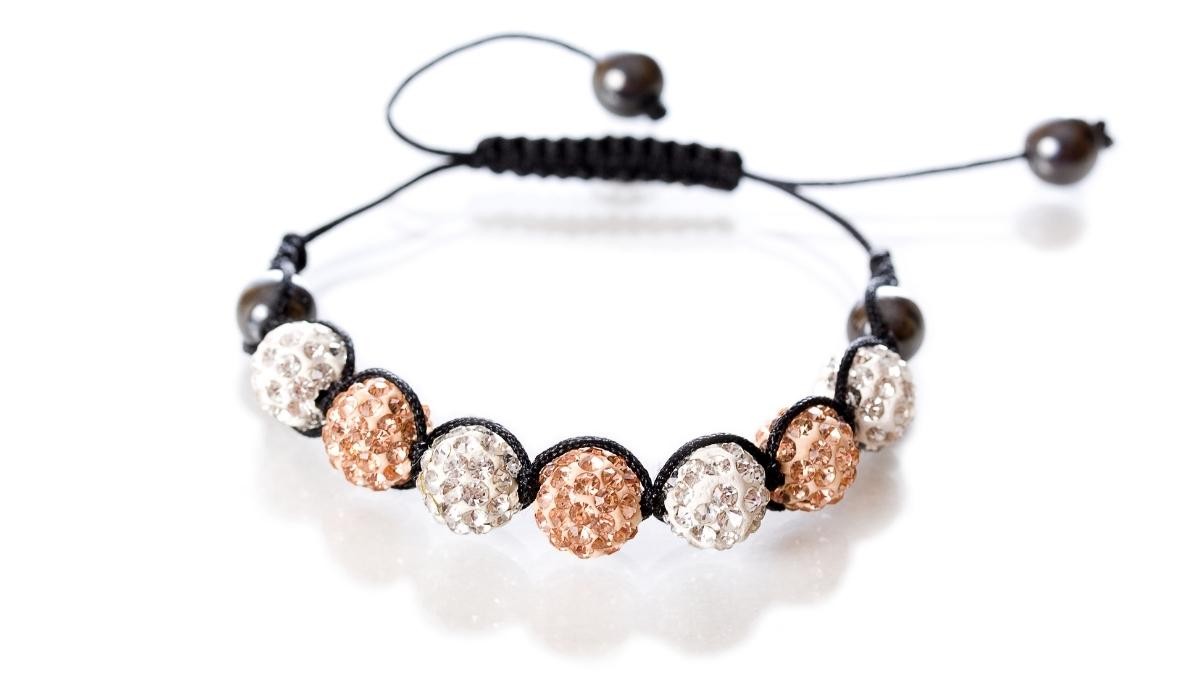
As its name suggests, micro-macramé is macramé in miniature. It's called this to differentiate it from macramé, which can be used to create decorative objects such as macramé hanging baskets or macramé cushions. The knots or sequences of knots are used to create decorative shapes. Technically, Brazilian bracelets could be described as a sub-category of micro-macramé, since they are also made up of knots.
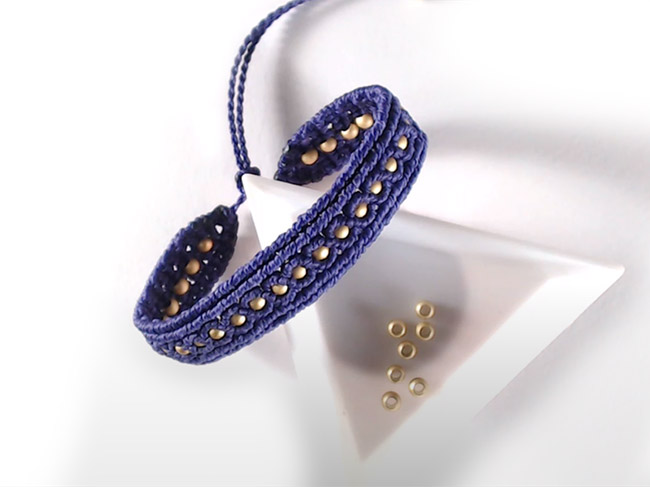
bracelet en micro macramé violet

Wire diameter

Micro-macramé is most often associated with jewelry, so fine wire is used. The advantage of micro-macramé is that you can see the knots, which is why most of the time, we use a cord between 0.5 mm and 1, or even 1.5 mm in the case of a larger necklace, for example. It is very rare to use a diameter greater than 2 mm to create a micro-macramé bracelet or necklace, or else these creations are no longer qualified as "micro" in most cases.
The smaller the wire diameter, the more details and finishes are possible.

If you're new to macramé, we advise you to use 1 mm wire to see the knots clearly. Once you've got the hang of it, if you like, you can try out micro-macramé wires with a smaller diameter. That way, you'll know which wire diameter you prefer!

For 0.35 mm, 0.5 mm, 0.75 mm, 1 mm, 1.2 mm or 1.5 mm... The diameter of the thread depends above all on the tastes of the person tying it and on the desired effect.
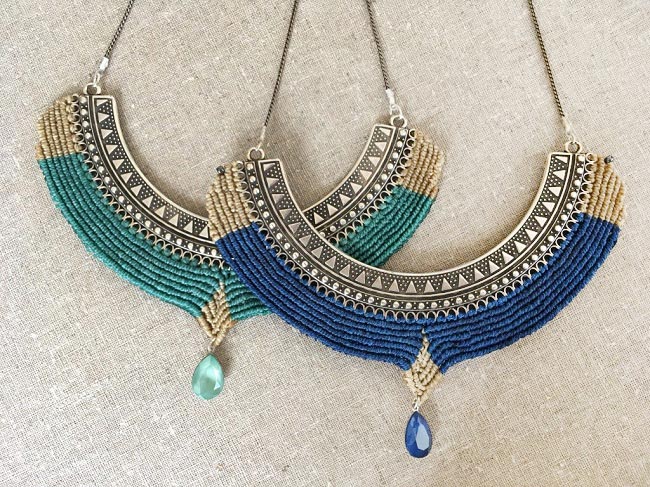
collier torque en micro macramé

Wire material

The micro-macramé technique creates a lot of repetitive friction. So you need a strong thread. It also needs to be very supple so that knots form properly. If it's waxed or soft, the knots will hold even better. You can use either synthetic or natural cords, but the finish to stop the thread will not be the same.

SYNTHETIC YARNS

In our opinion, the best for this technique is Linhasita yarn. Made in Brazil, it is specially designed for micro-macramé jewelry. It's coated with a synthetic wax that gives it a sticky feel, which may put some people off, but this wax holds the knots in place and makes the work much easier. It is rub-resistant and non-fading. The wax can, however, create color differences from one place to another due to reflections. This is the most widely used cord in recent years. To stop the thread, melt it with a thread burner or lighter. This serves as a replacement for glue.

Then there's C-Lon(C-Lon Beading cord, C-Lon Tex 400 Bead Cord and C-Lon Micro Cord). It's tough, glides well and is also coated with a wax, but unlike Linhasita, it's not sticky and knots don't hold together as well, so if they're not pressed together, they'll slip. This cord does not fade and is of good quality.

bracelet micro macrame bleuboucles d'oreilles micro-macramé

Slam Cord is a waxed polyester yarn like Linhasita with a few minor differences:

  • It's flat, which gives the knots a slightly different look, much appreciated by some designers. You can also play with the different faces of the flat yarn to achieve unique textured effects.
  • It allows you to create very precise, crisp details in your micro macramé creations. Because flat wire has a flat surface, it's easier to achieve intricate patterns and clean lines.
  • Flat wire is generally stiffer than the traditional round wires used in macramé. This means your creations will have greater stability.
  • It is a thread of European origin, unlike Linhasita thread, which is imported from Brazil.
  • This yarn is certified Oeko-Tex Standard 100 (n° 052111.O), which guarantees that this yarn and its dyes are non-toxic and designed without harmful substances.
  • It is manufactured by an ISO-9001:2015 (quality management) and ISO-14001:2015 (environmental management) certified company.
  • Available in three sizes: 0.6 mm / 0.8 mm / 1 mm

slam cord

BRAIDED NYLON THREAD

You can also use rat-tail or braided nylon thread. It's a little soft, which helps hold knots in place when tightened, but not as well as Linhasita. They have a sheen that gives them the appearance of silk thread. They are also very flexible and strong. If you're looking to make slip knots, this yarn will do just fine. The Griffin brand also offers good-quality braided nylon yarns of European origin.
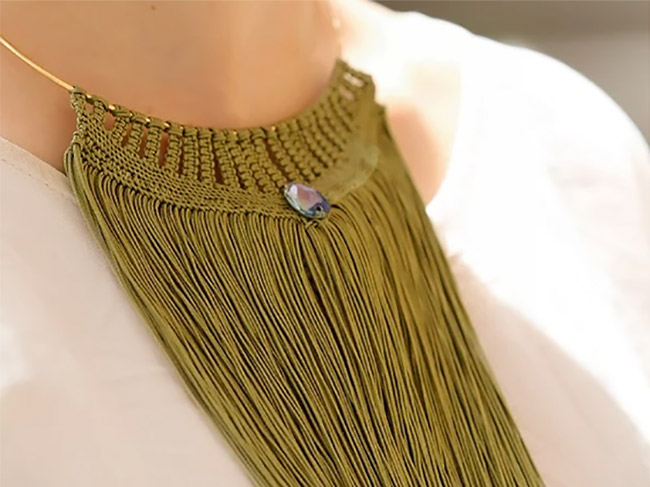
collier micro macramé fil nylon

NATURAL YARNS

We recommend waxed linen thread or Kesi Art waxed cotton thread. As explained above, the wax helps protect the thread from rubbing and holds the knots in place. For this type of thread, you'll need to either hide and wedge the thread ends in the creation, or make a knot, cut and apply glue.

You can also use natural cotton, or cotton embroidery skeins like those used for Brazilian bracelets.

collier en macramé fil de coton

OTHER THREADS

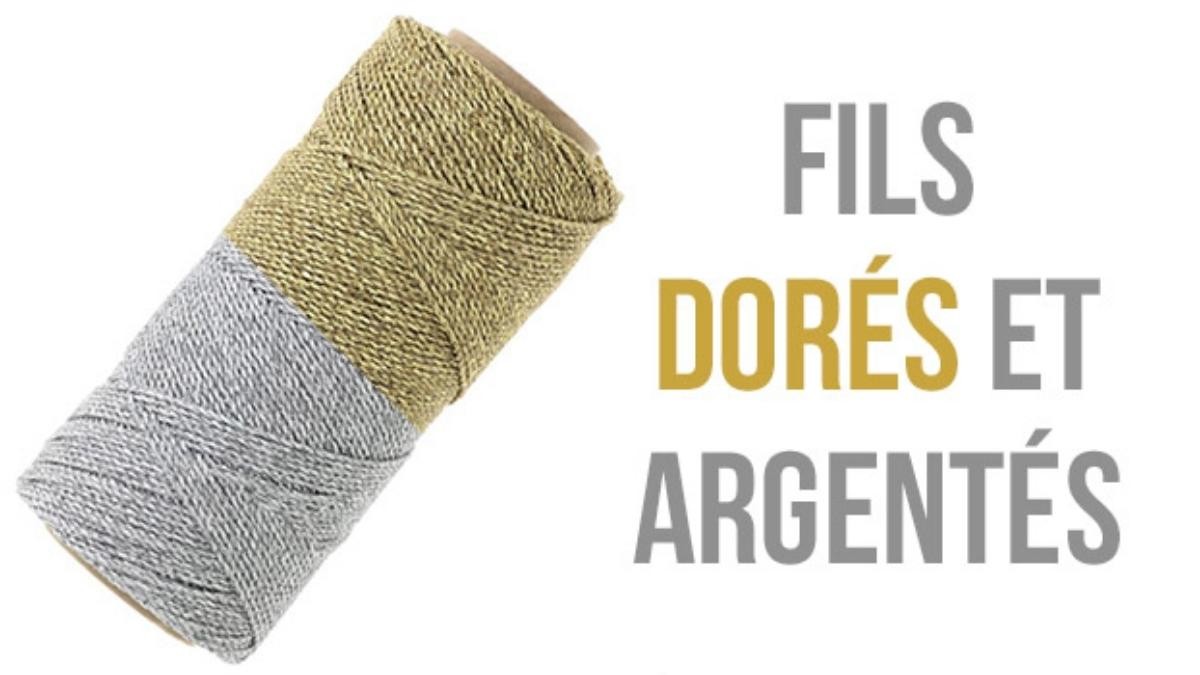
It's also possible to include other threads in macramé jewelry, mixing them with those mentioned above. For example, we've used Au Ver à Soie's size 16 shiny threadin this video tutorial, even though it's a little more fragile than the others. You need to use it sparingly and bear in mind that knots will unravel if they're not caught by other knots. Leather cords can be used for larger bracelets.

bracelet macramé fil brillantbracelet cordon en cuir

The tools

At first, you can simply tape your wires to the table with masking tape or hang them from your purse with a safety pin, but as soon as you want to make more complex creations, we suggest you invest in a flexible macramé tray. It's a handy tool for holding wires in place and preventing tangled brushes! You can secure them with special nails or sewing pins.

Tiffanie Perles Co
 Tiffanie Perles Co - Les tutos de Tiffanie
Bonjour, moi c'est Tiffanie. J'étais créatrice et designer produit chez Perles & Co. J'adore tester de nouveaux DIY et vous faire profiter de mes expériences. Vous pouvez toujours consulter les tutoriels que je vous avais concocté sur le site !
Share with my friends
Which material to use ?
Please note that the quantities of the suggested equivalents are not necessarily exact. You can adjust them in your basket.
List of useful products
T pins x35
OAC-1094
Qty : 1
60 in stock
5,30€
Micro-macramé work board 26,5x19 cm x1
OUT-018
Qty : 1
217 in stock
8,50€
C-Lon Beading Cord 0,50 mm Cerise x84m
3,30€
C-Lon Beading Cord 0,50 mm Periwinkle x84m
3,30€
Reel of waxed linen thread 0.7 mm Green Blue nr23 x 100 gr
8,80€
Your questions (10)
You have a question about this sheet? Ask our team and the people who have already tested it. The Perles & Co community is here to help!
By Véronique (03/12/2025 17:38:59)
Bonjour
Quelle colle utilisée en micromacramé si on peut pas brûler le fil
Merci
Translate the question
Please log in to use this feature
Our Lucie expert answers you (05/12/2025 16:38:47)
Bonjour, vous pouvez utiliser de la colle hasulith. Merci
Translate the answer
By Caroline (19/05/2025 20:25:08)
J'ai posé la question précédente et ne suis pas satisfaite de votre response ; j'ai serti des pierres avec du Linhasita 1mm et je trouve cela bien trop épais sur des cabochons de petite taille ; d'où l'envoi des liens que je vous avais joint. Pour posséder un exemplaire de ces bijoux, le fil est fin, très dur, et les nœuds ont un toucher un peu rêche. J'ai déjà consulté les liens que vous m'avez donné.
Le C Lon convient 'il ? Sinon quel autre ?
Cordialement
Translate the question
Please log in to use this feature
Our Lucie expert answers you (20/05/2025 09:06:22)
Bonjour, sur vos exemples, les cabochons semblent assez grands, ce qui explique l’utilisation d’un fil Linhasita de 1 mm. Pour des cabochons plus petits, un fil de 0,5 mm conviendra tout à fait.
Personnellement, je préfère le fil Linhasita pour le micro-macramé, mais je comprends qu’il ne convienne pas forcément à tout le monde. Vous pouvez essayer le fil C-Lon, qui est moins poisseux et a un toucher plus rêche, comme vous le mentionnez. Il existe aussi le fil nylon tressé, mais pour ce type de réalisation, je trouve que les nœuds tiennent moins bien que les fils cirés. Le fil de lin ciré est aussi une bonne alternative (mais le fil est de 0.7 mm). J’espère que ma réponse vous sera utile. Merci.
Translate the answer
By Caroline (18/05/2025 22:54:16)
bonjour
J'aimerais savoir quel fil est utilisé et de quel diamètre pour le sertissage de pierres comme sur ces liens ?
On m'a parlé de fil coton/ polyester ?
https://www.ebay.fr/itm/395247873786 - https://www.ebay.fr/itm/396617724377- https://www.ebay.fr/itm/396500160173
Si vous pouviez me conseiller dans ma commande
Cordialement
Translate the question
Please log in to use this feature
Our Lucie expert answers you (19/05/2025 11:24:37)
Bonjour, je vous conseille d’utiliser les fils Linhasita, spécialement conçus pour la création de bijoux en micro-macramé. Ils sont recouverts d’une cire synthétique qui leur donne un toucher légèrement poisseux. Cela peut surprendre au début, mais cette cire est très utile : elle permet aux nœuds de bien tenir en place et facilite grandement le travail.
En ce qui concerne l’épaisseur, au vu des éléments que vous avez partagés, je vous conseillerais du 0,75 mm ou du 1 mm. Si votre pierre est assez imposante, le 1 mm serait plus adapté. Nous avons un tutoriel qui pourrait vous aider à bien positionner les nœuds.
 
Translate the answer
By Fabienne (10/04/2025 05:22:58)
Peut on crocheter avec du fil ciré ?
Merci
Translate the question
Please log in to use this feature
Our Tiffanie expert answers you (10/04/2025 09:24:27)
Bonjour, pour la spirale de perles au crochet ou des créations au crochet sans perles ? Je pense que c'est faisable avec de grosses perles et un fil fin mais généralement, on utilise plutôt du fil en coton fin et souple comme le Lizbeth ou le fil DMC. https://www.perlesandco.com/fil-de-coton-lizbeth-taille-40-snow-white-n601-x274m-p-70177.html 
https://www.perlesandco.com/fil-a-crocheter-babylo-30-dmc-en-coton-blanc-x-1000-m-p-220051.html 
Pour crocheter le Linhasita sans perles, oui je ne vois pas de soucis.
Translate the answer
By Christine (21/03/2025 10:39:28)
Quel matériel faut-il pour créer le dernier bracelet marron à noeuds plats de cette page ? Je cherche un modèle pour homme qui soit assez large (10 à 20 mm)
Merci d'avance.
Christine
Translate the question
Please log in to use this feature
Our Tiffanie expert answers you (21/03/2025 14:19:53)
Bonjour, ce tutoriel a été refait entre temps car nous ne vendons plus exactement les mêmes produits. C'est celui-ci : https://www.perlesandco.com/tutoriels/t2861-bracelet-macrame-homme-cordon-cuir-et-fermoir-manille.html 
Translate the answer
Your reviews (0)
Notices subject to control
Please log in to use this feature

Credits

Perles & Co, Internet & E-Commerce company [31/12/2020] Any reproduction, representation, adaptation, in any form whatsoever, even partial, is prohibited, except for reproduction for private use not intended for collective use, representation in the family circle (art. L 122-5 CPI) and online publishing on condition that the source is mentioned and a link is included to the corresponding page of our site www.perlesandco.com.