Average Grades

Take two colors of dough, soften them separately in your hands, then shape them into cylinders and place them side by side.


How to make a polymer clay necklace?
How to create a molten multicolored effect with polymer clay?
In this tutorial, you'll learn how to make colorful polymer clay from a variety of clay gradations and target clay. You can use any clay, whether Fimo, Pardo , Cernit or Kato polyclay. Have fun inventing new colors by mixing and matching. The colors used in this tutorial are all very bright, but you can also make pastel-colored canes using the same technical principle!
We love to see your creations inspired by our tutorials, so don't hesitate to share them with us on our social networks with the #Perles&Co!
Take two colors of dough, soften them separately in your hands, then shape them into cylinders and place them side by side.

Flatten your cylinders with a rolling pin, then run them lengthwise through the dough machine. Fold the resulting sheet in half.

Insert the dough sheet back into the dough machine, starting with the thickest fold, always making sure to put the dough in the same direction. Repeat this step about fifteen times, staggering the dough colors as you fold the plate in half to allow the colors to blend.

Your gradient plate is now complete and expanded. Cut it into three parts from green to blue, then superimpose them.

Roll the dough lengthwise, then pass it through the machine at the thinnest setting, putting the blue first. Roll up the long ribbon of dough, starting with the green, to obtain your target cane.

Make as many target canes as you like, but a minimum of four is required.

Cut off bits of target cane without paying too much attention to the direction, put them together and then form a ball in your hand by compressing the different bits.

Stretch out your ball into a cylinder, slightly pointed at the ends, by rolling it under your hand on a flat surface.

Each cylinder corresponds to a unique blend of colors, creating a harmonious necklace. Choose a colorful duck, then slice it lengthwise.

Prepare a slab of black dough by running it through the dough machine at a medium notch, in this case notch number seven on the Impéria machine. Place your slices of duck on the black dough, cut the edges of each slice and run them lengthwise through the machine again, this time setting it to the widest notch.

Use your template plate by placing it on a slice of dough. Run your fingers underneath, pressing down to mark your dough. Remove the template and cut your long beads following the marks on the dough. Use the template for the central bead and the 2 others on the sides. Only the smallest beads are not used for this necklace - there are seven in all.

Make a new soleplate by recycling bits of colored dough and what's left of the black dough. Set the machine to the widest setting. Place your cut-out long beads on this plate, using a light rolling motion to expel any air that may be trapped between 2 layers, but not too hard so as not to deform and enlarge it.

Once again, cut around the beads, cutting off the right angles to round off the pieces. Bake in a 120-degree oven for 30 minutes.

Sand your beads in warm, soapy water, using 800-grit abrasive for the contours and back, then 1000-grit abrasive for the whole. Use micro-mesh to polish your parts, still in water, starting with 2400 grit and working your way up to 4000, 6000 and 8000 grit.

Using a hand chuck, drill a hole in the edge of the piece about 8 mm from the top of the bead. The drill hole should not be large, but should be used to pass a fine wire.

Make a slab of black dough by running it through the machine at step 7. Using the 2 smallest cookie cutters in the Kemper set, cut out 14 rounds of each size. Place them on a tiled baking tray.

With your index finger, flatten all the circles by pressing on them and then on the contours. Your circles will enlarge slightly, smoothing their surface to remove your fingerprints. Pierce all your discs. Don't remove them from the tiles to avoid deforming them, and bake for 30 minutes at 120 degrees.
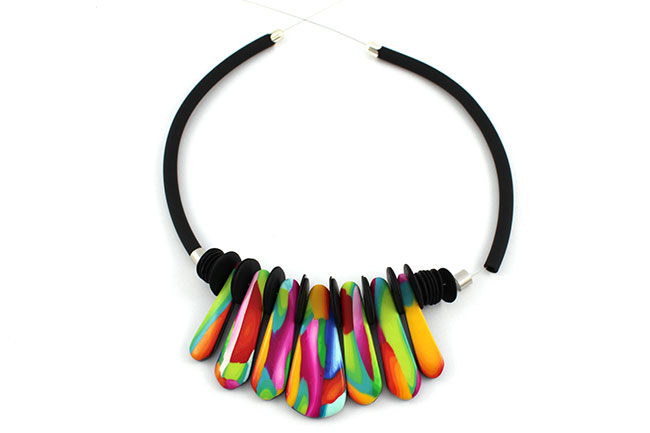
Cut 2 identical lengths of 6 mm buna cord between approx. 15 and 18 cm to suit your neck size. Thread your beads through the cord, placing the larger black beads in the center of the necklace and 2 by 2 between two long beads. Thread the buna cord and pass a silver tube on each side.

Thread a tulip cap, a squeeze bead and a double ring onto each side of the wired wire. Pass the wire through the bead to be crushed, then use pliers to crush the bead. Add a bead cover at this point, tightening it with pliers. Add your carabiner clasp to one of the 2 double rings.




You have a question about this tutorial? Ask it to our team and the people who have already tested it. The Perles & Co community is here to help you!
Credits
Perles & Co, Internet & E-Commerce company [22/06/2018] Any reproduction, representation, adaptation, in any form whatsoever, even partial, is prohibited, except for reproduction for private use not intended for collective use, representation in the family circle (art. L 122-5 CPI) and online publishing on condition that the source is mentioned and a link is included to the corresponding page of our site www.perlesandco.com.

