Average Grades
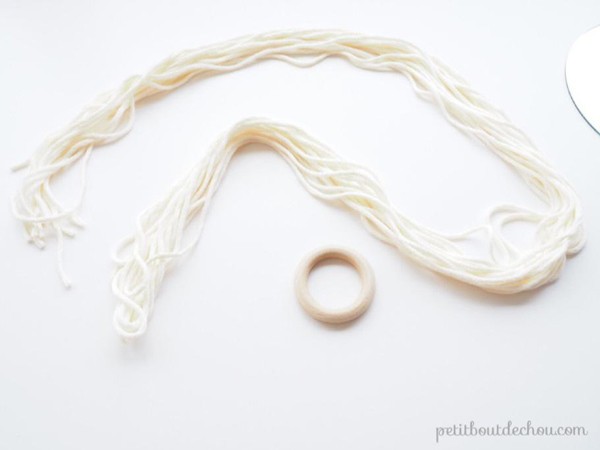
Cut 2m-long wires and fold them in half. Repeat 8 times.

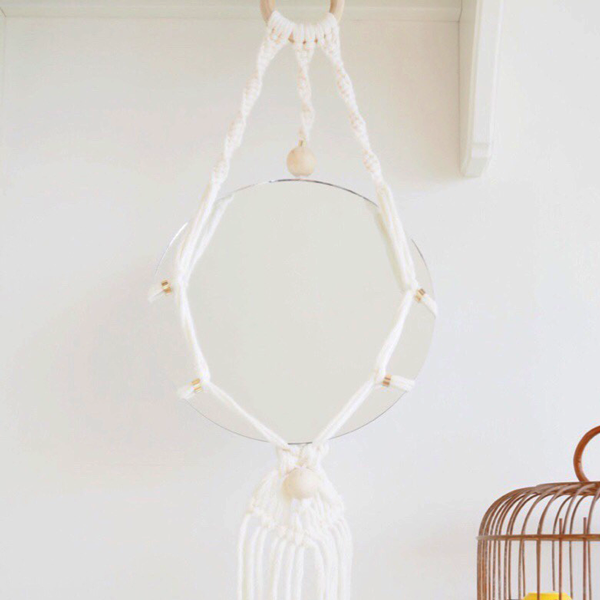
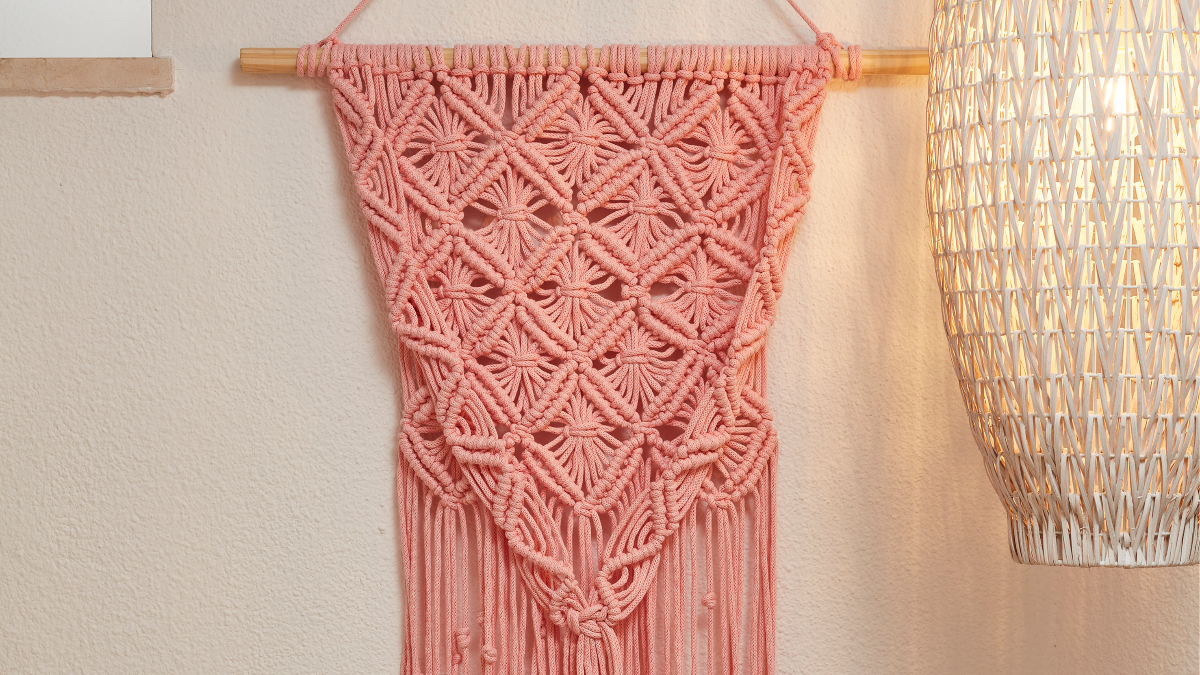
Ever heard of macramé ? It's a traditional weaving technique that involves making successive knots to create unique creations. DIY macramé is all the rage! Make a macramé hanging for your plants or a bohemian wall hanging (a macramé wall hanging) and bring a touch of originality to your home decor! But that's not all: you can also make micro-macramé jewelry (it's the same technique, but the thread is much thinner. Hence the name!)
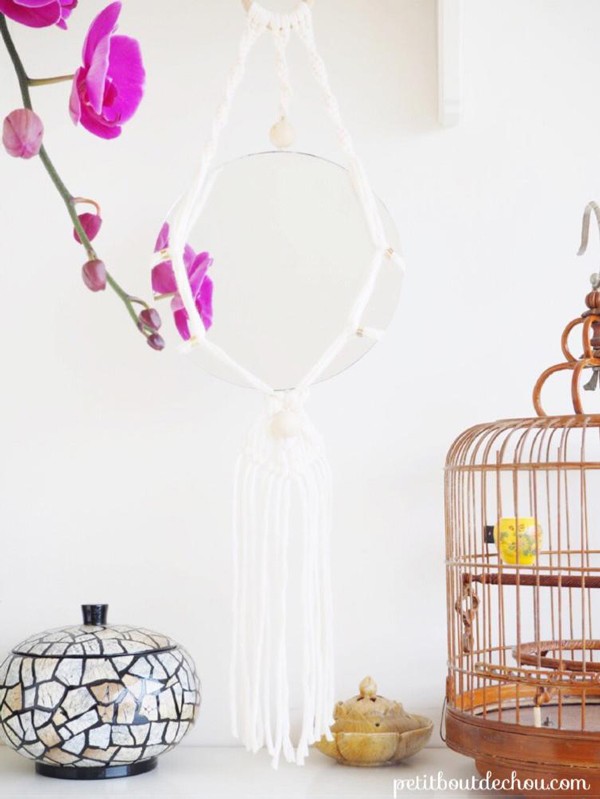
Thanks to Petit Bout de Chou , who offers us her version of the macramé hanging mirror!
In this easy tutorial, you'll make a variety of macramé knots, including the lark's head knot, the half-flat knot, the right-side knot and the wrong-side knot. To review how to tie knots and perfect your macramé technique, take a look at our basic macramé knots datasheet.
If you want to go even further, you can find step-by-step macramé books on our website.
As we love to see what you've made, don't hesitate to send us photos of your version of the hanging mirror on our Facebook page or tag us on Instagram with #perlesandco!
Cut 2m-long wires and fold them in half. Repeat 8 times.
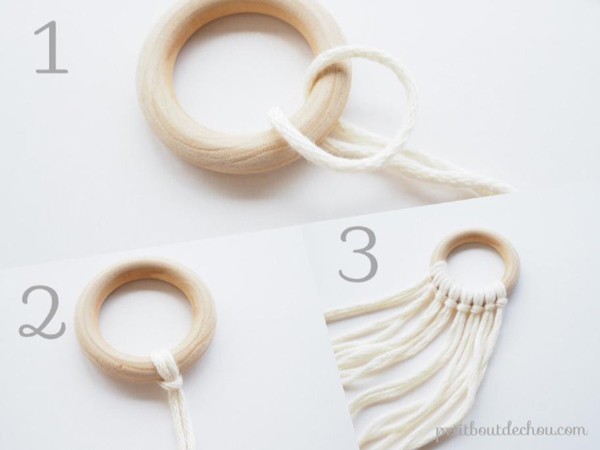
Pass the loop through the ring and feed both strands of wire through the loop to secure them to the ring. Repeat 8 times. Tighten securely.
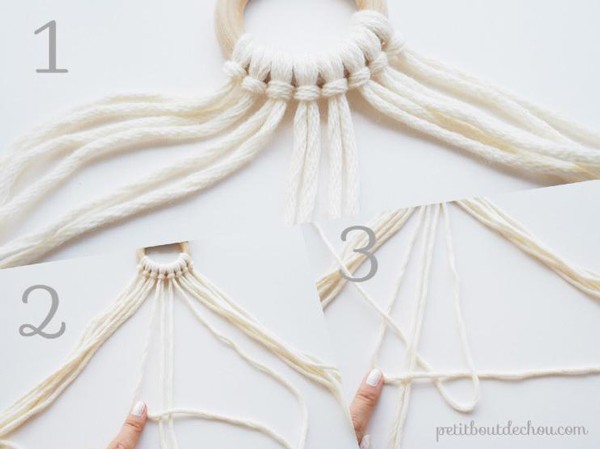
Separate strands into 3 groups (1): 6/4/6
The same technique is used for all 3 groups to create a macramé twist. It's the number of passive strands that varies between groups: 2 passive strands for the center group and 4 passive strands for the side groups. The outer strands are used to tie a half overhand knot around the passive strands.
Example for the center group : pass the left-hand strand over the passive strands, forming a "4" (2). With the right-hand strand, pass over the left-hand strand, then under the passive strands and finally into the loop of the "4" (3). Pull the outer strands.
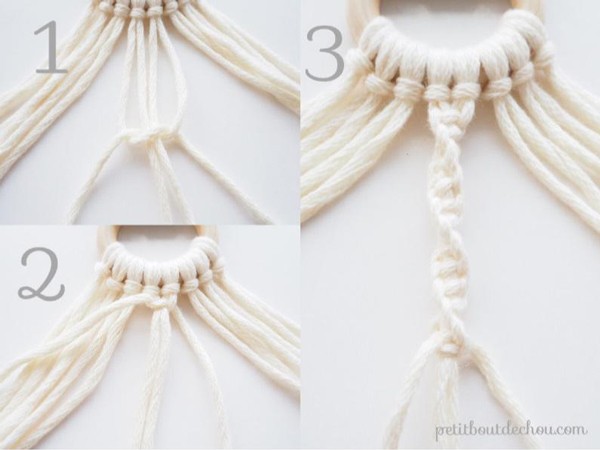
Pull the outer strands (1) until the first knot (2) is formed. Repeat until you have a nice 6-7 cm-long twist. Do the same for the two outer groups.
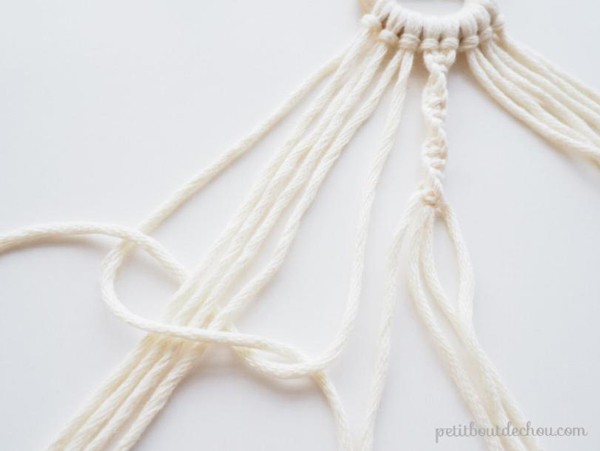
Do the same for the two outer groups, this time with 4 passive strands in the center.
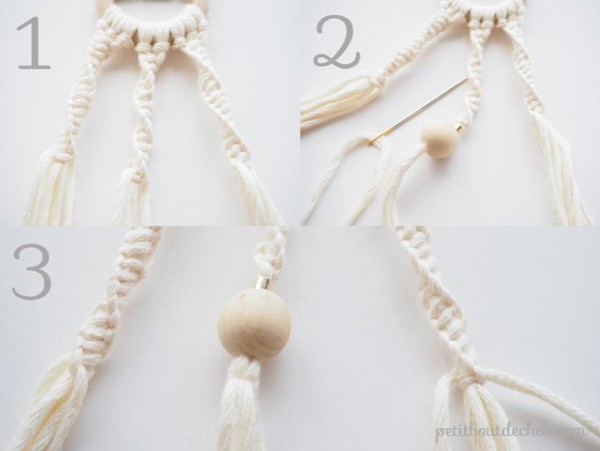
You now have 3 twists (1). Pass the 4 wires of the center group through a gold tube and then a wooden ball, using the tapestry needle (2). Tie a double knot to secure them (3).
Even out the lengths of the outer twists with the center strands, forming new knots if necessary.
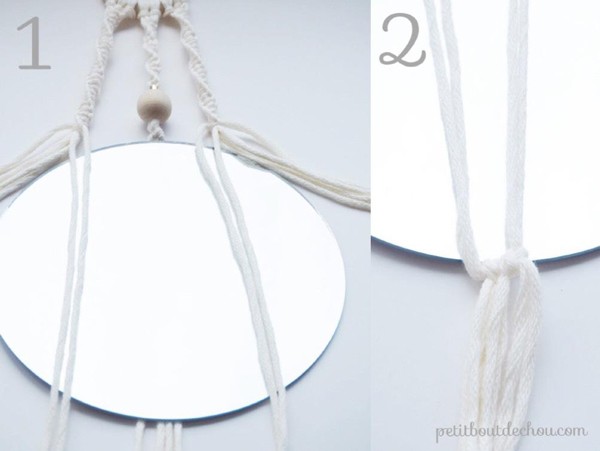
Place the 4 middle strands at the back of the mirror (1). Take two strands from the sides and tie a double knot at the bottom of the mirror with the strands from the back (2).
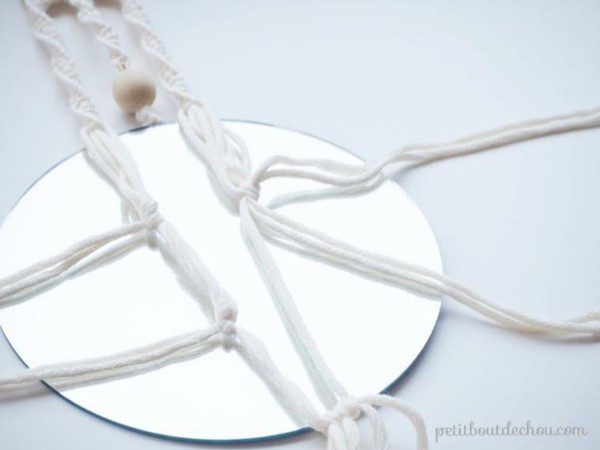
Taking two strands from the side, tie a double knot 1/3 of the way up. Lay the strands on their sides.
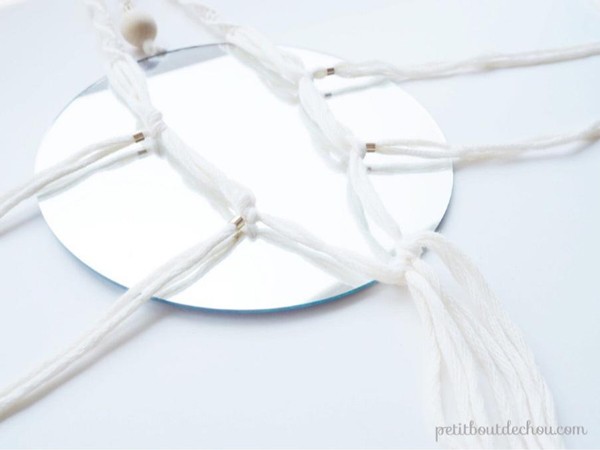
Take two more of the remaining strands and tie a double knot 2/3 of the way up, placing the strands on their sides. Repeat on the other side.
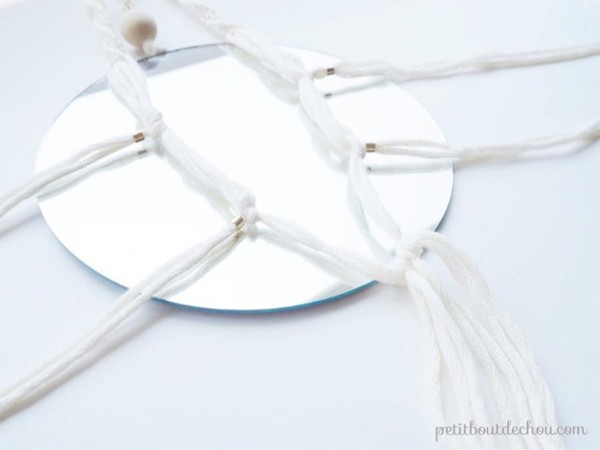
Thread tubes onto each of the 4 groups of strands placed to one side in the previous step, using the needle.
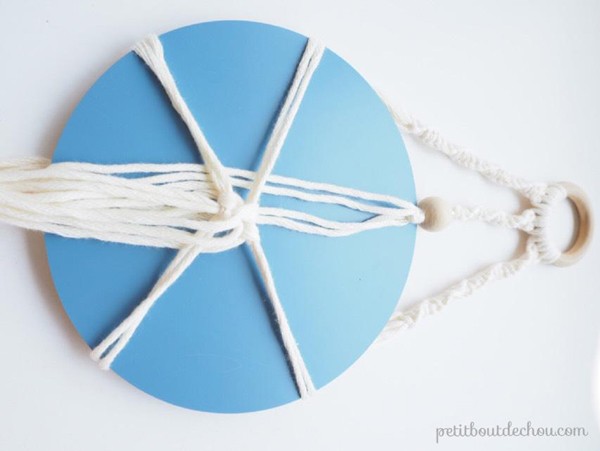
Tie a double knot at the back of the mirror with the 4 groups of strands to secure the mirror. Tighten this knot while checking the placement of the strands on the front.
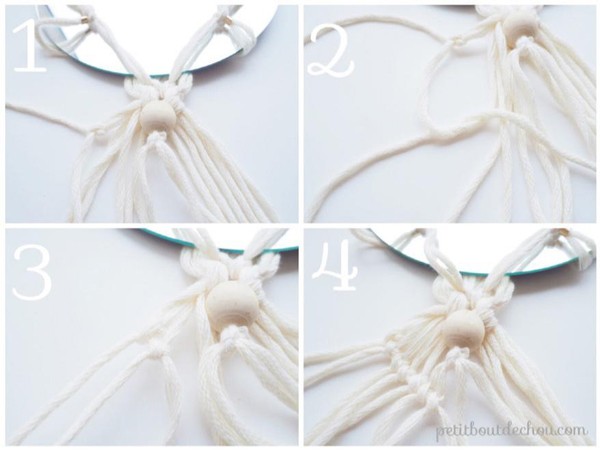
Tie double knots to secure the mirror and thread a bead onto the 4 center strands (1). Now we'll tie in a "V" shape. To do this, form a "4" with the left-hand strand on the next strand and pass the strand through the loop of the "4" (2).
Repeat a second time (3). You've made a right-angle knot, just like a Brazilian bracelet. Continue to form right-angle knots until you reach the last strand on the left (4).
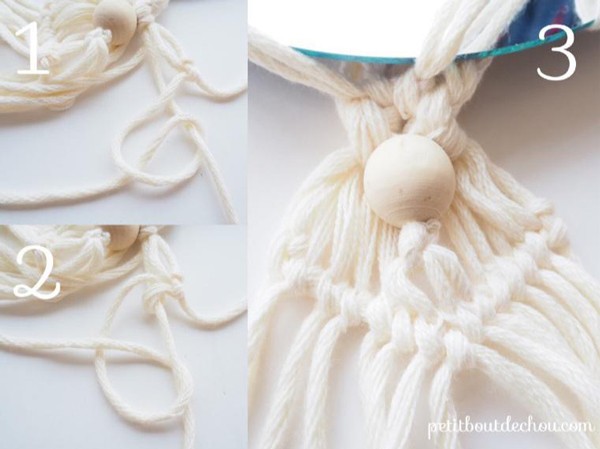
Then form reverse knots starting from the rightmost strand. To do this, form a "4" under the next strand and loop through (1). Repeat (2) to finish the reverse knot. Continue to the last strand on the right-hand side. Finish with a right-hand knot between the two center strands (3).
Finish by cutting the strands into a "V" shape 15 cm from the last knot.








You have a question about this tutorial? Ask it to our team and the people who have already tested it. The Perles & Co community is here to help you!
Credits
Perles & Co, Internet & E-Commerce company [17/06/2017] Any reproduction, representation, adaptation, in any form whatsoever, even partial, is prohibited, except for reproduction for private use not intended for collective use, representation in the family circle (art. L 122-5 CPI) and online publishing on condition that the source is mentioned and a link is included to the corresponding page of our site www.perlesandco.com.