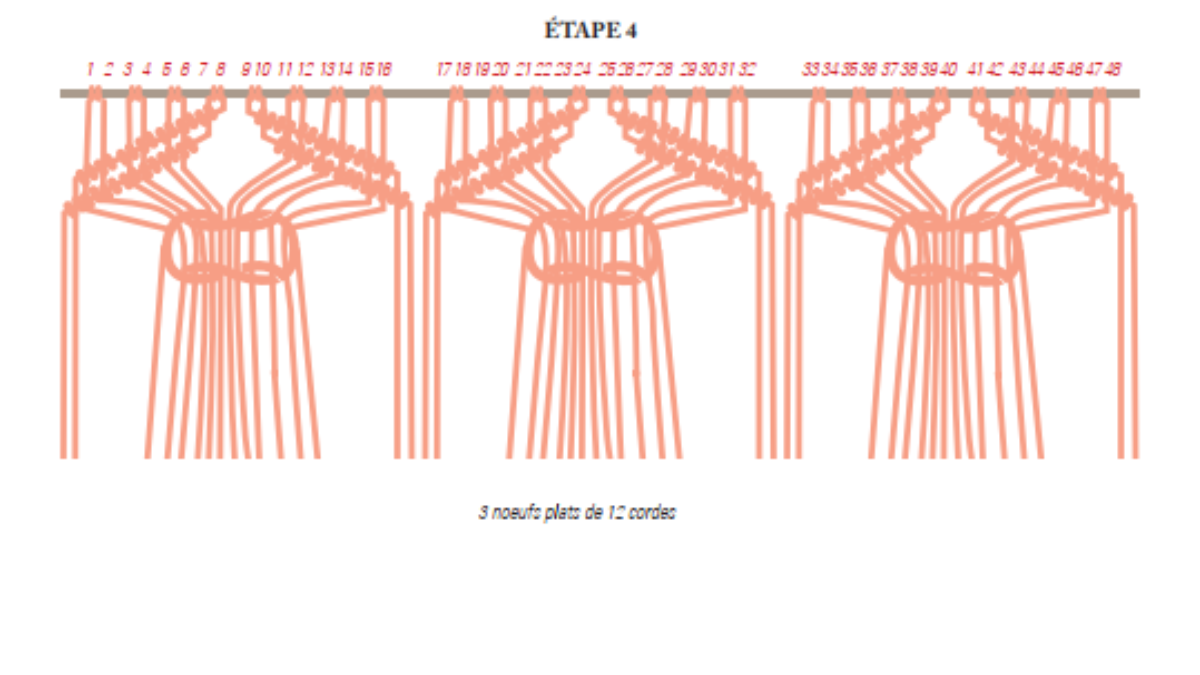
Work from left to right. Leave ropes 1-2 on standby and then tie a square knot with the next 12 ropes (ropes 3 and 14 are for tying the 10 central ropes).
Skip 4 ropes, make the same knot with the next 12 ropes (ropes 19-30 knot the 10 central ropes) then repeat the operation for the last group of threads, i.e. skip 4 ropes then make a square knot with the next 12 ropes (ropes 35 and 46 are for knotting the 10 central ropes).
You get 3 square knots.
Step 2
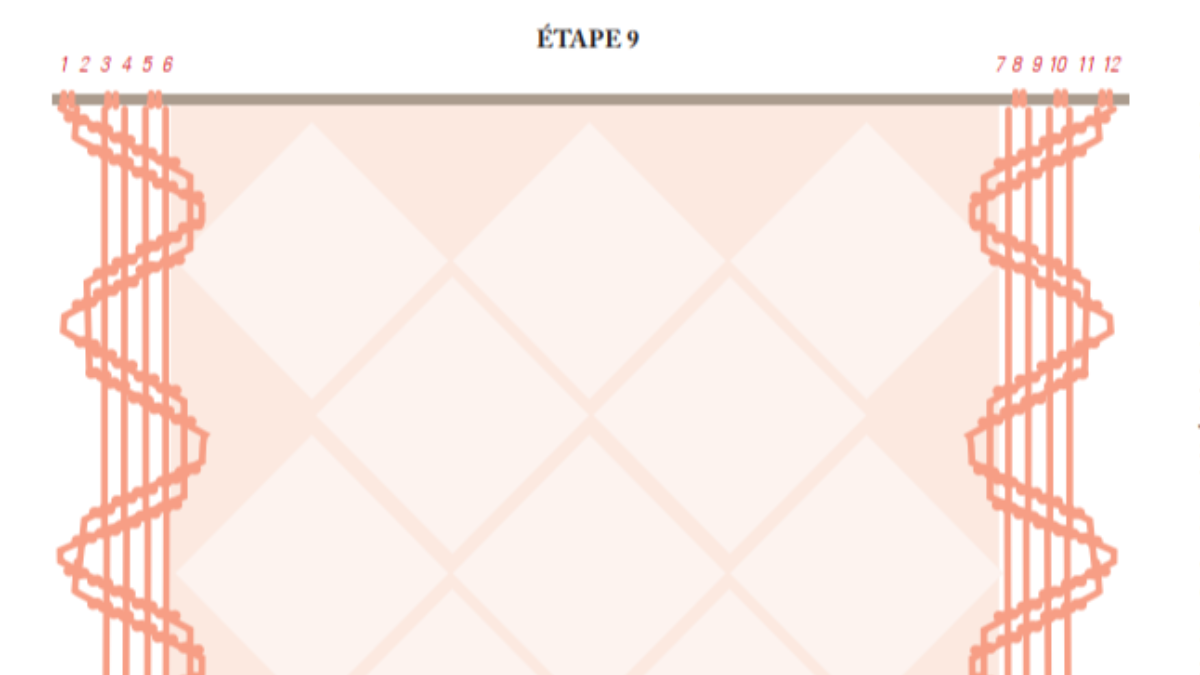
Cut 30 ropes of 4.5 or 5 meters long. Fold each of the ropes in half and tie them to the stick with a lark's knot. This gives you 60 ropes. Leave the first 6 and the last 6 ropes on hold until step 9. Number the remaining ropes from 1 to 48.
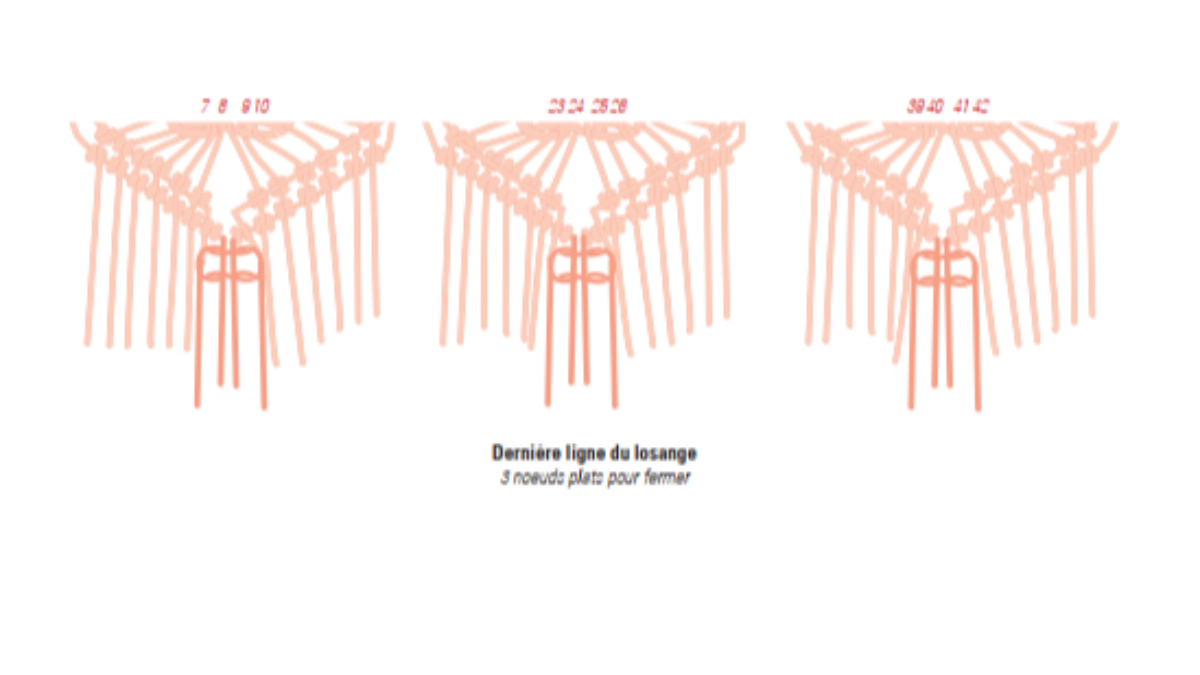
Make 3 groups of 16 strings to knot 3 diamond patterns (1-16) (17-32) and (33-48). Start knotting the diamond pattern: use string 8 as a support thread, tie a bar diagonally from right to left. Repeat with strings 24 and 40.
Make another diagonal bar from right to left with strings 7-23-39 as load-bearing threads. Repeat these knots from left to right with cords 9-25-41 as load-bearing yarns and then continue with cords 10-26-42 to tie the second diagonal bar.
Step 3
To make the lower part of the diamond, divide the strings of the group (1 to 8) and (9 to 16) in half again. Leave string 1 as a standby string and with string 2 as the supporting wire, work diagonally from left to right towards the centre of the diamond.
Take the standby string 1, use it as the supporting wire and work the outer bar diagonally from left to right towards the centre of the diamond. Leave all 8 strings on standby.
Before closing the diamond, tie diamond 1 to the next diamond. To do this, take the first string of the next group (17) as the supporting wire and work a bar diagonally from right to left with the strings of diamond 1 (16 to 9) to the centre of the diamond.
Count 8 strings from the left, take string 8 (15) to make the outer string. You must have 16 ropes in each group.
When you take a rope from the next group, once you have made the first bar, pass the rope to the next group (rope 16 from group 1, replace rope 17 from group 2).
Repeat step 5 to make the lower part of the other two lozenges.
Step 4
To make the second row of diamonds, work from left to right. Leave ropes 1 to 10 on standby, tie a square knot with the next 12 ropes (ropes 11 and 22 tie the 10 middle ropes). Skip four ropes and make the same overhand knot with the next 12 ropes and leave the last 10 ropes on standby.
Starting from the left, *count 9 ropes and tie a bar diagonally from right to left. Count 8 ropes from the beginning and with rope 8 as the main thread, tie the other bar diagonally from right to left. With the next 8 strings, tie 2 bars diagonally from left to right and leave the strings on hold *. Repeat from * to *.
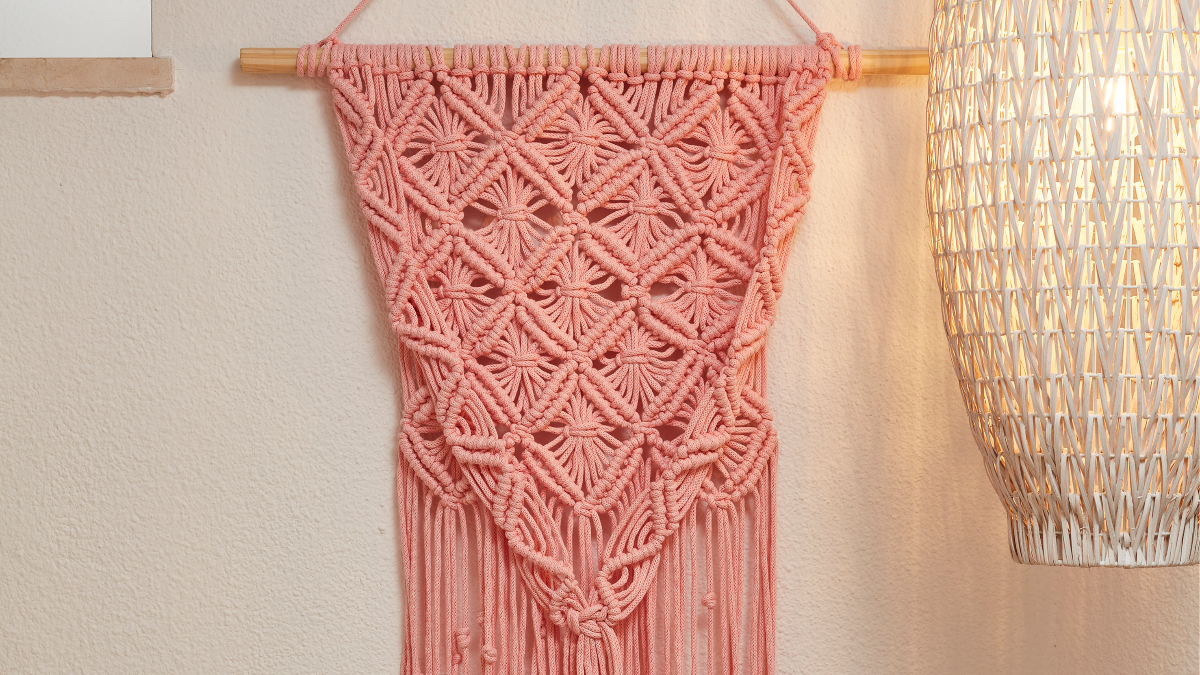
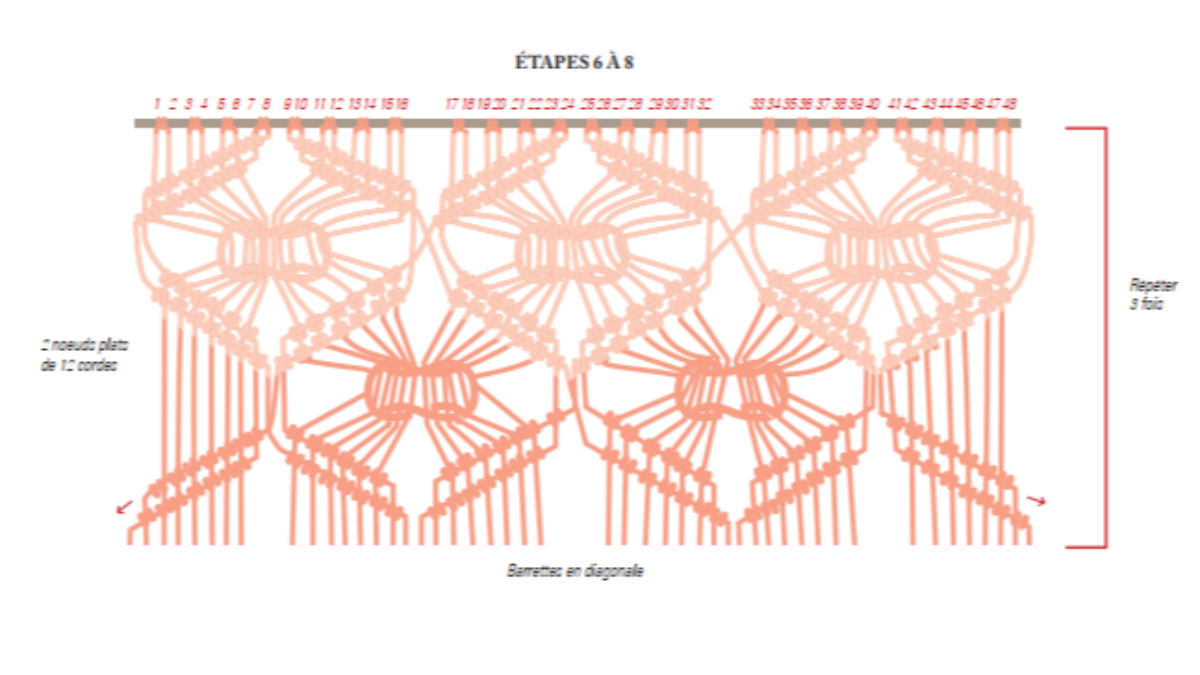
With the last 8 strings, tie 2 diagonal bars from left to right. Repeat steps 4 to 8 to complete 3 rows of 3 diamonds and 2 rows of diamond spacers.
Step 5
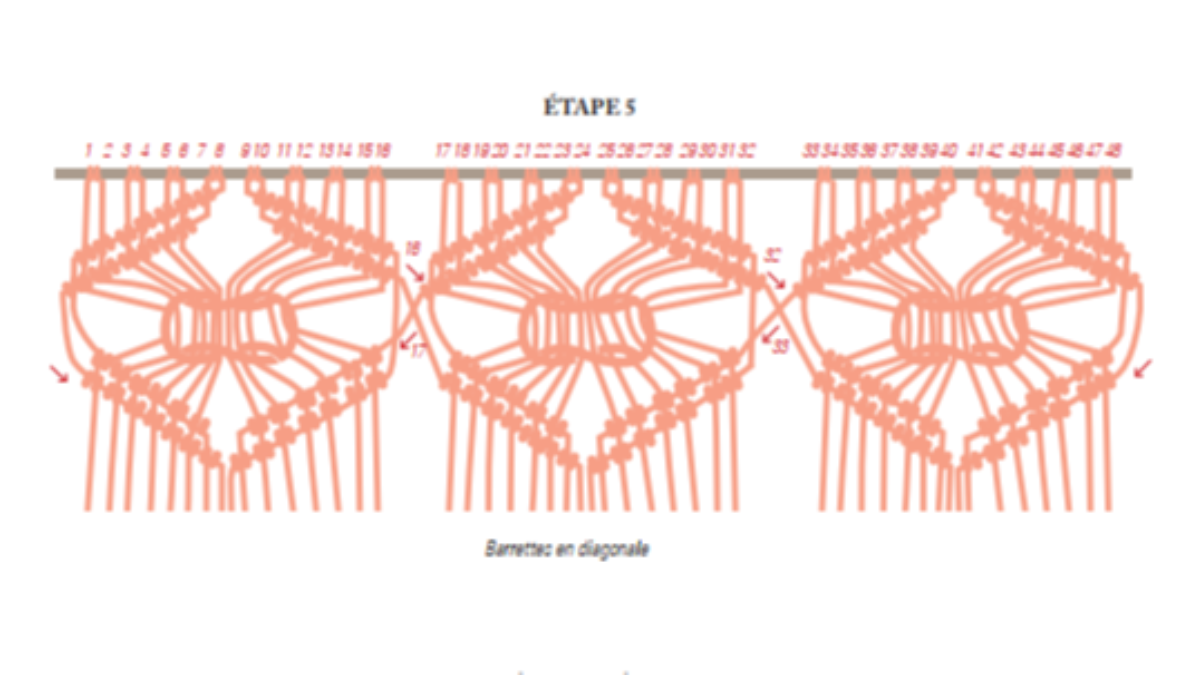
Close the tip of the diamonds with a square knot. From left to right, leave 6 ropes on standby, make a 4 rope knot. Leave 12 ropes on standby, make a 4 rope square knot. Repeat one last time, leaving 12 ropes on standby, and make a square knot of 4 ropes. Leave 6 ropes waiting behind the overhand knot.
Step 6
Number the first 6 and the last 6 strings left on hold.
With string 1 as the supporting thread, tie a barrette diagonally from left to right. Repeat underneath with rope 2 to make the outer barrette. Change direction from right to left and work 8 double bars by drawing an "S".
Step 7
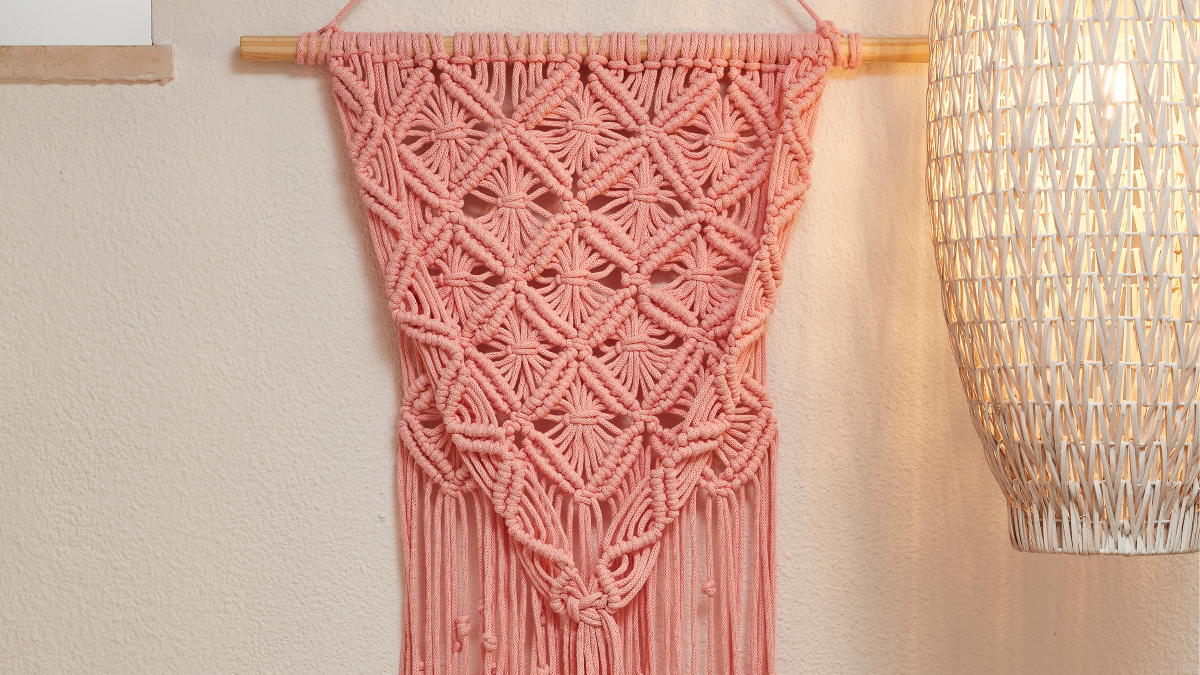
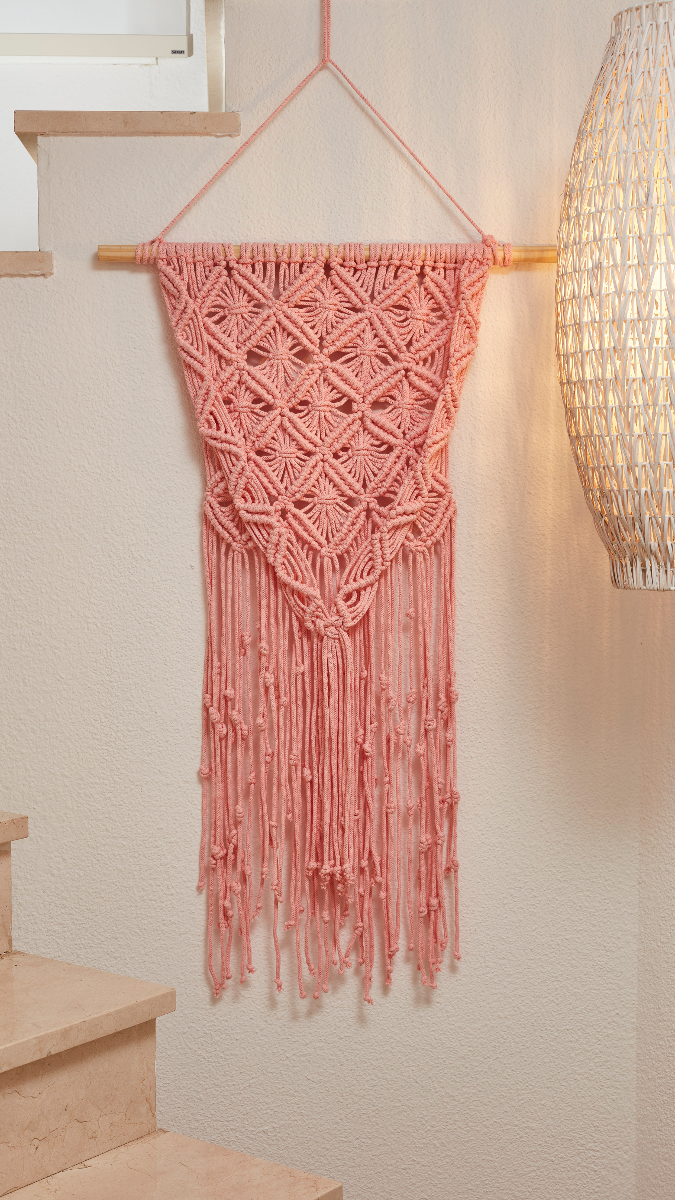
Assemble the border strips and make a square knot of 8 cords in the middle and 2 threads on each side to tie. Make a few capuchin knots in all the cords in an irregular and staggered way.
Cut the cords to the desired height. Tie a knot at each end of all ropes.
Use a rope to tie your work to the wall.
Step 8
Repeat, but this time only with rope 1 as the carrying wire from left to right and right to left. Then leave the ropes on standby. Repeat this step, knotting in the opposite direction with the last 6 ropes left on standby.
You have a question about this tutorial? Ask it to our team and the people who have already tested it. The Perles & Co community is here to help you!
By David (21/03/2023 15:00:52)
A l'étape 4, mes cordes 1 et 2 se retrouvent, en partant vers la gauche, en troisième et quatrième position ? Est-ce normal ?
1 Answer
Show answers
Hide answers
Translate the question
Please log in to use this feature
Our Tiffanie J. expert answers you
(22/03/2023 09:21:26)
Bonjour, Vous parlez de l'étape 4 écrite au-dessus des schémas ou de l'étape 4 du site ?
Translate the answer
By Chantal (10/12/2021 02:13:37)
Longueur des cordes
0 Answer
Translate the question
Please log in to use this feature
Your reviews (0)
Notices subject to control
Credits
Perles & Co, Internet & E-Commerce company [13/01/2021] Any reproduction, representation, adaptation, in any form whatsoever, even partial, is prohibited, except for reproduction for private use not intended for collective use, representation in the family circle (art. L 122-5 CPI) and online publishing on condition that the source is mentioned and a link is included to the corresponding page of our site www.perlesandco.com.