Average Grades
Comment puis trouver les pierres naturels pour faire mes bracelets
1 Answer
Show answers

To determine the length of wire to cut for your DIY jewelry, start by measuring your wrist or neck circumference, and add a margin of ease depending on the diameter of the beads. For elastic bracelets, allow around 10 cm extra for the knot, while for bracelets with clasps, allow 10 to 12 cm for the finishing touches, and 15 to 30% if there are knots between the beads.
Are you new to DIY jewelry making and don't know how much wire to cut for a bracelet or necklace? This article will help you find out. First of all, it's crucial to determine the type of jewelry you want to create, such as bracelets, necklaces or rings. The length of wire required will vary according to the design chosen, the size of the jewel and the technique used. This data sheet does not take into account micro-macramé jewelry, whose wire length is almost impossible to predict exactly. Depending on the design, it can be as little as one or as much as four times as long.
But before you start, you need to know the size of your wrist (or hand, in the case of bracelets with a sliding knot). We have several articles to help you:
The Margin of Ease is an extra length added so that the jewel doesn't pinch the wrist or neck. The larger the beads, the greater the margin of ease. The calculation method is: ((wrist diameter + bead diameter) x Pi) + about 0.5 cm for a bracelet close to the wrist, or 1 or 2 cm for something looser.
| Bead diameter | 1 to 3 mm | 4 to 6 mm | 7 to 9 mm | 10 to 12 mm | 13 to 15 mm |
| Approximate margin of ease to be added | 1 cm | 2 cm | 3 cm | 4 cm | 5 cm |
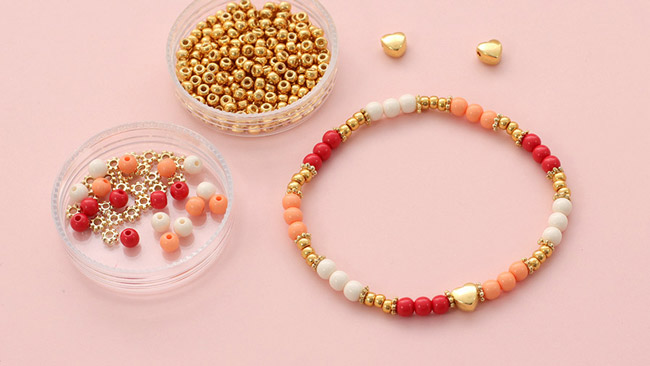
eg: My wrist measures 15 cm. I want to make a bracelet with 5 mm diameter beads. 15 (wrist circumference) + 2 (slack) + 10 (to make the knot) = 27 cm.
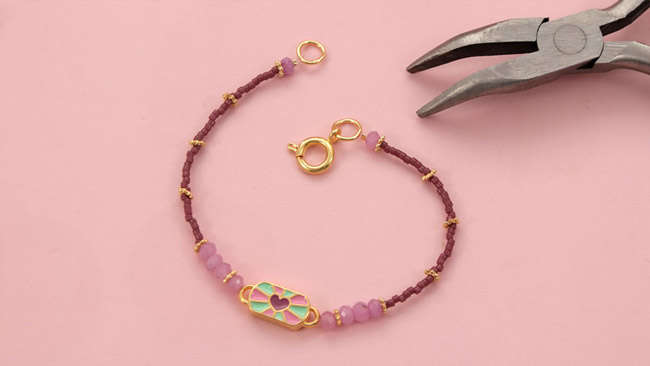
These values are approximate and give you enough margin.
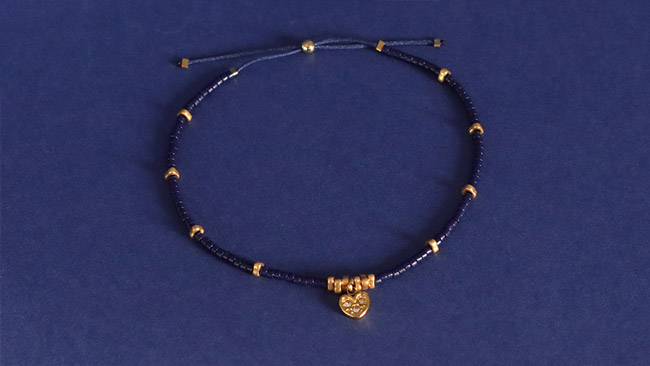
The method is the same as for a bracelet with a clasp, but add a 20 cm margin instead of 10 cm. The sliding knot is made with another piece of wire, usually 20 cm long.
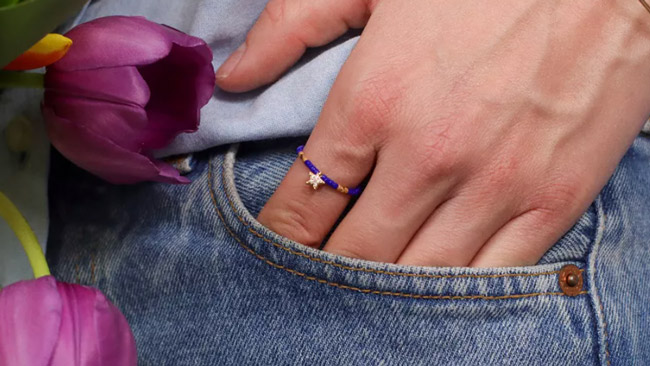
Of course, the length of wire depends on the model.

There are several types of necklace. Necklaces have different names depending on their length. Find out here what necklaces are called according to their length: How to choose the length of your necklace.
For necklaces that are very close to the neck, add a margin of comfort according to the table. Add 10 to 12 cm for finishing.

You've decided to follow a tutorial to make a piece of jewelry from woven beads? Does the tutorial not mention the length of thread to cut? We'll explain why.
When weaving beads with a needle, whether Miyuki or Puca beads, there's no set length of thread, for the simple reason that in most cases you'll need to cut several meters of thread. Can you imagine having to handle several meters of wire every time you add a new bead, especially when a Miyuki bracelet can contain several hundred beads? Sounds impractical, doesn't it? That's precisely why another method is used. But what is it?
In bead weaving, we speak of"wire arm length", or more explicitly, we cut a piece of wire the length of the distance between our arms. Once the thread has been passed over the needle, this length is roughly halved. You'll be much more comfortable weaving. This length varies from person to person, but is generally between 1.3 m and 1.7 m. Sometimes you can use 2 m to avoid having to replace the thread too many times.
When you've only got 15 cm of thread left on the needle, you can replace it. When weaving with large beads, such as Puca beads or Czech glass beads, you need to make a double knot on the thread already woven and attached to the beads, then pass the thread back through the beads in the opposite direction. Put a dab of glue on the knot and cut off the excess thread. You take an arm's length of thread and knot it upstream in the weave, returning to where you left off.
In the case of bead weaving such as Peyote or brick stitch, but also loom weaving, there's no need to tie a knot. Simply thread through the beads several times to secure the thread. Pull on the last bead to check that it's stuck. Take a new piece of thread and jam it in turn.
Find an example here: loom, what to do when my thread is too short?
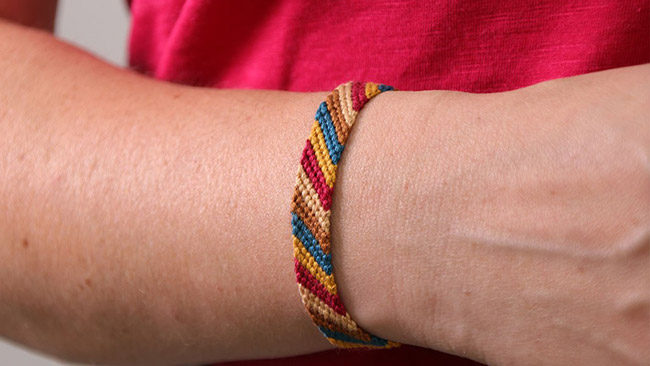
The length of the threads for a Brazilian bracelet will depend on the size of the wrist and the desired pattern. In general, here are a few tips for determining the length of wires for a Brazilian bracelet:
Measure your wrist: Use a tape measure or string to measure the circumference of your wrist. This will help you estimate the length needed to make the bracelet.
Consider the number of wires: The number of wires used will depend on the pattern you choose. Simple Brazilian bracelets generally require between 3 and 8 wires, while more complex patterns may require more.
Calculate wire length: For each wire, allow a length of around 5 times the circumference of your wrist. For example, if your wrist measures 15 cm, each thread should measure between 75 cm. This extra length will ensure that you have enough wire for the knots and bracelet fastening.
Add an extra margin: It's always a good idea to have an extra margin in case of error, or if you want to adjust the size of the bracelet as you go. Add about 20 cm to the length of each thread to ensure you don't run out of material.
In summary, to make a Brazilian bracelet, measure your wrist, determine the number of wires needed for the pattern you've chosen, and multiply the wrist circumference by 5 to obtain the wire length. Then add an extra margin for any adjustments or mistakes.



Credits
Perles & Co, Internet & E-Commerce company [22/01/2025] Any reproduction, representation, adaptation, in any form whatsoever, even partial, is prohibited, except for reproduction for private use not intended for collective use, representation in the family circle (art. L 122-5 CPI) and online publishing on condition that the source is mentioned and a link is included to the corresponding page of our site www.perlesandco.com.