Average Grades
Quel fil utiliser pour faire des colliers et bracelets comme Une à Une ?
1 Answer
Show answers

925 Sterling Silver wires, composed of 92.5% solid silver, are highly malleable and are available in hardened (stiffer) or annealed (softer) versions. Gold Filled wires, on the other hand, with a layer of gold on a brass base, are ideal for more resistant and elegant creations, but their rigidity can vary according to thickness. Choose silver for fine, supple jewelry, and Gold Filled for more durable, refined pieces.
This text compares the characteristics of 925 silver wire and Gold Filled wire. We'll look at their differences in terms of hardness and jewelry applications. At the bottom of these articles, you'll find a table with recommended applications according to the desired rigidity of your jewelry.
Gold Filled (laminated gold) and Gold Plated are good alternatives to solid gold, which not everyone can afford. Gold Filled is the mechanical application of a layer of gold, usually 14-carat or 12-carat, to a base often made of brass. The quantity of gold must correspond to 1/20th of the product's weight. Gold plating is a chemical or electrical process that applies a thin layer of gold to a brass base. The plating must be at least 3 microns thick, and the gold used is between 12 and 24 carats. If you'd like to know more about the difference between Gold Filled and Gold Plated, here's the link to the article.
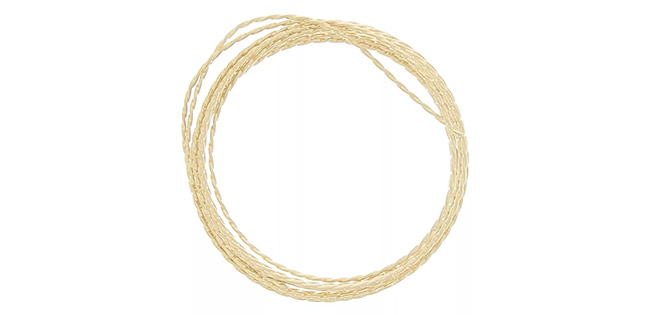
925 silver is 92.5% solid silver. Since silver is very soft, it is supplemented by 7.5% of other metals to make it suitable for jewelry-making. On the product pages of the silver wires we sell, a hardness is indicated, e.g. hard, semi-hard or soft, as well as work-hardened and annealed.
Naturally, a metal will harden as a result of the mechanical stresses and strains it undergoes during manufacture, such as hammering, twisting, bending and shaping. This is called work-hardening. And the more it is work-hardened, the harder it is, and therefore the more difficult it is to deform.
To reduce hardness and restore malleability (softness) and ductility (the ability of metal to undergo plastic deformation without breaking), metal is annealed. This involves heating a metal to a certain temperature with a flashlight, to restore its mechanical properties and make it easier to work. This is why on the site, 925 silver wires indicated as hard are also noted as "écroui" and wires noted as semi-hard or soft are "recuits".
But in truth, it's not quite that simple. A very fine 925 silver wire, such as 0.20 mm, may be work-hardened, noted as hard, but still be easy to deform, because it is so fine. The difference with soft wire of the same thickness is that hardened wire will have a more springy effect than soft wire.
925 silver wire is available in silver and gold.
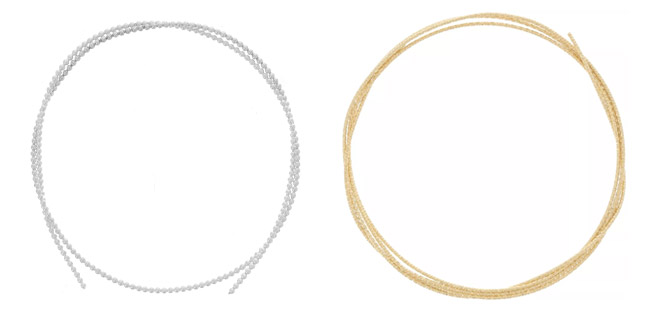
Now that you know a little more about Gold Filled and Silver 925, as well as the difference between work-hardened and annealed, let's take a look at the cases where we can choose one or other wire hardness. You'll find a comparison table below.
| Reference | Thickness | Extra soft | Soft | Semi-hard | Hard | Extra Hard | Extra Hard | Applications |
| GOLD FILLED | ||||||||
| GFD-094 | 2.6 mm | X | Forks, Torques | |||||
| GFD-096 | 1.75 mm | X | Forks, Torques | |||||
| GLD-554 | 1.25 mm | X | Rods, weekly | |||||
| GLD-040 | 0.8 mm | X | Weekly patterns, hooks, creoles, rings, lettering (expert) | |||||
| GLD-069 | 0.81 mm | X | Weekly dividers, hooks, creoles, rings, lettering, dividers | |||||
| GLD-241 | 0.8 mm | X | Weekly planners, lettering, rings, dividers | |||||
| GLD-110 | 0.64 mm | X | Weekly dividers, hooks, creoles, rings, lettering (expert), dividers | |||||
| GLD-111 | 0.64 mm | X | Weekly planners, lettering, rings, dividers | |||||
| GLD-112 | 0.64 mm | X | lettering, rings, dividers | |||||
| GLD-242 | 0.40 mm | X | Fine spacers, charms, bead winding | |||||
| SILVER 925 | ||||||||
| SL-080 | 2 mm | X | Snoods, Torques | |||||
| FC-388 | 2 mm | X | Snoods, Torques | |||||
| SL-556 | 0.8 mm | X | Rods, weeklies, rings, dividers | |||||
| FC-163 | 0.8 mm | X | Weekly organizers, hooks, creoles, rings, lettering, dividers | |||||
| SL-551 | 0.8 mm | X | Weeklies, lettering, rings, dividers | |||||
| SL-558 | 0.4 mm | X | Thin spacers, charms | |||||
| SL-553 | 0.4 mm | X | Fine spacers, charms, bead winding | |||||
| SL-554 | 0.2 mm | X | Thin spacers, charms, bead winding |
To make thick bracelets, bangles or torques that are virtually dimensionally stable (for standard jewelry use and proper, respectful storage), you need hard wire thicker than 1.5 mm. To be able to process these wires, it is advisable to have some knowledge of jewelry-making, especially for finishing the jewel.
Hard wires from 0.8 mm to 1.5 mm will enable you to make finer beads, such as semainier bracelets. But these wires are difficult to shape, so they are not suitable for beginners.
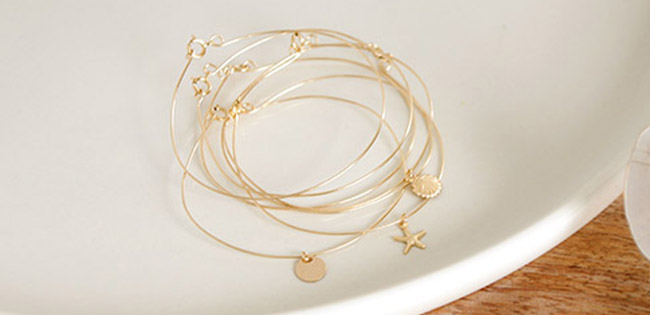
The hard 0.8 mm and 0.64 mm wires can be used to make ear hooks, creoles, semainiers and rings for amateurs. They can also be used for lettering, but there's no room for error, as the wire can break if twisted the other way. For lettering, it is recommended only for experienced designers.
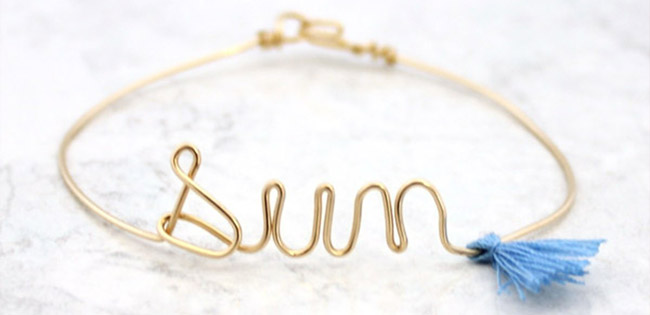
Semi-hard 0.8 mm and 0.64 mm wires will enable you to make weekly beads with clasps integrated into the beads, ear hooks and creoles a little more easily than with hard wire. You can also try lettering with these wires.
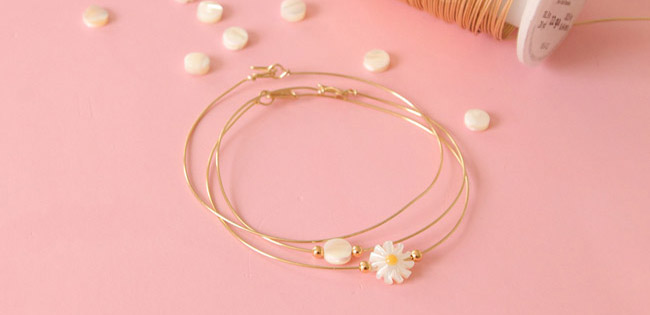
Soft wires 0.8 and 0.64 mm are ideal for lettering and rings with coiled wire. The jewelry is softer, but lettering is easier. They are too soft for ear hooks and creoles.
The extra-soft category contains mainly very fine wires. These will enable you to make charms or spacers by forming pigtails. They can also be used to wrap pearls around a creole or bracelet.
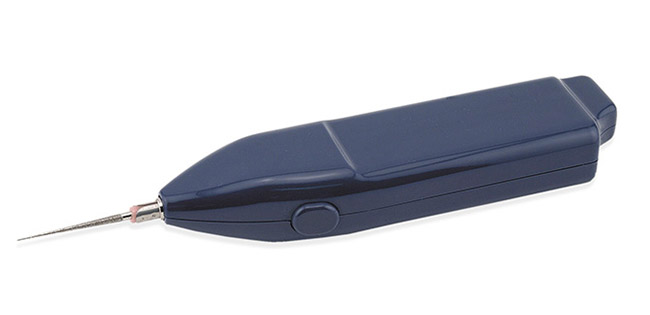
When creating hooks, creoles or other types of earrings with metallized wires, note that the cut end of the wire will be sharp and may injure the ears. You'll need to sand down the end of the wire before you can wear the earrings. To do this, you'll need an electric bead reamer and a wire-rounding bit. You'll find these tools at the bottom of the page.



Credits
Perles & Co, Internet & E-Commerce company [16/10/2024] Any reproduction, representation, adaptation, in any form whatsoever, even partial, is prohibited, except for reproduction for private use not intended for collective use, representation in the family circle (art. L 122-5 CPI) and online publishing on condition that the source is mentioned and a link is included to the corresponding page of our site www.perlesandco.com.