Free shipping on orders over 50€ up to 500g
French Online shop for beads and accessories for the creation of DIY jewellery and other creative hobbies

Log-in

Lesson 4: How to make a golden bracelet

Made by :Tiffanie Perles Co
Published on the :03/08/2022

Today we meet again for episode 4 of our beginner's jewelry course where we will make gold colored weekly bracelets. But what is the meaning of a weekly bracelet? Semainier bracelets are bracelets or rings composed of 7 simple rings, like the 7 days of the week. They can be worn together or separately. You can add beads on them or make bracelets out of wire or metal wire without anything else. The wire for making bracelets that we are going to use is golden copper wire treated against tarnishing. This is the same wire we used in episode 2 to make beaded earrings.

The purpose of this course is to help you learn how to make jewelry while building your skills little by little. In this lesson, you will be able to use the leftover materials and tools from previous lessons. Remember to keep 3 mother of pearl pucks and 1 to 3 stopper beads for the fifth and last lesson of the season.

1- Which wire to choose to make metal bracelets?

Soft, semi-hard or hard wire

To make bracelets or rings, you will need to use a metal wire. The harder and larger the wire, the more difficult it will be to form. Conversely, the softer and thinner the wire, the easier it will be to form, but the more easily it will deform when worn. Therefore, hard wire is ideal, but we recommend starting with soft wire if you are a beginner. The more you practice shaping the wire into a bracelet, the easier it will be to use harder wire.

Choosing wire material

In this lesson, we recommend that you practice with the copper wire we used in the previous lesson. Why this one in particular? Because it is soft enough to be used by beginners and strong enough not to deform when worn. Also, being anti-tarnish treated, it is of good quality and has a good quantity/price ratio. This means you'll have enough length of wire to practice on.

Copper wire is an inexpensive and flexible option, perfect for beginners. It also comes in silver. Other types of wire can be used:

  • Gold filled wire is a brass wire coated with a thicker layer of gold than gold plated. It is a very durable wire but it is expensive.
  • 925 silver wire is a good silver and hypoallergenic option. However, silver is a metal that oxidizes and needs to be cleaned regularly.
  • Stainless steel is a little darker than silver but as its name indicates, it does not oxidize and is very resistant over time. However, it is a very hard metal and very difficult to form.

Wire diameter

The ideal is to take a wire between 0.6 and 1 mm. You can of course use a thicker wire, but this will complicate the closing system. Indeed, if the clasp loop is larger, you will have to use larger rings as well, or make a more visible wire clasp. If you do soldering, that's a different story, you'll need to learn professional jewelry making and equip yourself with the proper machinery and tools. You can take a look at our courses on professional jewelry making to get a better idea.

2- Putting a clasp on a wire bracelet

As explained in the video, there are basically two ways to add a clasp to a wire bracelet. You can either form loops on each side of the bracelet and add a ready-made clasp, or form a hook system with a loop on one side and a wire hook on the other. This is the second method we chose, but there is nothing to stop you from doing the first. If you are interested, it has been presented in more detail in this tutorial: DIY Gold Filled 14K Gold Wire Bracelet.

faire un fermoir avec du fil

It is also possible to form beaded bracelets without clasps. In this case, you need to make wider beads so that you can easily put them on without opening them. This is the technique that was used in this tutorial 925 silver bracelet.

bracelet semainier argent

3- Tools to make the weekly gold bracelets

The Cutter Flush pliers

The Cutter Flush is a very precise cutter that allows you to cut metal wires cleanly and as close as possible to the winding of the wire on the bracelet for example. Be careful not to use it with stainless steel wire or memory wire, as these wires are very hard and will damage the blades of the pliers. With the latter, use a pair of shears.

Ring making pliers

These pliers serve the same purpose as round-ended pliers, but instead of having cone-shaped tips, thinner at the tip and thicker at the base, they are made of two cylinders of uniform size. This makes it possible to form loops that are always the same size. It also makes it possible to create rings that will all have the same size.

pinces à bijoux pour former du fil de fer

The triboulet

There are triboulets for rings and others for bracelets. They can be made of wood or metal. They are used to shape and measure rings and bracelets. This tool will come in very handy if you want to start selling handmade jewelry. If you don't need it regularly, you can always use everyday objects to shape your bracelets. For example a glass or a candle.
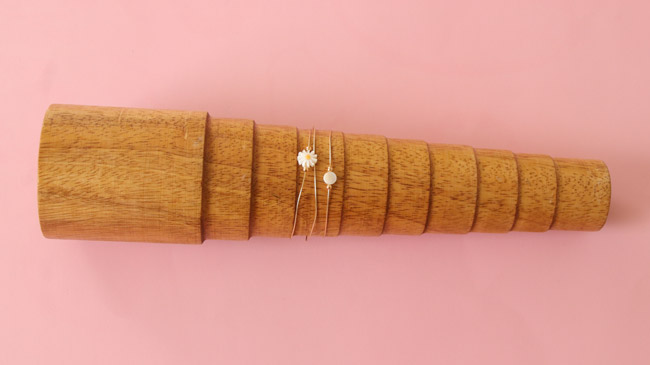
triboulet en bois pour former des bracelets

Tiffanie Perles Co
 Tiffanie Perles Co - Les tutos de Tiffanie
Bonjour, moi c'est Tiffanie. J'étais créatrice et designer produit chez Perles & Co. J'adore tester de nouveaux DIY et vous faire profiter de mes expériences. Vous pouvez toujours consulter les tutoriels que je vous avais concocté sur le site !
Share with my friends
Which material to use ?
Please note that the quantities of the suggested equivalents are not necessarily exact. You can adjust them in your basket.
Supplies
Mother-of-Pearl Round Pucks  6mm Natural x20
2,80€
Stopper beads 3 mm with a 0.5mm hole fine Gold plated x10
1,80€
Suggested reference for this article:
10mm Mother of Pearl Daisy Flower Bead - White - Orange x1
1,80€
Subtotal : 15,30€
Tools
Bent chain nose pliers Beadalon Econo - 12 cm x1
9,80€
Specialized wire looping pliers 1,5 mm, 2.5 mm x1
8,90€
Cutting pliers Flush cutter eco x1
OUT-019
Qty : 1
42 in stock
9,50€
Wooden Ring gauges for forging round bracelets x1
13,50€
Subtotal : 41,70€
Equivalent product
Spring clasp 7 mm with extension chain - fine Gold plated x1
11,17€ 10,50€
Your questions (5)
You have a question about this sheet? Ask our team and the people who have already tested it. The Perles & Co community is here to help!
By Laëtitia (27/10/2024 18:28:46)
Bonsoir, les pinces proposées lors du cours précédent (boucles d'oreille) font elles l'affaire pour fabriquer ces bracelets? Ou faut-il se procurer les pinces recommandées dans ce tuto?
Translate the question
Please log in to use this feature
Our Tiffanie J. expert answers you (28/10/2024 08:47:22)
Bonjour, vous pouvez utiliser les 3 pinces de base que vous m'avez partagé dans votre autre question. Cette pince pour former les anneaux et la pince coupante flush cutter sont là pour étoffer vos outils mais elles ne sont pas obligatoires pour réaliser le projet.
Translate the answer
By Michèle (30/09/2023 18:57:34)
Bonjour peux t on faire la même chose pour des boucles créole avez-vous un tuto ? Je cherche des modèles de créoles à garnir
Translate the question
Please log in to use this feature
Our Tiffanie J. expert answers you (02/10/2023 14:41:28)
Bonjour, oui nous avons celui-ci : https://www.perlesandco.com/ressources/ft30802-comment-faire-des-boucles-d-oreilles-creoles.html
Translate the answer
By Camille (19/05/2023 09:32:15)
Bonjour , avec ce type de fil, que cela soit Le fil Gold filled ou L'acier inoxydable, sont t'il des fils qui vont se déformer après plusieurs utilisation ? je souhaiterais en utiliser pour la conception de jon . sont t'il des fils recommandé? ou dois je utiliser un fil mémoir ? autre chose, le FIL DE CUIVRE ROND COLOURCRAFT WIRE 0.64 MM s'oxyde t'il ? puis je l'utiliser pour la formation de jon également ? Merci beaucoup .
Translate the question
Please log in to use this feature
Our Lucie L. expert answers you (24/05/2023 09:06:44)
Bonjour,

Les fils métalliques, quelle que soit leur matière (gold filled, acier inox etc) se déclinent selon plusieurs niveau de rigidité / souplesse. Vous trouverez des fils souple, semi-dur et dur. Vous pourrez donc les travailler avec plus ou moins de facilité pour leur donner leur forme finale. En revanche cela signifie aussi que selon le type de fil choisi leur déformation à l'usage sera plus ou moins rapide.

Vous pouvez vous inspirer de plusieurs de nos tutoriels de jonc en fil métallique pour réaliser les vôtres :
https://www.perlesandco.com/tutoriels/t20851-tuto-diy-bracelet-jonc-semainier-avec-fil-d-argent.html
https://www.perlesandco.com/tutoriels/t30112-tuto-bracelet-jonc-gold-filled-en-resine-noire-opaque.html
https://www.perlesandco.com/tutoriels/t27591-diy-jonc-en-metal-petit-coeur-purecrystal.html

Pour répondre à votre deuxième question, le fil de cuivre en question (FCU-878) est anti-ternissement mais peut s'oxyder selon l'usage que vous en faites (eau, stockage, acidité de la peau etc...). Comme expliqué dans la leçon 4 vous pouvez utiliser ce fil pour réaliser des joncs.
Translate the answer
By dominique (18/09/2022 17:49:59)
Bonjour, Ne peut-on pas remplacer les perles sauteurs par des perles à écraser? L'effet est- il identique?
Translate the question
Please log in to use this feature
Our Tiffanie J. expert answers you (19/09/2022 09:21:49)
Bonjour, oui vous pouvez mettre une perle à écraser aplatie sur le fil + un cache perle.
Cordialement
Translate the answer
By Fanny (02/09/2022 16:01:14)
Bonjour, Afin de réaliser ces bracelets avec du fil gold filled, lequel faut-il acheter ? quel diamètre ? Vaut-il mieux souple, dur ou semi-dur ? En vous remerciant par avance.?
Translate the question
Please log in to use this feature
Our Tiffanie J. expert answers you (05/09/2022 09:16:04)
Bonjour, je vous conseille celui-ci : https://www.perlesandco.com/Fil-dur-0.64-mm-en-Gold-Filled-x1.5m-p-64569.html
https://www.perlesandco.com/Fil-dur-0.64-mm-en-Gold-Filled-x10m-p-268691.html
Attention, plus le fil sera épais et en dur et plus vos bracelets seront difficiles à former. Si vous ne souhaitez pas mettre les perles de l'exemple et faire des semainiers simples, vous pouvez prendre du 0,8 ou du 1 mm.
Translate the answer
Your reviews (0)
Notices subject to control
Please log in to use this feature

Credits

Perles & Co, Internet & E-Commerce company [03/08/2022] Any reproduction, representation, adaptation, in any form whatsoever, even partial, is prohibited, except for reproduction for private use not intended for collective use, representation in the family circle (art. L 122-5 CPI) and online publishing on condition that the source is mentioned and a link is included to the corresponding page of our site www.perlesandco.com.