Before we move on to the reasons why a Miyuki weave might be irregular, let's first look at what a regular bead weave should look like. Here's a list of tutorials and datasheets that show you how to weave beads on a loom:
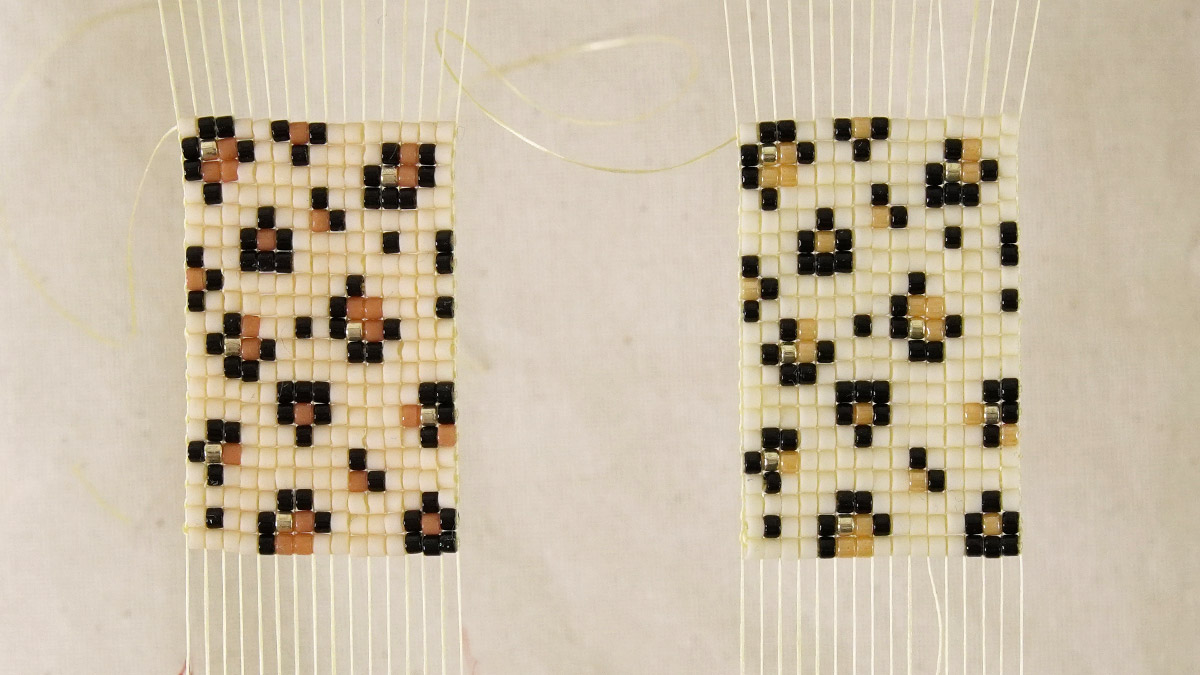
The image at the top of this page shows a good example of weaving done correctly (right), and another showing one of the problems we'll be looking at next (left). If your weave is correctly done and made in Miyuki Delicas 11/0, it should look like the one on the right. Of course, the result will differ according to the beads chosen.
Diagram of a correctly made bead weave :

Here are 5 reasons why your loom bead weave isn't as straight as you'd like:
1- Beads are irregularly shaped

On the left, Seed beads from the '90s and on the right, Miyuki Delicas 11/0.
The final result of your weaving depends very much on the beads you use. You might be tempted to use the seed beads that have been lying around in your drawer since the '90s, but since then, manufacturers have made great strides in the production of these beads. So, while these irregular beads may suit you very well for bead-strung jewelry or for making crocodiles or dragonflies, you may be disappointed by using them for loom weaving.
Of course, this can be an artistic choice - we don't forbid you to use them! But if what you like about the jewelry that has inspired you to start weaving beads again is the regularity and beauty of the patterns, then we wouldn't recommend using irregular Seed beads.
You'll need to choose newer beads of similar size. A number of brands make beautiful beads in different shapes. The most popular in recent years are Miyuki Delicas 11/0, which have a cylindrical shape. In the same style, there are TOHO Treasures 11/0.
If you're more nostalgic for our beloved Seed beads, Miyuki, Toho and Ornella also make very regular round seed beads in various sizes. If you're a beginner, be sure to use only one type of bead from the same brand!
2- You didn't pass through the beads correctly

This is the mistake most beginners make. It's not easy to see, but repeated over an entire bracelet, the difference is striking. You can see a woven example in the presentation photo of this datasheet. On the left, a poor second pass through the beads, and on the right, a correct second pass.
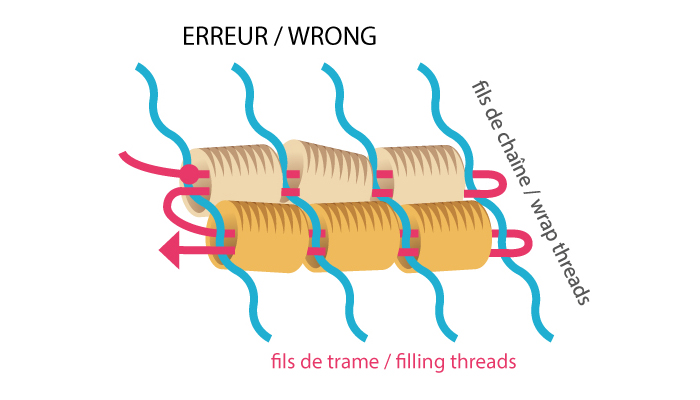
To solve this problem, the following steps must be followed. Once the beads have been threaded, pass the thread with the beads under the warp threads of the loom and place each bead between 2 warp threads. Then, and this is where the mistake is made, you have to pass through the beads with the needle, but you have to be very careful to pass over the loom threads.
It's very important to check. If you pass through the beads without paying attention to this detail, you may very regularly pass under the warp threads and you'll get the approximate result shown in the example.
3- Warp threads not sufficiently taut (or too taut)
A little more obvious mistake this time. The wires placed on the loom must be taut, as they will be used to position and align the beads along the entire length of the bracelet. Conversely, if they are too taut, you won't be able to bring them together, and the beads will float between two wires and won't be "wedged" either.
Ideally, you should touch the wires with your finger. You should feel some tension, but be able to lower the wires by a few millimeters. It should feel like it's bouncing a little when you press on it.
Depending on your loom, you can adjust the thread tension by unscrewing and turning the wooden logs.
4- You haven't aligned the beads as you go along

Each time you place a new line of beads, make sure that the line is perpendicular to the warp threads and stuck to the previous line. Replace them as you go, using your fingernail or finger, and pull your weft thread taut over the needle (without forcing it!!). Regularity is very important.
5- You've used different beads

It's not a good idea to mix different kinds of beads. For example, Miyuki's Delicas and TOHO's Treasure both have a cylindrical shape and an almost similar size, but it 's important to keep this in mind.
On a whole weave, if you use only Delicas and Treasure for a single color, the difference in size and shape will be noticeable. The same applies to 11/0 Seed beads of different brands. 11/0 means the same size, but 11/0 does not mean the same dimensions from one brand to another.
Of course, once again, we don't forbid you to experiment! It can be your choice for a particular design you've imagined! But if this irregularity wasn't foreseen, here's one reason why it might appear.
Another reason that can make your weave curl, but only at the end, is to over-tighten when you knot the threads 2 by 2 at the end. This pulls on the warp threads, which shorten, and the beads end up on top of each other. Want to know more about the different ways to finish a loom bracelet? Click here: How to finish a Miyuki or Seed beads woven bracelet?