It's decided! This year, you're going to crochet.
Long neglected in favor of its cousins, knitting needles, crochet is taking its revenge! In recent years, crocheting has even become an ultra-trendy creative hobby. Gone are grandma's doilies, and now you can crochet trendy bags, stylish clothes, baskets to keep everything tidy, cute amirugumi for your little one and a whole host of other DIY creations.
But here's the thing: there are as many types of crochet hooks as there are crocheters, which means an infinite variety with a multitude of specificities: the Tunisian hook with its very long handle, the upholsterer's hook, the Lunéville hook specially used for art embroidery, the very fine lace hook, classic, design or ergonomic hooks. So how do you find your way around? Which hook to use? Don't panic! In this fact sheet, we tell you everything you need to know about crochet.
What is crochet?
Crochet is a technique that enables you to make a wide range of creations with wool, cotton or traphilo yarn, using just one needle.
But crochet is also the tool you'll use to make sweaters, shawls, accessories, comforters, baskets...
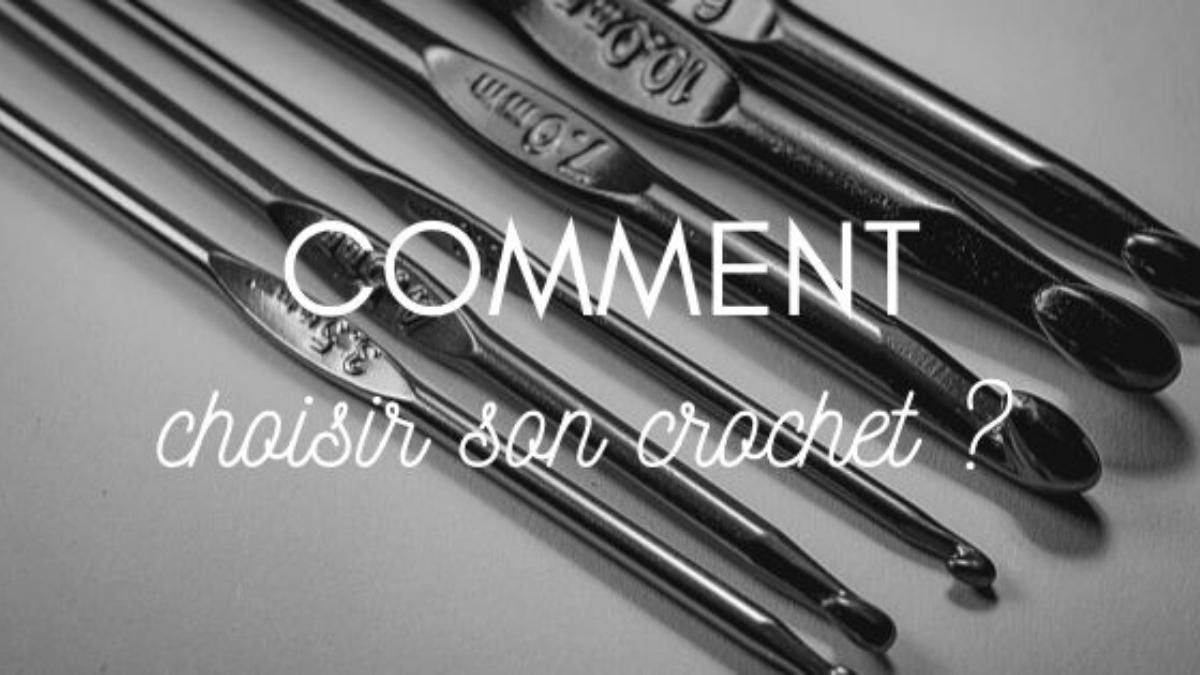
Let's take a closer look. At the end, there's the point: it's used to prick into the stitch and then pull the thread through it to create more or less openwork stitches, depending on the model chosen.
There are very sharp points, practical for making full or very tight stitches, and flat-headed hooks for making very airy stitches such as lace stitches.
Then, just after the point, there's the throat. This holds the thread in place. This part can be very right-angled, as with bamboo hooks, or more rounded, as with metal hooks.
After the groove and before the handle is the shank. This determines the diameter of your tool. If you're just starting out, it's more practical to choose a long, straight shank that will enable you to hook more easily.
And finally, there's the handle, which allows you to grip your tool. And there are all kinds: ultra-design handles, ergonomic handles, voluminous or discreet handles, straight handles, handles with thumb rests, colored handles, girly handles... There are even handleless models!
How to choose? It's all a matter of taste, and depends on how you hold your hook.
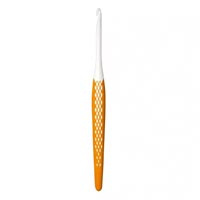
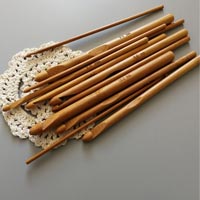
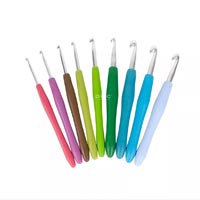
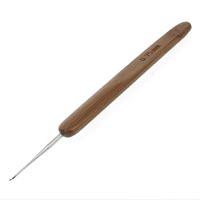
Hook material
A plastic hook
Plastic crochet hooks cost less than other hooks. It's perfectly suited to work with thick wools, as it has a larger diameter.
A bamboo hook
Bamboo hook s have a smooth surface, are lightweight and pleasant to use.
In general, bamboo hooks have a larger diameter, enabling them to be used for larger projects, such as roofing.
Steel hooks
Steel hooks are thinner because of their smaller diameter. It is ideal for fine work such as lacemaking.
How do I know the size of a hook?
Hook length
As with knitting needles, there are different hook lengths. Hook lengths range from 12.5 cm to 20 cm. For beginners, it's a good idea to work with a 15 cm hook. This is the most common size.
Hook diameter
The diameter is the small number on your hook. Here again, you'll find that there are several different diameters. As a general rule, the smaller the hook number, the finer the wire diameter. Your stitches will be fine
How do you determine hook size? It's easy to understand: a 6 hook corresponds to a hook with a diameter of 0.6 mm.
The most commonly used is the 8 hook, with a diameter of 0.8 mm. It can be used to work cotton thread, fine silk and fine yarns, and to attach beads (spirals) and sequins.
Diameters 2, 3 and 4 are ideal for cotton yarns to create "amigurumi" plush toys, which are very tightly crocheted. So we choose the hook number corresponding to the size marked on the wool, and no larger.
We crochet the creative bubble yarn used to make our ecological sponges with number 2.5, for example.
The largest diameters, around number 10, are used to create baskets for your pets, rugs and other decorative items with coarse wools or Trapilho.
The smallest hook diameters correspond to fine work with fancy yarns, silk thread, lurex, mohair or very fine cotton thread.
Which crochet hook to choose for beginners? It's best to start with a number 4 or 5 crochet hook and a wool yarn of the corresponding number, as fancy yarns are more difficult to use.
It is possible to crochet a number 6 yarn, for example, with a number 7 or 8 hook, which will enable you to obtain looser stitches and therefore a slightly looser work. It's a question of taste and habit, depending on whether you work with the yarn always very taut or with more flexibility. With this size, you can make sweaters, scarves, hats...
Still wondering how to choose the right hook? Here's a simple tip to check. To find out if you've chosen the right hook, pass the thread of your ball of wool under the point. It should pass through freely, without digging in or coming out.
Now that you know all about choosing the right hook, all you have to do is crochet. All that remains is to learn the various basic crochet stitches, you might say. We've prepared a video on the subject for you. Soon, you'll know all about chain stitch, tight stitch,cast-on stitch,bridle, half-bridle and double-bridle.
Now it's your turn! Start, for example, by knitting an easy crochet creation like a pot holder or this pouch with paper yarn. Once you've got the hang of it, you'll be able to knit more complex pieces, such as a spiral necklace with Miyuki beads.
Still not sure? Then it's time to read the 10 good reasons to start crocheting!