Average Grades
Bonjours je veux faire du tissage sur un métier a tissé est-ce qu'on met le même fil pour faire nos colonnes que le fil comprend pour tisser les perles?
2 Answers
Show answers

Abalone
Natural mother-of-pearl with iridescent green, blue, violet and sometimes pink reflections, from the shell of a marine mollusk. Also known as "Paua mother-of-pearl", "Sea Opal" or "Sea Ear".
Stainless steel
Steel with more than 10.5% chromium. Also known as "stainless steel". It is non-corrosive, non-oxidizing, non-allergenic and low-maintenance.
Bead reamer
Tool used to unblock pearl holes, enlarge holes, undo knots or reposition pearls.
Reamer with rounding tip
Tool for rounding wire ends.
Joining rings
Indispensable for jewelry-making, rings are used to connect elements such as chains, clasps, pendants, spacers... They can be round, oval, triangular, open or closed.
Jewelry primer
These are all the small elements used to create a piece of jewelry, such as clasps, studs or pins, ear studs, rings...
Silver 925
Sterling Silver 925 is composed of 92.5% silver and 7.5% other metals, usually copper. Pure silver is too soft to be worked, so a little copper is added to increase its hardness and resistance.
Baguier
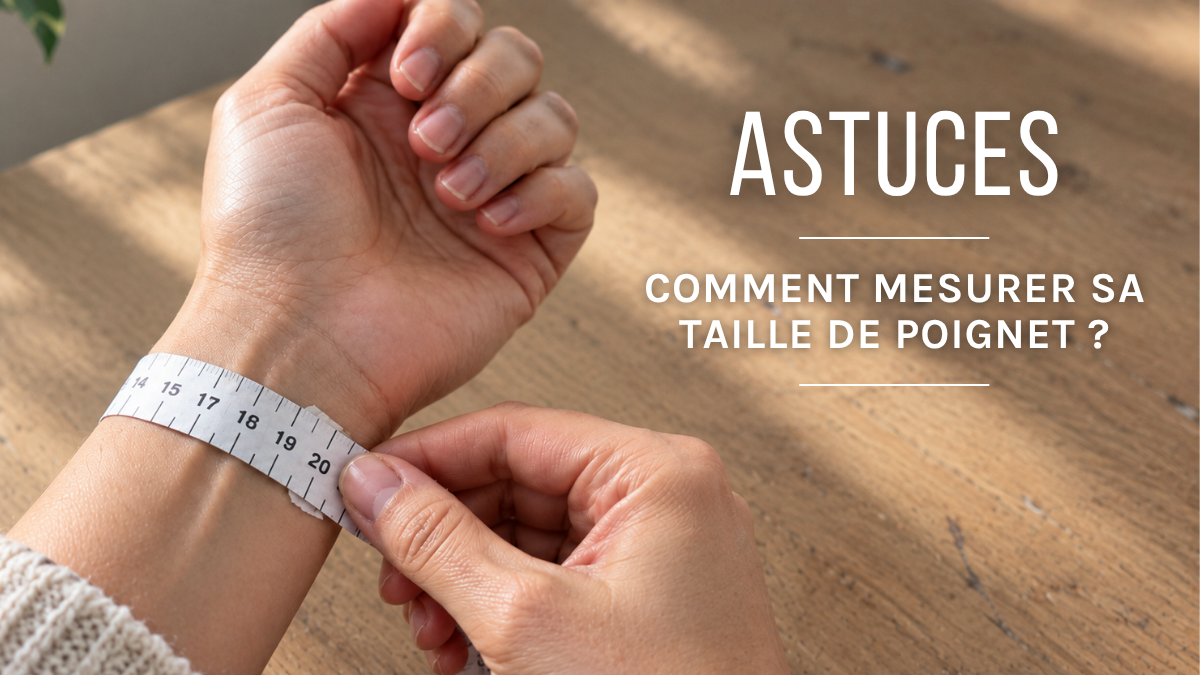
A set of rings used to measure the circumference of a finger.
Baroque
Non-spherical beads with irregular shapes.
Bélière
Pendant attachment, a more or less elaborate ring used to suspend a medallion, pendant, etc.
Breloque
Smaller than a pendant and larger than a sequin, the charm is a jewelry component for hanging from a necklace, chain, bracelet, earrings, anklet or ring.
Brick stitch
A weaving technique performed with a needle, without a loom. Beads are woven horizontally in a staggered pattern.
Brucelles
Specific tweezers for catching small parts or beads.
Cabochon
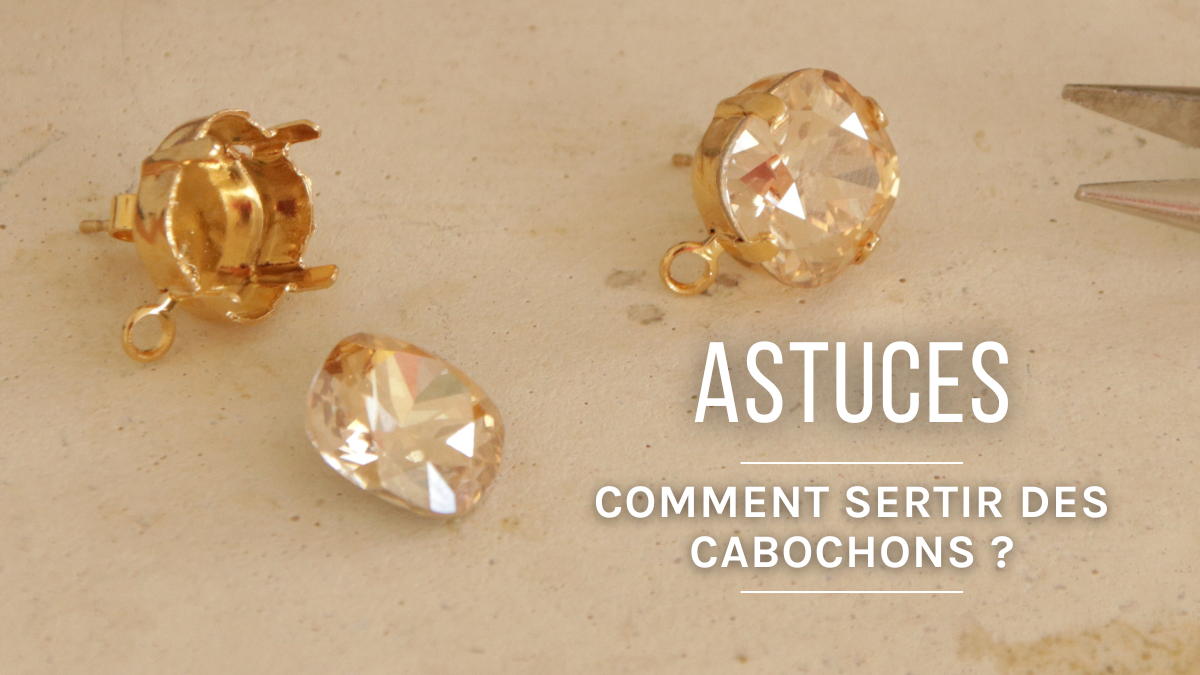
Size of a polished gemstone. It usually has one flat side and one domed side. It can be oval, round, pear-shaped, teardrop-shaped, triangle-shaped or teardrop-shaped. It can be crimped or glued to a support.
Crushable pearl cover (or knot cover)
Used to hide crush beads and unsightly knots in your costume jewelry settings. You'll be able to create professional-looking jewelry in no time at all. It's very easy to use: simply close it over the bead to be crushed, using a crushing bead pliers.
Cameo
A low-relief engraving technique applied to a shell or fine stone. Characters stand out against a lighter or darker background. It has been a jewelry classic since Antiquity.
Cane
Assembly of several pieces of polymer clay. They have been pressure-welded together to create a strand of paste, in the center of which a motif has been placed. To use, it must be sliced.
Carat
Unit of weight for precious stones and gold. 24-carat gold is pure gold.
Candlestick
A piece of metal, designed to hang from a necklace, studs or ear hooks. Adorn it with pearls, charms, small pendants...
Chocker
A necklace worn at the base of the neck. Very popular in the '90s, it's back in fashion today.
Clip
The earring for those who don't have a pierced lobe. The lobe is "clamped" between a support and a fastener fitted with a rubber pad.
Stud
This jewel-primer is also called a "stud". It can have a flat head, a round head, a ball head or it can be a nail with a fancy head.
Ear studs
This is the most common type of earring. Ultra-light and discreet, they feature a stem that is held in place with a butterfly clasp. Because of their small size, they're also known as "ear chips".
Connector
Another name for the spacer.
Cup
Metal pieces used to separate pearls or to decorate a pearl. It may also be called a "cap".
Creoles
These are the oldest type of earrings. They consist of a round or semicircular hoop. They come in all shapes and sizes: heart, rectangle, triangle, oval...
Ear hooks
Ear hooks are claspless posts that cannot be used on their own. The ear hook is always fitted with a ring for hanging all kinds of things, such as pearls, feathers, pompoms, chains, pendants...
Cubic Zirconia (or zirconium)
A beautiful, flawless, durable synthetic stone that's far less expensive than real diamond. It is very popular as a diamond substitute, thanks to its hardness and magnificent rainbow-colored reflections.
Donut
This is a pendant, very often made of gemstones. It has a large hole in the center for a chain or lark's bow cord.
Sleepers
These earrings were designed to be worn while sleeping and without injury. In the past, it was thought that the piercing hole could close during the night.
DIY
These are the initials of "do it yourself". It means "do it yourself".
Estampe
A piece of metal cut and shaped between two dies to produce a relief pattern. The stamp can be decorated with wires, pearls, rhinestones, etc.
No content for this part
Galvanizing
The action of coating a metal with a layer of another metal.
Gems
Name given to natural stones, whether precious, fine or ornamental. To qualify as a gemstone, the stone must be derived from a mineral, rock or organic material. It must also meet specific criteria such as size, color, transparency and hardness.
Gold-Filled
A jewelry-making technique that originated in the United States. It consists of applying a 14K gold finish to a base metal (usually brass), by mechanical pressure or hot-application. The weight of gold corresponds to 1/20 of the total weight of the product.
Engraving
A decorative technique involving the removal of material, widely used in jewelry.
Griffe
Metal stem of a setting. They hold and enclose the stone.
Heishi
These are flat, disc-like beads. They can be made of shells, synthetics, wood, gemstones, metal, polymer clay... These beads can be worn by both men and women.
Herringbone
A weaving technique used to weave beads at an angle. It is also known as "slipper stitch".
Inclusion
An impurity contained in a gemstone, such as trapped air bubbles, crystal, another gemstone, plants and even insects. The term is also used when adding dried flowers, resin elements, microbeads or flakes to resin.
Spacer
As the name suggests, this is a jewelry primer that is inserted between two components of a piece of jewelry, between two pieces of chain, between two cords or between two macramé wires.
No content for this part
No content for this part
No content for this part
Macramé
A traditional braiding technique involving the successive knotting of a thick cord or rope. Used for decoration and hammocks.
Precious metals
Gold, silver and platinum
Non-precious metals
Brass, Aluminium, Steel, Bronze, Copper, Pewter, Titanium, Zinc, Cobalt, Lead.
Micro-macramé
This variant of macramé uses the same knots, but with finer wires. That's why it's used more for jewelry-making.
Millefiori
Italian for "thousand flowers". Millefiori is a technique for making glass mosaics.
Miyuki
Famous brand of Japanese seed beads, ideal for bead weaving.
Mother-of-pearl
Inner coating of certain shells. Thanks to its unique iridescent reflections, mother-of-pearl is highly prized in the world of jewelry and decoration.
Opalescence
The milky transparency of certain gemstones such as Moonstone, Opal, Rose Quartz and Chalcedony.
Polymer clay
PVC-based modeling paste that hardens after baking. There are several types, including Fimo, Cernit, Sculpey and Ceralun.
Beading
The art of attaching beads to one another by threading them with a sewing or beading needle and thread. The term is widely used in embroidery and sewing. More broadly, it refers to any DIY activity involving beads.
Kashmir beads
Beads made entirely by hand. On a metal support, the craftsman creates a base composed of a mixture of polymer clay and resin. The beads are then decorated with mini glass beads, metal elements, sequins...
Freshwater pearl
A fine pearl that forms naturally in freshwater mollusks, without human intervention, unlike traditional seawater pearls, which require a small particle to be embedded inside the pearl shell. Freshwater pearls are 100% mother-of-pearl.
Peyote
Loomless pearl weaving technique. It allows pearls to be woven in a staggered but vertical pattern.
Vernier caliper
Instrument for measuring height, inside and outside diameter, hole depth and thickness of small objects.
Precious stones
Diamond, Sapphire, Emerald and Ruby
Fine gemstones
These are natural stones (also known as gemstones). In the past, they were grouped together under the name "semi-precious stones".
Jewelry pliers
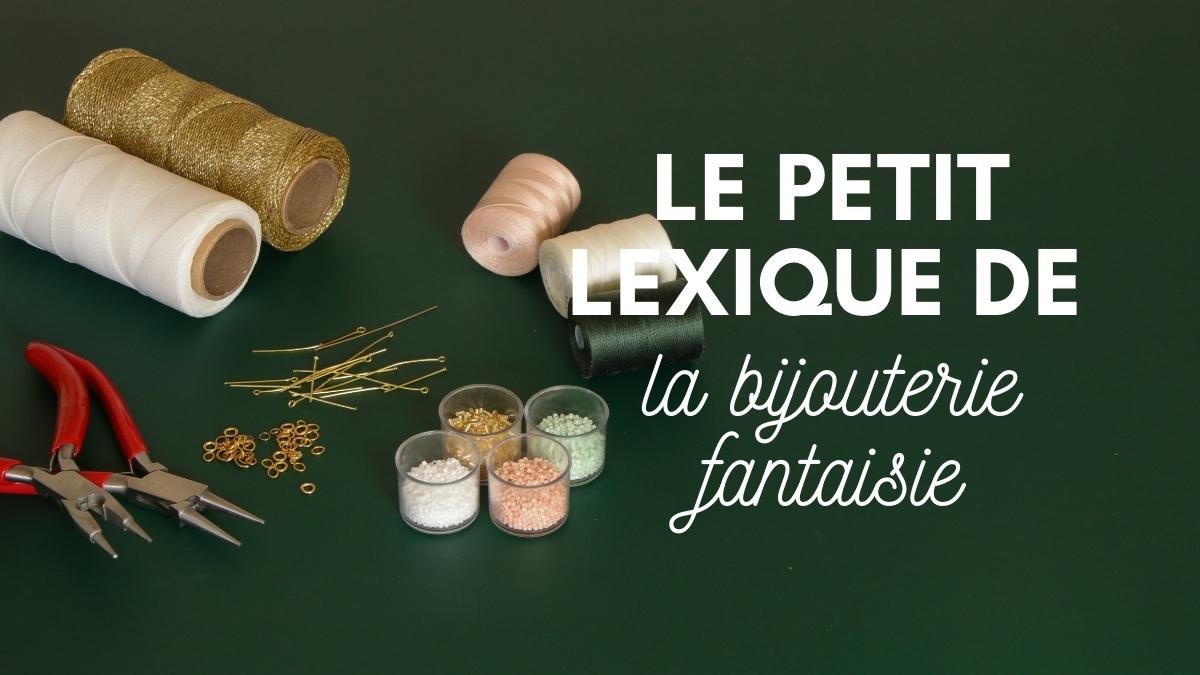
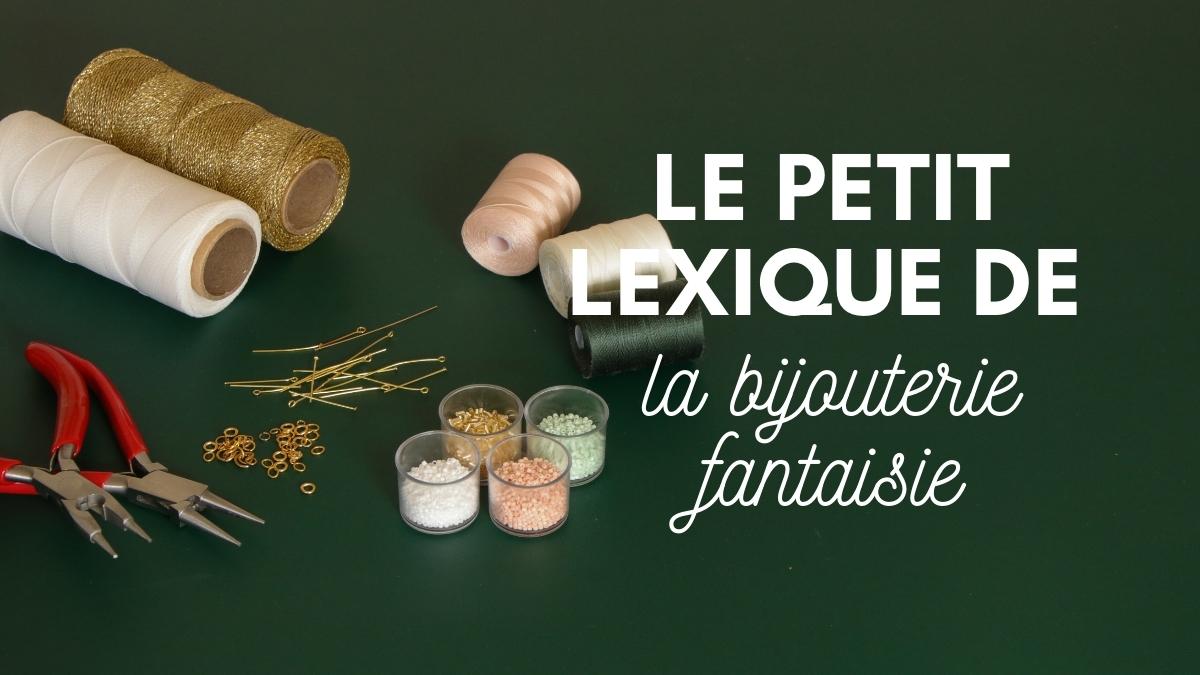
These are the essential tools for creating jewelry. There are many different types for many different purposes. But if we had to choose just three, they would be cutting pliers, round-ended pliers and flat-nose pliers. These three basic pliers are ideal for beginners.
Gold plating
The coating of a metal with a thin layer of gold. In France, a thickness of 3 microns is mandatory for the term "gold-plated" to be granted.
Hallmark
Metal tool used to engrave a pattern on metal, wood or leather. The hallmark also designates the tool used to mark precious metals: the master hallmark, the responsibility hallmark and the guarantee hallmark.
Polishing
The technique of polishing, i.e. making a part smooth and shiny.
Pyrography
A technique that uses a pyrography iron to burn a pattern into an object made of wood, leather, ivory or bone.
Pigtail
A strong, practical loop formed on a nail or jewelry pin. It's so called because the wire is twisted (like a pigtail) between the pearl and the loop. It's used to hang beads, create charms, pendants, spacers or dangling earrings.
Rocaille
Small glass beads known since the dawn of time. They are used to create DIY costume jewelry, decorative objects and customize accessories and clothing. Their shape is very popular for bead weaving.
Scrapbooking
This name comes from the English word "scrap" and "book". Scrapbooking is all about putting photos together in an album, frame or box, according to a theme. To decorate the images, anything goes: collage, drawing, painting, commentary, stamps, stickers... Also known as "Creacollage" or "Collimage".
Set
A jewelry technique that sets a stone on a bezel. There are different setting techniques.
Sequin
A component for hanging jewelry. It is smaller than a pendant or charm. Very often, unlike a charm, a sequin does not have a ring to pass a chain or cord through, but does have a hole.
Silk screen
A stencil for printing patterns on polymer clay. The same technique is used as for screen printing on fabric.
Stacking
Accumulation of several pieces of jewelry of the same type. Trendy for necklaces, rings and bracelets.
No content for this part
No content for this part
Dichroic glass
Dichroic glass is made by multiple fusions of different metals (titanium, chromium, aluminum, zirconium, magnesium or silicon) on the surface of the glass, creating various reflections of reflective colors, depending on the viewing angle.
Wrap
A technique consisting of two cords between which pearls, stones and many other elements are attached. Wrap bracelets can be single or multi-turned.
Wire-wrapping
Technique of wrapping metal wires around a support such as gemstones or pearls, creating simple or complex patterns.
No content for this part
No content for this part
Zamak or Zamac
Acronym for the alloy Zinc (95%), Aluminium (4%), Magnesium (approx. 0.03%), Copper (approx. 1%). Its melting point is around 400°C. Easy to work with, it is ideal for die-casting, as it has excellent fluidity. It is more resistant than most plastics, but less so than ferrous alloys.
Zircon
This natural gem is renowned for its brilliance. It comes from a mineral called zirconium silicate. It comes in many colors: blue, pink, yellow, green, orange, red, fuchsia, pink... It can also be crystal-colored. Its brilliance and transparency make it look very much like a diamond, and it can be used as a substitute for diamonds in jewelry. This is why it is sometimes mistakenly called "synthetic diamond". It should not be confused with zirconia (also called zirconium oxide or zirconia), which is an artificial stone.

Credits
Perles & Co, Internet & E-Commerce company [06/12/2021] Any reproduction, representation, adaptation, in any form whatsoever, even partial, is prohibited, except for reproduction for private use not intended for collective use, representation in the family circle (art. L 122-5 CPI) and online publishing on condition that the source is mentioned and a link is included to the corresponding page of our site www.perlesandco.com.