Average Grades
Free shipping on orders over 50€ up to 500g
French Online shop for beads and accessories for the creation of DIY jewellery and other creative hobbies
Log-in
0
Shopping cart
Shopping cart

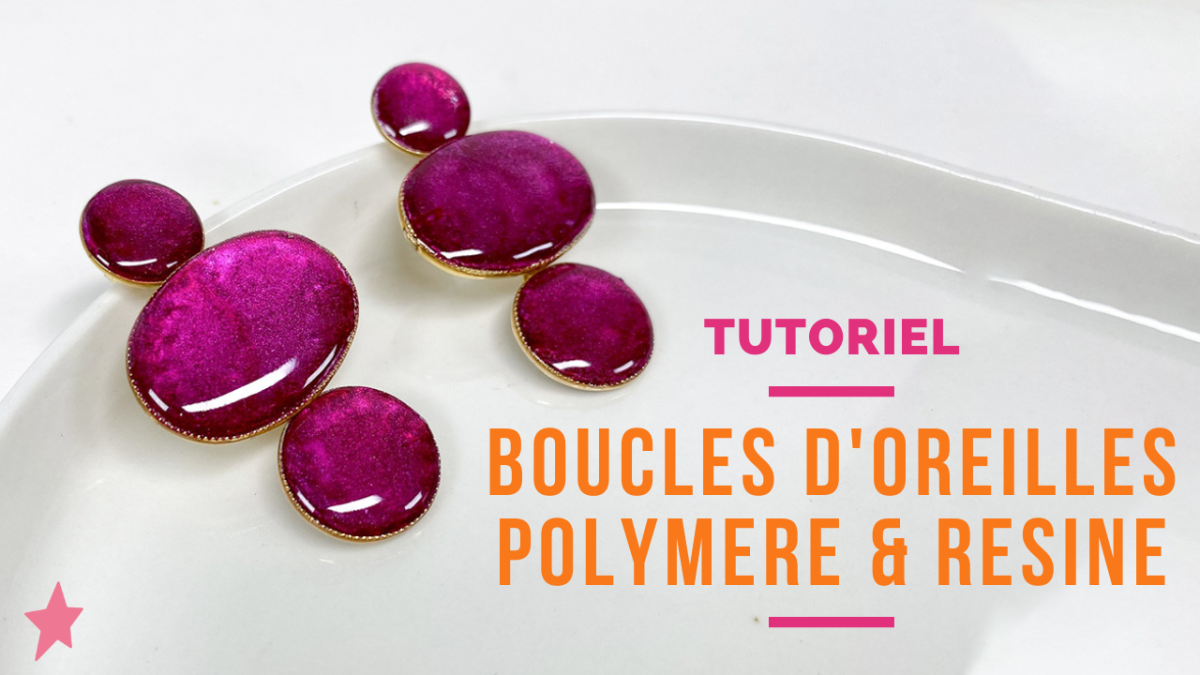
Do you know how to imitate wax fabrics with polymer clay? Follow our step by step to make these African and colorful earrings.
Step 1
Take 3 bars in a white bread, condition your dough by passing it several times in the dough machine. Make a plate with the thickest notch. Take 2 bars in a blue bread roll, pass them to the machine go down to the finest notch. Using a roller to remove the air, place the blue plate on the white plate.

2nd step
Cut several threads into a 1mm waxed spool. Place your threads on the blue paste, pass the roll to push them.

Step 3
Put new threads on the dough and then roll the roll, be careful not to accumulate too many threads on the dough because by removing them they may tear your plate, it must be done little by little.

Step 4
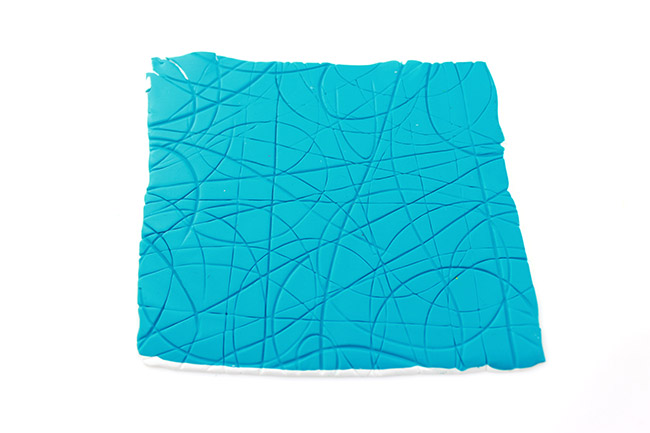
Remove all the threads, you can roll the roll over and reduce the dents.
Step 5
Work with a flexible blade by bending slightly you will come to scalp the blue paste until reaching the level of the white paste. This technique is called a Sulton slice or it is about scalping the textures of a paste. Here is about the same difference that we are not going to make the precision. For the wax effect we need to see the remaining blue areas (we do not scalp everything), we need to see also these blue features that appear on the white.

Step 6
Your plate now has a damaged surface, so it must be smoothed. Put baking paper on the dough and then roll the roll or a card by making small rotations to not push a specific area.

Step 7
With yellow paste and brown paste, make two plates in the dough machine of the same thickness as the blue one. For that you just have to put your pasta side by side to realize their thickness.
Take a 4 cm cookie cutter and remove from the round two round dough.

Step 8
Take another 3cm cookie cutter, take two rounds smaller in a symmetrical pattern from the blue circles. With the same cookie cutter, take two more rounds in the brown plate to place them in the big blue circles. You must put aside the 2 pieces of blue pasta taken with the 3 cm cookie cutter. We do not completely leave the brown circles we take the cookie cutter to leave only a thin slice of brown plate, made finer than in the photo this step will be later modified.

Step 9
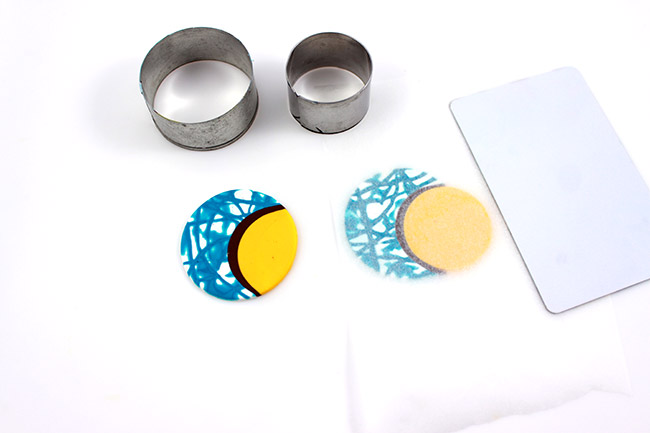
In your yellow plate take two rounds of 3 cm. Place them next to the brown band. Take the 4 cm cookie cutter to reform a round with these 3 colors.

Step 10
It is now necessary to solder the pasta together with baking paper as you already did in step 6 to smooth the dough. If your shape is a little enlarged you can rectify it with the cookie cutter.
Step 11
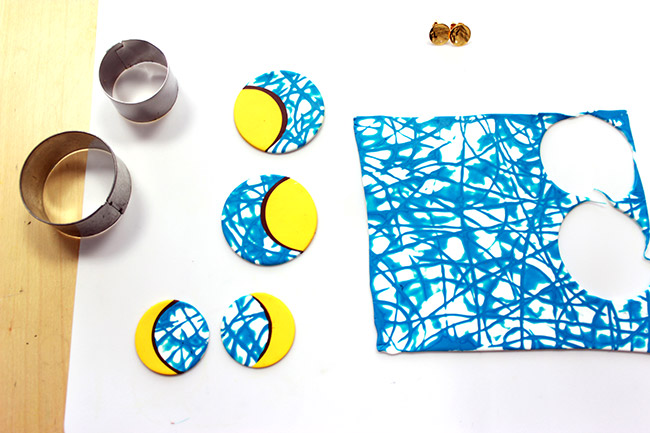
Take the blue falls that you have set aside to do in the same principle as the large loops, the smaller ones.
Step 12
Take two other large circles from your blue plate and put them on the back of the already worked rounds. Lightly roll the roll so that no air is trapped between the 2 rounds.

Step 13
Take the smallest cookie cutter to remove a portion in each large round. Be careful to work symmetrically with respect to the second loop. Book your little rounds.

Step 14
You still have to make 2 smaller circles in the blue plate with a 12 mm kemper punch. And with the smallest cookie cutter in the series you can remove two other rounds for smaller loops.

Step 15
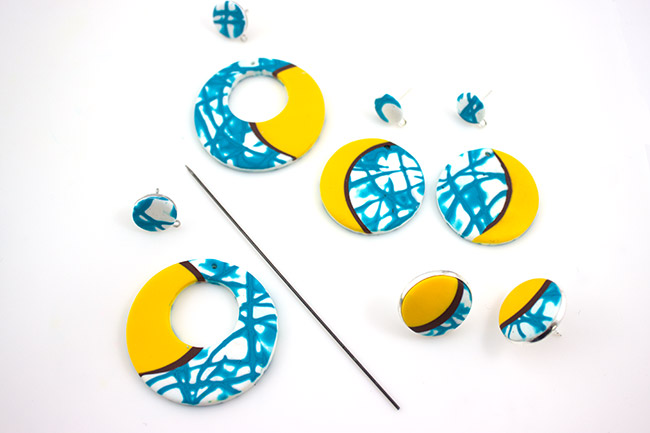
Drill a hole for each big earring with a needle. Place the smaller loops in a cabochon stud earrings holder. Make a bake of all your pieces at 120 degrees for 30 minutes the ear studs cook in their support.
Step 16
Remove the round of small loops then put some Hasulih glue before repositioning them. Also stick your ear studs on their support. Place rings to connect the other two pairs of earrings to their studs.


Have fun making plates of all colors to vary your creations.




You have a question about this tutorial? Ask it to our team and the people who have already tested it. The Perles & Co community is here to help you!
Credits
Perles & Co, Internet & E-Commerce company [30/04/2018] Any reproduction, representation, adaptation, in any form whatsoever, even partial, is prohibited, except for reproduction for private use not intended for collective use, representation in the family circle (art. L 122-5 CPI) and online publishing on condition that the source is mentioned and a link is included to the corresponding page of our site www.perlesandco.com.

