Free shipping on orders over 50€ up to 500g
French Online shop for beads and accessories for the creation of DIY jewellery and other creative hobbies

Log-in

Polymer clay jewellery with a graphic pattern made of Fimo threads

Made by :Karine Barrera
Published on the :28/12/2020
Time :2h
Level :Easy
Prices :11,14€

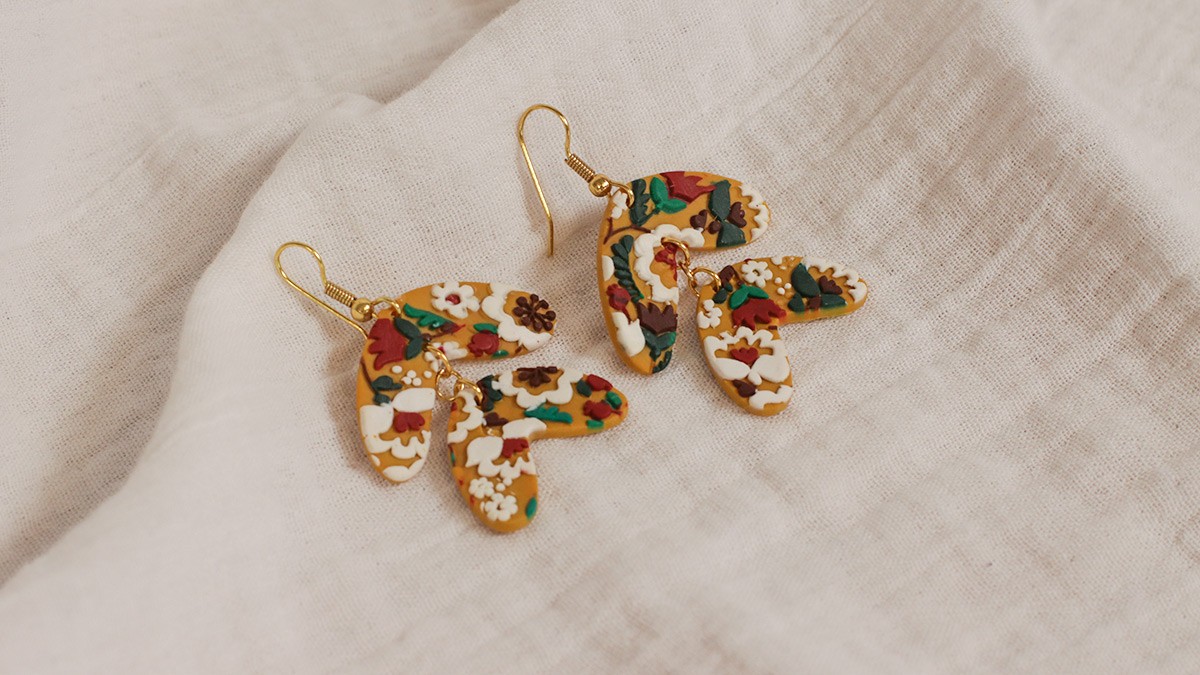
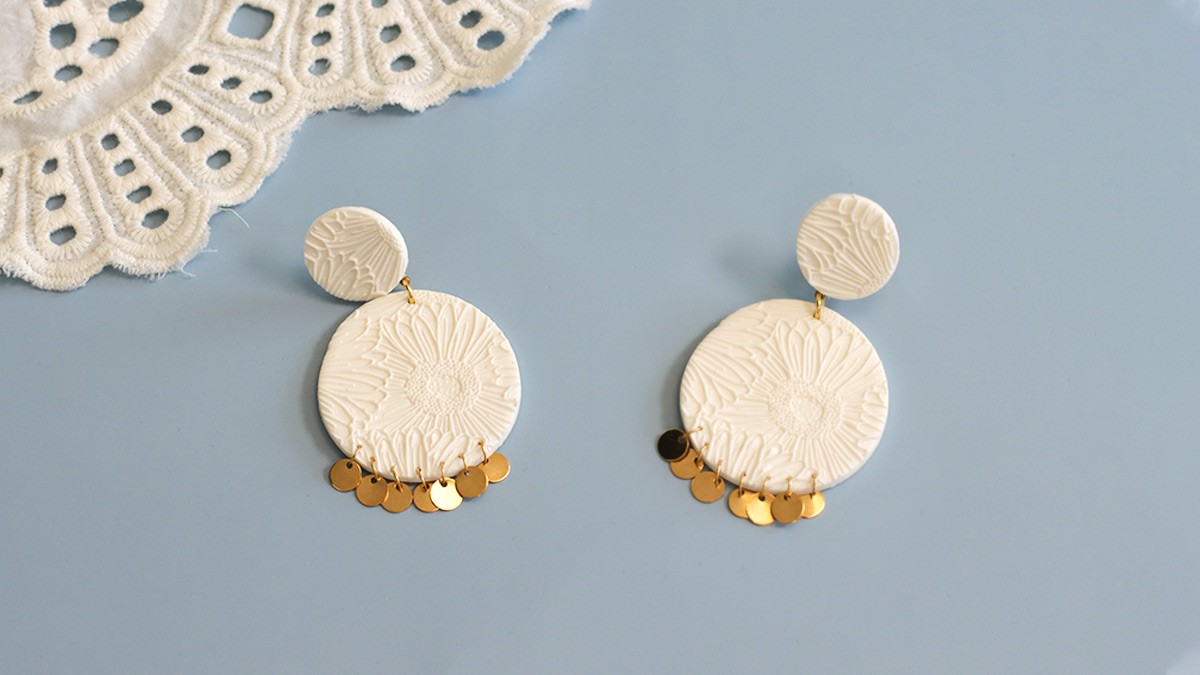
Make a trendy pattern on your polymer clay jewellery by extruding clay to obtain Fimo wires that will make up the decoration by placing them on a clay plate. This gives a very small relief of white threads that contrast with the coloured background, giving a graphic and urban style that matches the textile collections of the moment.

This video tutorial is primarily for beginners, it can be a first project of polymer creation because it does not require much technique, you must however equip yourself with an extruder to have threads of identical diameters.

Tutorial steps

Step 1

Prepare a polymer sole plate (which will be the working base for the design to be created) by passing it through a medium notch of the dough machine, pass it several times by folding it over itself and in the same direction in the MAP so that it does not contain air and does not deform during cooking.
Step 2

Take 2 bars from a white dough loaf, roll them on a support to obtain a white cylinder. You can scrape the surface of your cylinder with a blade to remove the dirt stuck on the white. Insert the dough into the extruder, place a disc with 19 tiny holes in the thread opposite the crank handle. Turn the crank to extrude the wires.

Step 3

Place a first wire on the plate, bending it. Place a sheet of baking paper on the surface and then gently roll it over to weld the pasta but without flattening it too much. Continue to place the threads as you wish.

Step 4

Place your template on the dough choose your design, cut out your shape with a cutter, start again to make the second shape, don't forget to cut out small drops to create the ear studs. Smooth the edges of the pieces with your fingers then bake at 120 degrees for 30 minutes.

Step 5

Sand with 1000 grit abrasive under lukewarm water the edges of the pieces and their backs so that your jewellery is not angular and is soft to the touch. Drill a hole in all the pieces with a hand chuck and then mount your earrings by passing a 5 mm ring between the two parts. Glue your ear studs to the back of the small drops (tip to make sure it never comes off you can glue your primers with epoxy resin either the inclusion or the topping).

Result
Schema  Polymer clay jewellery with a graphic pattern made of Fimo threads
Karine Barrera
 Karine Barrera - Les tutos de karine
Bonjour, je suis karine créatrice chez Perles and co, je suis en charge du développement du rayon polymère et résine. De part mon caractère passionné, je suis toujours partante pour tester de nouvelles techniques et vous les transmettre.
Associated keywords
Techniques
Matières
Couleurs / Effets
Niveau de réalisation
Pour qui ?
Share with my friends
Which material to use ?
Please note that the quantities of the suggested equivalents are not necessarily exact. You can adjust them in your basket.
Supplies
Fimo Soft Polymer Clay 57gr White (n°0)
FIMO-000
Qty : 1
197 in stock
2,20€
Jewel Glue Hasulith 30ml
OUTIL-007
Qty : 1
5549 in stock
2,40€
Flat pad earstuds 8mm fine Gold plated x4
3,00€
Polymer Clay Fimo Professional 85gr Ochre (n°17)
3,30€ 2,64€
Round jumprings open 5x0.8 mm Gilded with fine 24K x25
0,90€
Suggested reference for this article:
5x0.8mm Round open rings - Gold Tone x25
0,90€
Subtotal : 8,50€
Please note that the quantities of the suggested equivalents are not necessarily exact. You can adjust them in your basket.
Tools
3 blades set FIMO Cutter x1
OUTIL-068
Qty : 1
11 in stock
12,50€
Clay Gun set Makin's Clay 20 design tips x1
30,90€
Cutter and 7 precision blades
OUT-991
Qty : 1
Out Of Sotck
5,60€
Suggested reference for this article:
152x100mm Rigid template for polymer clay - Drops patterns x1
6,90€
Subtotal : 25,90€
Your questions (3)

You have a question about this tutorial? Ask it to our team and the people who have already tested it. The Perles & Co community is here to help you!

By Claire (31/07/2023 17:55:10)
Bonjour, je viens de sortir du four les formes... Elles étaient très jolies avant la cuisson mais en les sortant, le blanc a perdu toute sa blancheur :-( Ce n'est plus du tout aussi beau. Comment cela se fait-il??? 1000 mercis d'avance pour réponse.
Translate the question
Please log in to use this feature
Our Lucie T. expert answers you (29/08/2023 16:50:22)
Bonjour, pour ne pas perdre la blancheur de la pâte, vous pouvez attendre 5 mn de cuisson et ajouter un papier sulfurisé. En espérant vous avoir aidé. Belle création
Translate the answer
By Anonyme (27/05/2022 10:19:05)
Bonjour :) La taille indiquée des anneaux ronds ouverts (5 x 0.8 mm) est beaucoup trop petite en ce qui me concerne. J'hésite à acheter la taille supérieure ou du fil en laiton pour être sûre de ne pas me tromper. L'épaisseur de mes pièces font 3 à 4 mm. Qu'en pensez-vous ?
Translate the question
Please log in to use this feature
Our Lucie L. expert answers you (30/05/2022 16:39:18)
Bonjour Marie,

Il est en effet possible que le diamètre des anneaux ouverts diverge un peu selon vos pièces et l'endroit du trou. Le fil de laiton peut aussi être une solution mais je crains qu'il soit plus malléable et que vos anneaux se déforment plus facilement. Cependant c'est une bonne option pour faire des anneaux de toutes les tailles.

J'opterai plutôt pour des anneaux plus gros. Compte tenu de l'épaisseur de vos pièces (3 ou 4 mm) ce qui est assez plutôt épais pour des pièces en polymère j'opterai pour des anneaux en 7 ou 8mm minimum.
Translate the answer
By Joanna (23/07/2021 14:04:03)
Si on fixe le clou d'oreille avec le resine uv ou halusith ca ne tiendra pas ?
Translate the question
Please log in to use this feature
Our Lucie L. expert answers you (26/07/2021 09:44:36)
Bonjour Joanna,

Vous pouvez également fixer votre clou d'oreille avec l'une de vos deux propositions : résive UV ou colle Halusith conviendront égalemen très bien. Bonne création :)
Translate the answer
Your reviews (0)
Notices subject to control
Please log in to use this feature

Credits

Perles & Co, Internet & E-Commerce company [28/12/2020] Any reproduction, representation, adaptation, in any form whatsoever, even partial, is prohibited, except for reproduction for private use not intended for collective use, representation in the family circle (art. L 122-5 CPI) and online publishing on condition that the source is mentioned and a link is included to the corresponding page of our site www.perlesandco.com.