Average Grades
Free shipping on orders over 50€ up to 500g
French Online shop for beads and accessories for the creation of DIY jewellery and other creative hobbies
Log-in
0
Shopping cart
Shopping cart

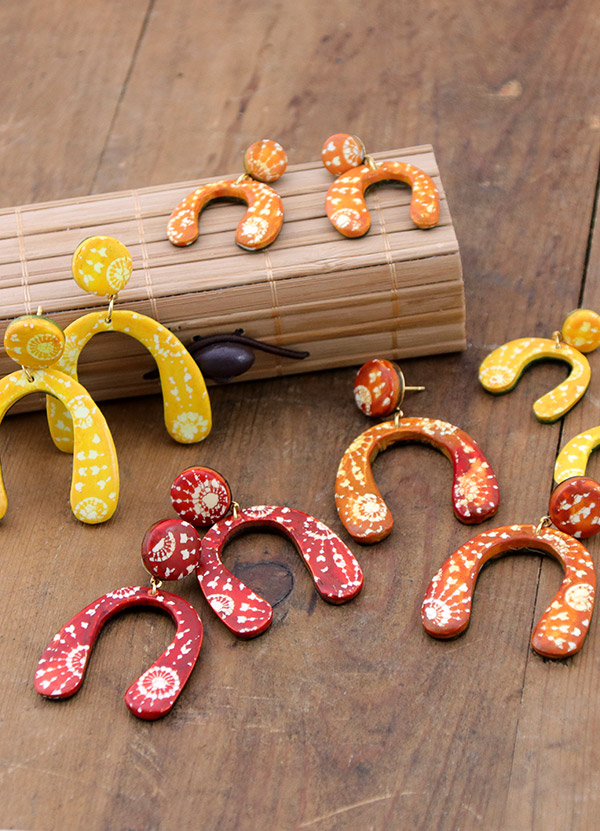
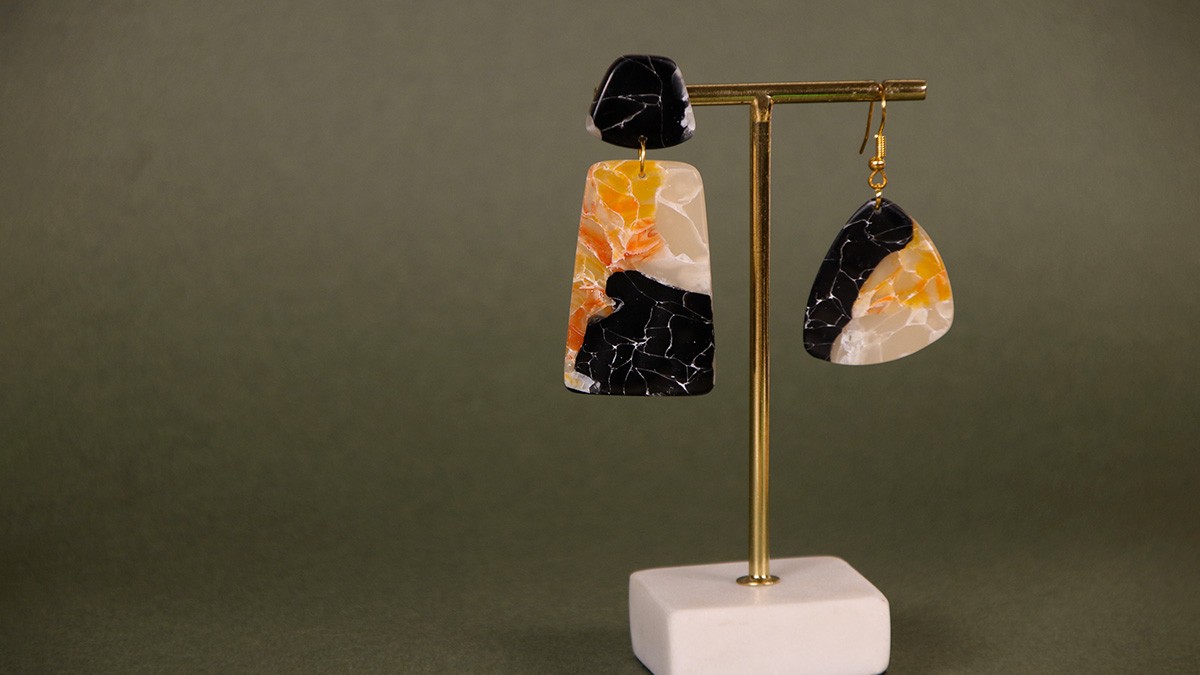
Have you ever used polymer clay jewelry with a batik effect? We offer you a step by step to get this effect on earrings. The technique of batik on polymer clay is borrowed and adapted from an old traditional technique of printing on fabric that is practiced in Asia and Africa. The wax is then replaced by gouache thus preventing the ink from tinting its covered parts. Let yourself be tempted by this project the result is beautiful and the path is more fun.
Step 1
Take half a loaf of white dough and then package it by passing it through the widest dough machine so as to obtain a plate. Put your silkscreen upside down on the dough then roll the surface. (The sikscreens of other brands such as Moiko are not placed on this side but in front of you, the orange screens are exceptions.) Spread gouache paint tape on the width of a card and then spread it on the entire surface of the screen printing screen. Remove the silkscreen immediately and wash it.

2nd step
Let your gouache dry well on the dough for 10 minutes. Make a second plate of black paste that you will pass to the MAP a notch not too fine, this will be the back of the jewels. Put your white plate on the black then gently roll the roller on the set. Put on your plate your primers that will serve you as templates. Cut out all the contours with a precision cutter.

Step 3
Cut out in the same plate thanks to two round cutters of 9 and two of 13 mm per pair of earrings. Use film paper between the dough and the cookie cutter to obtain rounded circles. You can also put this same paper on the other bridge-shaped pieces to press with a finger on the edges and break the right angles. You can using a needle to pre-pierce your curls.
Cook in a traditional oven at 120 degrees for 30 minutes.

Step 4
You can now, before coloring your pieces, use 800-grit sanding paper to work the edges of your pieces, but without using water that could cause the gouache patterns to leave.
Pour ink into a jar, dip a large brush and then cover all the surface of your curls without forgetting the small circles. You can make shades of colors by dipping another brush into another ink and spreading it as quickly as possible to the place you want, do not wait until the first ink is dry on the contrary.

Step 5
Wait 5 or 10 minutes for the ink to dry and then soak your parts in warm water. It must be done one after the other by leaving them 2 minutes in the water then gently with the fingertips rub the surface, you will see the gouache dissolve letting appear white at these places. Dry your pieces in a cloth.

Step 6
Drill all your pieces except the rounds with a hand mandrel. The wick of your forest should not be too thin it is necessary that the ring that we will pass later has a little game.

Step 7
Put a dot of glue on all the discs of the ear studs and place your polymer rounds under each other well press each round. Wait for the glue to take well at least 2 hours before handling your curls. Pass a ring in each bridge then connect it to the ring of the studs.
Small tip , you can remove all metal butterflies from your ear studs and replace them with silicone pushers. The pressure surface is better distributed and you will feel less the weight of your curls. It also allows you to exert less pressure when the earrings are removed from your ears which could gradually cause the glue to come off.





You have a question about this tutorial? Ask it to our team and the people who have already tested it. The Perles & Co community is here to help you!
Credits
Perles & Co, Internet & E-Commerce company [20/08/2019] Any reproduction, representation, adaptation, in any form whatsoever, even partial, is prohibited, except for reproduction for private use not intended for collective use, representation in the family circle (art. L 122-5 CPI) and online publishing on condition that the source is mentioned and a link is included to the corresponding page of our site www.perlesandco.com.
