Free shipping on orders over 50€ up to 500g
French Online shop for beads and accessories for the creation of DIY jewellery and other creative hobbies

Log-in

Agate: Meaning, origins and properties

Made by :Pauline Perles Co
Published on the :17/11/2025
Agate: Meaning, origins and properties
In summary

Agate, renowned for its diversity of colors and patterns, is ideal for creating unique jewelry. Its main deposits are in Germany, Australia and the USA, and its varieties include red, blue, green and many others. Choose the agate that best suits your style and give free rein to your creativity.

Agate is appreciated in jewelry for its incredible palette of colors and numerous patterns.
Take a look at our agate jewelry components and create beautiful natural stone jewelry without limits, inspired by our tutorials.

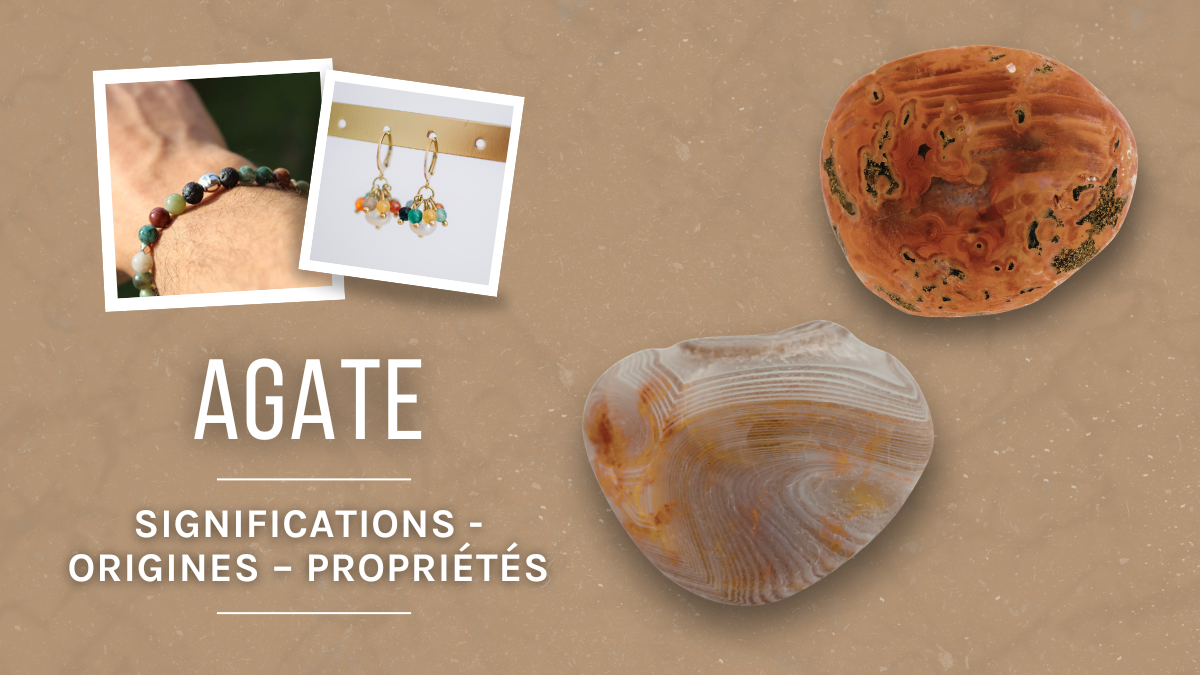
agate rouge

What does "Agate" mean?

The name of this natural stone comes from the Achates River (now the Dirillo River in Sicily), where it was first discovered in large quantities.

The origin of agate

For many civilizations, this fine stone is associated with gods and goddesses. In Greek mythology, it symbolized Gaia, the primordial goddess of the Earth, considered the mother of all creation. The Romans associated it with Aurora, the goddess of dawn. For the Celts, agate represented Ceridwen, the Welsh goddess of death and fertility.

As far back as antiquity, the Romans and Greeks used agate to make jewelry such as rings and bracelets, as well as ornaments and decorative objects like vases and receptacles. Greek legend has it that King Mithridates the Great possessed over 4,000 vessels made of agate.

What are agate's properties?

Agate is a stone with a hardness of between 6.5 and 7 on the Mohs scale and a density of 2.6.

What colors does agate come in?

This fine stone (formerly known as a"semi-precious stone") comes in many shapes, patterns and colors (white, green, gray, blue, pink, red, purple, brown, black... and even multicolored). Its striped or speckled appearance is due to the presence of tiny crystals.

Agate is easily tinted to offer a wide range of colors not found in nature.

agate du Botswanaagate rougeagate indienne

What are the different types of agate?

  • Red agate: owes its red or orange color to the presence of iron oxide in its composition.
  • Blue agate: with several shades of blue, from light and translucent to deeper and more opaque, it owes its blue color to the presence of mineral impurities.
  • Gray agate: its color ranges from light, pale gray to a darker, almost black shade.
  • Green agate: its color ranges from light, translucent green to a deeper, opaque green. Bands and patterns may be present.
  • Black agate: mineral impurities give it its characteristic dark color.
  • Orange agate: its color oscillates between a bright, luminous orange and a deeper, reddish-orange. Also known as sardony.
  • Indian agate: renowned for its diversity of patterns and colors, ranging from white to gray, beige, brown, red, green, blue and violet. They may feature bands, swirling patterns, inclusions or iridescent effects.
  • Tree agate: also known asdendritic agate. It owes its name to specific tree- or vegetation-shaped brown or black inclusions.
  • Moss agate: if you look closely, you get the impression that it contains a small piece of moss.
  • Botswana agate: named after its country of origin, Botswana in Africa.
  • Aagate crazy: this stone features varied, vibrant patterns (stripes, spots, swirls, etc.) and colors (white, gray, beige, brown, red, green, blue, purple, etc.).
  • Purple Lace agate: distinguished by its lace-like patterns and colors ranging from purple to lavender to deep violet.
  • Blue Lace agate: features the same motifs as the previous one, but with a color that varies from light blue to sky blue to pale turquoise.
  • Fire agate: its color ranges from bright red to orange, yellow and golden brown. Its inclusions evoke the movement of flames in a blazing fire.

agate bleue

Where is agate found?

Agate stone is found in many parts of the world. The main deposits are in Germany, Australia (agate with green, yellow, pink or red stripes) and the United States, but it is also found in Brazil, Morocco, New Zealand, Mexico, Botswana, Namibia, Uruguay, Madagascar and China.

What are the benefits of agate?

In lithotherapy, this gemstone is considered a protective and harmonizing stone. It can be used to overcome any kind of energy blockage. It is reputed to balance energies, help calm emotions, regain self-confidence, bring sincerity and reduce stress and anxiety.

Depending on their color, gemstones act on different chakras:

  • Red, black, orange and yellow agates are linked to the root, sacral and solar plexus chakras.
  • Blue and violet agates are associated with the throat chakra and the Third Eye.
  • Green and pink agates act on the heart chakra.
  • Beige and white agates act on the coronal chakra.

How do I recharge agate?

For agate to regain its full energy, it needs to be purified and recharged regularly.
To clean it, soak it in a container of distilled or fresh water with a little salt for a few hours. Then wipe dry with a soft cloth.
The best way to recharge it is to leave it in the sun for a few hours. You can also place it on a quartz cluster or amethyst geode. This works for all agates. However, blue agates prefer moonlight.

How to wear agate

Generally, cool-colored agates are mounted on jewelry made with silver-colored primers, such as 925 silver, stainless steel or rhodium-plated metal. For warm-colored agates, the preferred color is gold, with Gold Filled, 3-micron gold-plated, 925 gold-plated silver, gold-plated stainless steel or 24k gold-plated metal.

In lithotherapy, we recommend combining agates with other gemstones, depending on the desired effect:
- for a stimulating effect: combine a blue agate with fluorite, larimar, apatite, amazonite or aquamarine.
- for a calming effect: combine fire agate with carnelian, citrine or red jasper.

Be careful not to combine them with stones with opposing energies. Avoid, for example, wearing black agate with rose quartz or blue agate with onyx. Putting them together would cancel out their benefits.
But you can, of course, combine them with any stones you like, according to your taste.

bracelet agate indiennecollier perles agate teintée

boucles d'oreilles agate du Botswanacollier Heishi agate

Pauline Perles Co
 Pauline Perles Co - Pauline Perles&Co
Moi, c'est Pauline, je suis assistante SEO chez Perles & Co et depuis mon arrivée, je me découvre une passion pour les bijoux DIY ! Quel plaisir de dénicher la nouveauté qui nous fait craquer et de confectionner des pièces personnalisées..! J'en apprends davantage chaque jour et je partage ça avec vous.
Share with my friends
To go further
Gemstones - What are they?
Howto
Gemstones - What are they?
Howto
Gemstones - What are they?
Howto
Gemstones - What are they?
Howto
Gemstones - What are they?
Howto
Gemstones - What are they?
Howto
Gemstones - What are they?
Howto
Gemstones - What are they?
Howto
Gemstones - What are they?
Howto
Gemstones - What are they?
Howto
Which material to use ?
Agate - Red
Agate - Red
Beads Blue Agate
Beads Blue Agate
Agate components
Agate components
Your questions (3)
You have a question about this sheet? Ask our team and the people who have already tested it. The Perles & Co community is here to help!
By Knada (17/02/2025 21:05:03)
Pourquoi suis je sensible à la pierre d'Agathe ?
Translate the question
Please log in to use this feature
Our Tiffanie expert answers you (18/02/2025 17:25:31)
Bonjour, je suis désolée, nous ne sommes pas spécialisés en lithothérapie.
Translate the answer
By Nass (18/12/2024 12:42:54)
j’ai trouvé une agathe rose qu’est-ce que cela veut dire svp merci
Translate the question
Please log in to use this feature
Our Tiffanie expert answers you (20/12/2024 16:25:27)
Bonjour, si votre question concerne la lithothérapie, je vous conseille de vous tourner vers un spécialiste. Nous ne sommes pas spécialisés sur ce sujet.
Translate the answer
By Vanessa (03/06/2024 14:35:50)
Super 👍🏼 Avez-vous la traçabilité des pierres ? Bonne journée
Translate the question
Please log in to use this feature
Our Laurence T. expert answers you (03/06/2024 15:11:24)
Bonjour,
Le gisement et l'origine de la plupart des pierres naturelles vendues sur notre site sont précisés sur nos fiches produits. Le gisement correspond à l'endroit où la pierre a été extraite.
Translate the answer
Your reviews (0)
Notices subject to control
Please log in to use this feature

Credits

Perles & Co, Internet & E-Commerce company [17/11/2025] Any reproduction, representation, adaptation, in any form whatsoever, even partial, is prohibited, except for reproduction for private use not intended for collective use, representation in the family circle (art. L 122-5 CPI) and online publishing on condition that the source is mentioned and a link is included to the corresponding page of our site www.perlesandco.com.