Average Grades

Puedo combinar rodonita con ojo de tigre?
1 Answer
Show answers

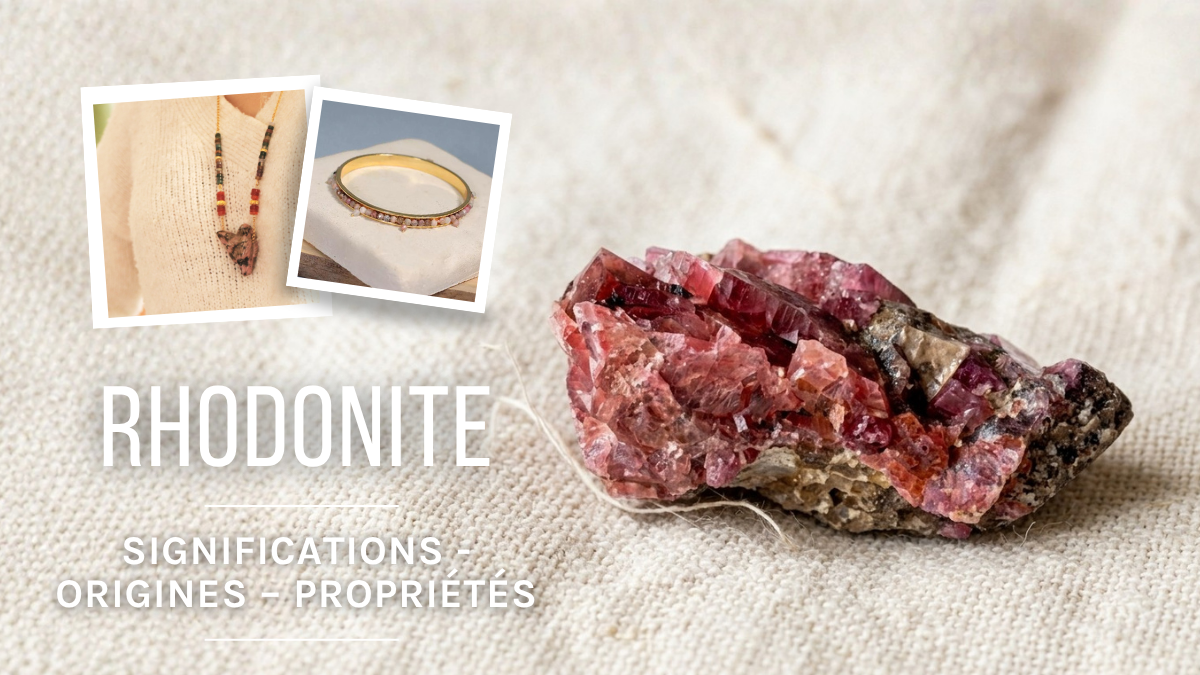
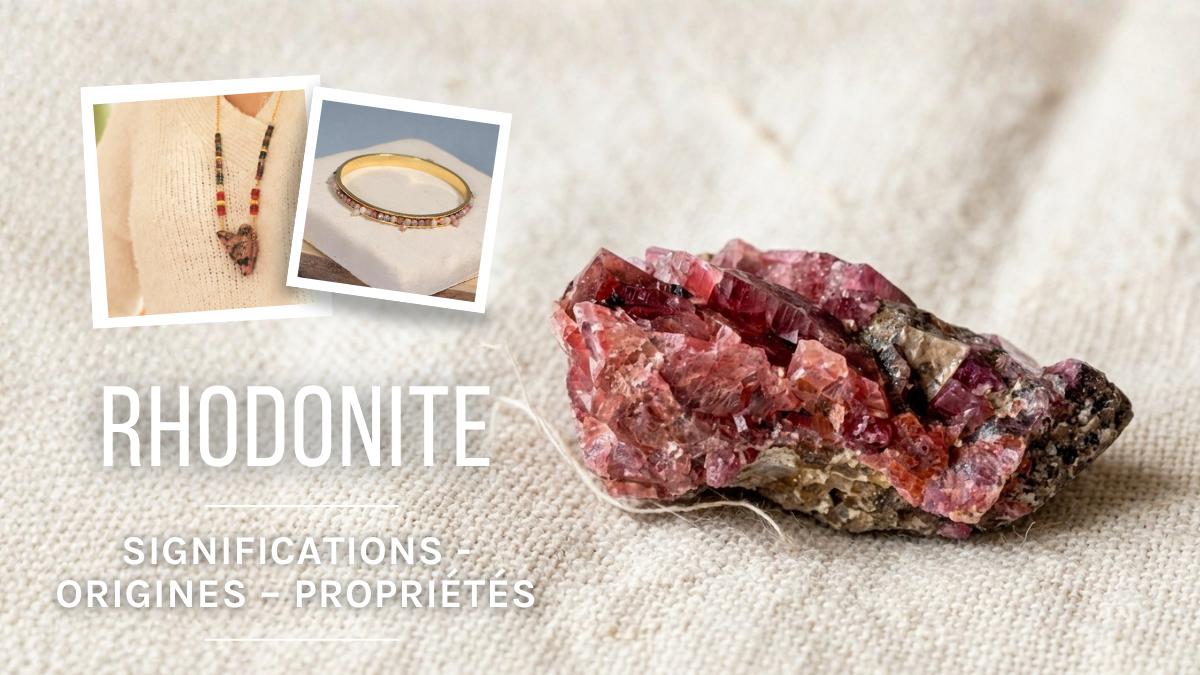
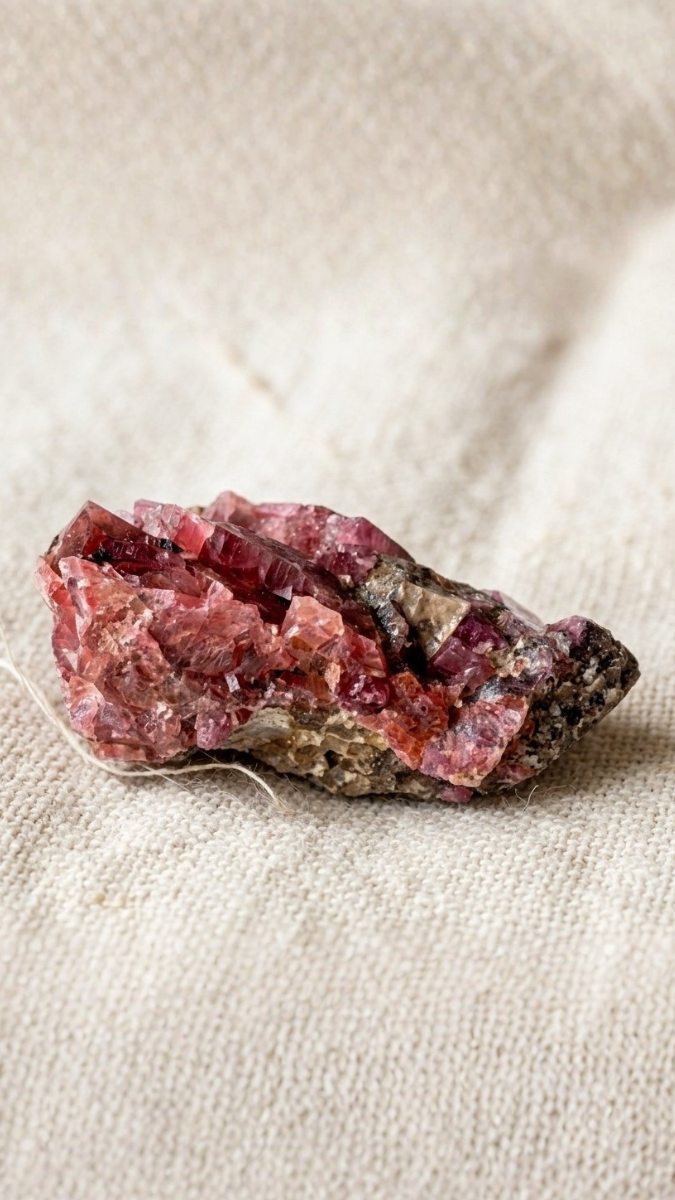
Rhodonite is a light pink to bright red natural stone with black veins, prized for its beauty in jewelry. Its main deposits are found in Brazil, Russia and Sweden. Ideal for creating original jewelry, it is perfect for those looking for an aesthetic and symbolic stone without insisting on its spiritual benefits.
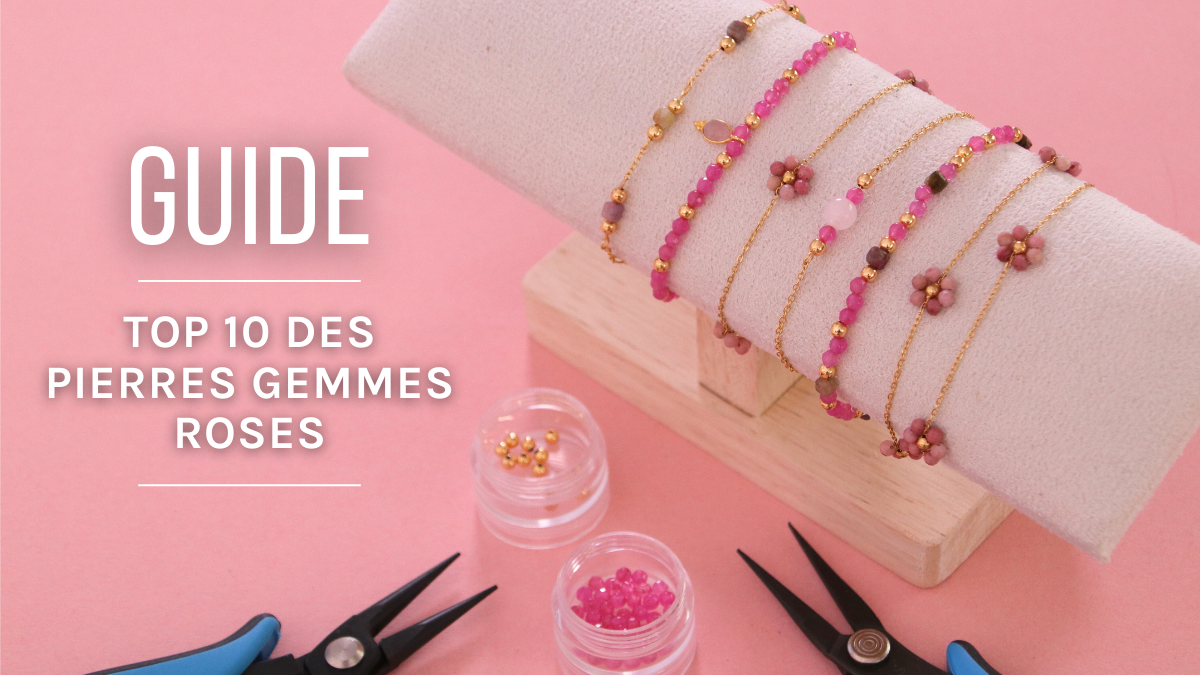
A protective, soothing, balancing, and healing stone, rhodonite is widely used in crystal healing. In jewelry, it is prized for its light pink to bright red color, veined with black. Whether in earrings, a ring, a bracelet, or a necklace, create natural stone jewelry pieces—each as unique as the next—with our rhodonite beads and jewelry findings. Get inspired by our tutorials!
The name of this fine stone (formerly known as a “semi-precious” stone) comes from the Greek word “rhodon,” which means “rose.”
Rhodonite has been known since ancient times. Back then, it was considered a symbol of affection. It was given as a gift to express feelings of friendship.
The Romans and Greeks wore it as a protective amulet to ward off bandits during their travels.
During the Renaissance, it was believedto bring joy, intelligence, and a good memory.
In Russia, rhodonite was highly prized in jewelry, art, and decoration. Tsar Alexander II had the tomb slab for his late wife, Maria Alexandrovna, carved from a single block of rhodonite weighing 49 metric tons (the largest ever found in the Ural Mountains).
In Russian museums and at the Palace in Saint Petersburg, visitors can admire columns, obelisks, vases, basins, statuettes, and cups adorned with this gemstone.

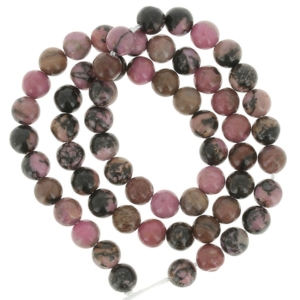
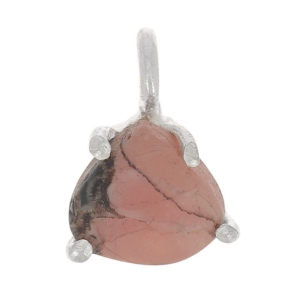
| Heart-shaped pendant made of rhodonite and zirconium oxide | Round rhodonitebeads | Faceted triangle pendant with prong setting—925 Sterling Silver and rhodonite |
Rhodonite is a natural stone belonging to the pyroxenoids family. It has a hardness of between 5.5 and 6.5 on the Mohs scale, and its density ranges from 3.4 to 3.7 g/cm³.
Rhodonite is primarily composed of pink manganese and silicon.
The color of rhodonite ranges from light pink to bright red, including reddish-brown and magenta, sometimes with shades of brown and beige. It is veined with black or gray lines and cloudy inclusions.
It is often confused with rhodochrosite.
This gemstone is found on every continent: Brazil, Russia, Sweden, Taiwan, France, South Africa, Australia, Argentina, China, Canada, India, Mexico, Madagascar, Russia, Sweden, the United States...
It is extracted from manganese ores. It is rarely found in its pure form; it is often associated with other minerals.
In crystal healing, rhodonite offers numerous benefits. It is a balancing, protective, and healing stone. It is said to soothe stress and emotional overload, bring tenderness and gentleness, and help overcome emotional wounds and past traumas.
It is also said to promote meditation and relaxation, help balance emotions, and boost self-confidence.
Which chakra is rhodonite associated with? This pink stone is linked to the heart chakra. It is considered the stone of love, tenderness, sincerity, compassion, and mutual understanding.
Please note: Our gemstones are not sold for crystal healing. The effects of gemstones have not been scientifically proven. Natural gemstones are in no way a substitute for medical expertise or medical treatment.
Over time, rhodonite accumulates negative energy. To restore its full benefits, it’s important to purify and recharge it regularly.
To purify it, simply soak it in a container of distilled water or spring water for a few hours. Don’t forget to dry it with a soft cloth afterward. Be careful not to use tap water, and especially do not add salt, as this can damage the stone.
There are other methods, such as smudging with incense or burying it in the ground.
To recharge it, place it indirect sunlight for a few hours. You can set it on a cluster of quartz or an amethyst geode to enhance this effect.
The light pink color of rhodonite is perfectly complemented by the cool tones of 925 Sterling Silver or stainless steel. But there’s nothing stopping you from creating gold-colored jewelry; gold-plated or Gold Filled findings will give it a luxurious touch.
You can pair rhodonite with carnelian to stimulate creativity. To stimulate the heart chakra, combine it with rose quartz or pink aventurine. When paired with labradorite, its protective properties will be enhanced.
Which stones should you avoid pairing with it?However, crystal healers advise against pairing it with stones that are too powerful, such as turquoise, malachite,emerald,onyx, or black tourmaline. These stones would absorb the energy of the rhodonite.

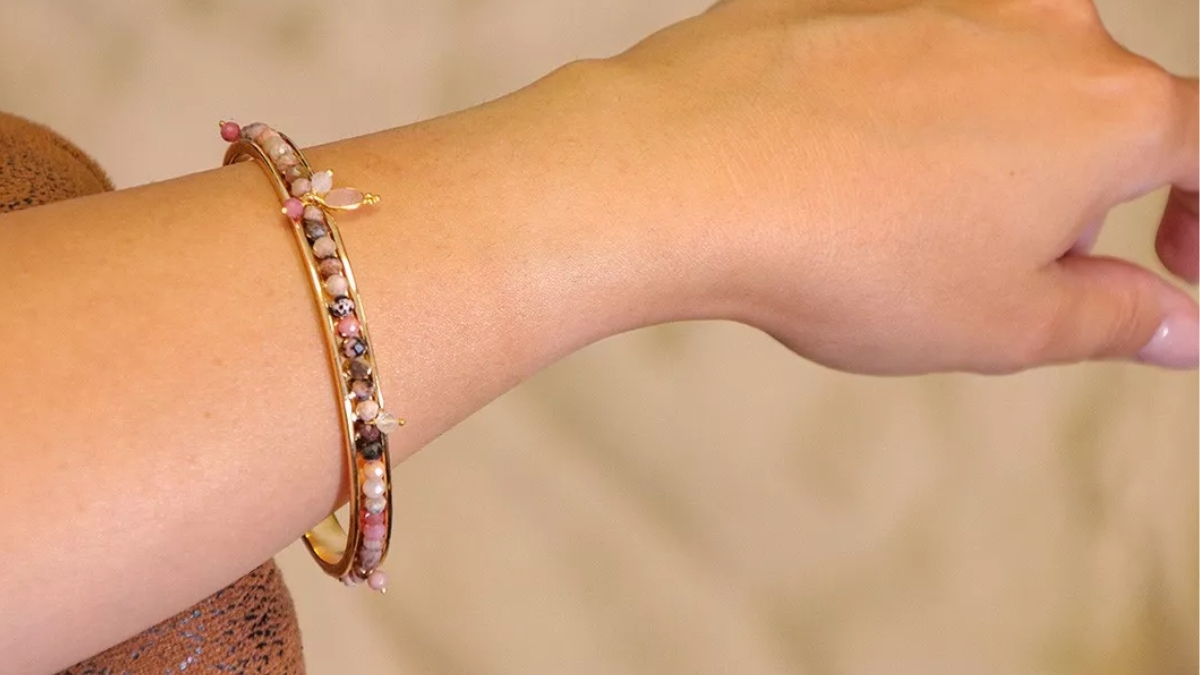
| Rhodonitewolf-head pendant necklace with Heishi beads made of carnelian and dyed agate. | Gold-tone bangle bracelet for women made of rhodonite gemstone |

Credits
Perles & Co, Internet & E-Commerce company [18/02/2026] Any reproduction, representation, adaptation, in any form whatsoever, even partial, is prohibited, except for reproduction for private use not intended for collective use, representation in the family circle (art. L 122-5 CPI) and online publishing on condition that the source is mentioned and a link is included to the corresponding page of our site www.perlesandco.com.