Average Grades
Bonjour je veux faire un bracelet payotte pour un poignet standard 15cm combien de cm de fil il me faut svp merci ?
1 Answer
Show answers

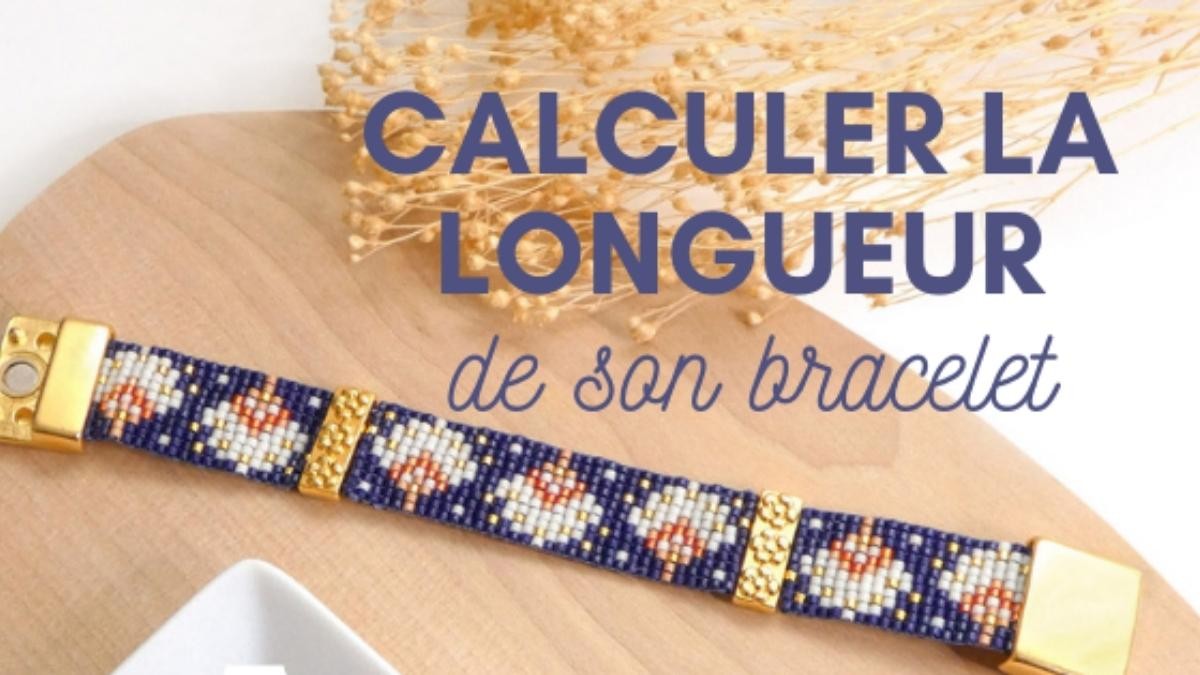
To adjust the size of your Miyuki bracelet, it's essential to measure your wrist correctly and take into account the dimensions of the beads. For a bracelet that's too large, simply modify the weaving grid by removing the desired number of beads symmetrically; for a bracelet that's too small, techniques such as lengthening by pattern can be used. Get ready to adjust your creations for a perfect, personalized fit.
What size is this Miyuki bracelet? The bracelet is too small, what can I do? I followed the weaving grid and the bracelet is too big for me, how can I shorten it?
These are questions you often ask us, but it's easier to prevent than to cure! A weaving grid is easy to adapt, and it's best to adapt it before you start weaving. You might think that without the bracelet pattern and a ruler in your hands, it would be impossible to know how many beads to add or remove. You'd be wrong! With a little concentration and a few simple calculations, you'll easily be able to answer your own question! No need to wait all weekend for an answer from our team!
This data sheet will cover 4 weaving techniques, but the method is valid for many others: Peyote/Brick stitch, loom weaving, circular peyote bangles, simple bead stringing.
Before starting your project, measure your wrist. To do this, take a sewing tape or a piece of thread and a ruler. Wrap the tape measure or thread around your wrist where the bracelet should sit. That is, not at the base of the hand, but just below the wrist bone. If you're using a wire, pinch the point where the two parts of the wire cross and spread the wire out on the ruler to see how long it is.
The bracelet should not be exactly the same size as the wrist. Add about 1.5 cm for ease, and at least 1 cm. If you're using very large beads, 1 cm in diameter for example, it may be useful to go up to +2 cm.
To measure the circumference of the hand, close the fingers with the thumb stretched out under the palm and measure at the widest point without squeezing. This measurement is very important when creating bangles. Bangles are bracelets without clasps that are not elastic and are simply slipped over the wrist. So they need to be wide enough to slip your hand through. Add 1.5 cm to this value.
Things to know: You can use Peyote weaving tips and bead loom tube tips slightly smaller than the width of your bracelet. In this case, you'll need to make a few beads smaller on the end of your loom weave. Example: Miyuki bead diamond bracelet. A tip 1 mm larger or smaller will hardly be visible on the bracelet.
Now that you have all the information in hand, you can get down to the calculations. Count the number of beads in the width of the bracelet, then in its length, and note it down on a sheet of paper. Look at how the bead is positioned to see if you need to multiply its width or length. For example, for a Peyote weave of 21 delicas beads 11/0 wide. It's the height of the beads that needs to be multiplied, i.e. 1.27 mm. So you need to make: 21x1.27 = 26.67 mm wide. We always round up, so we get 2.7 cm wide.
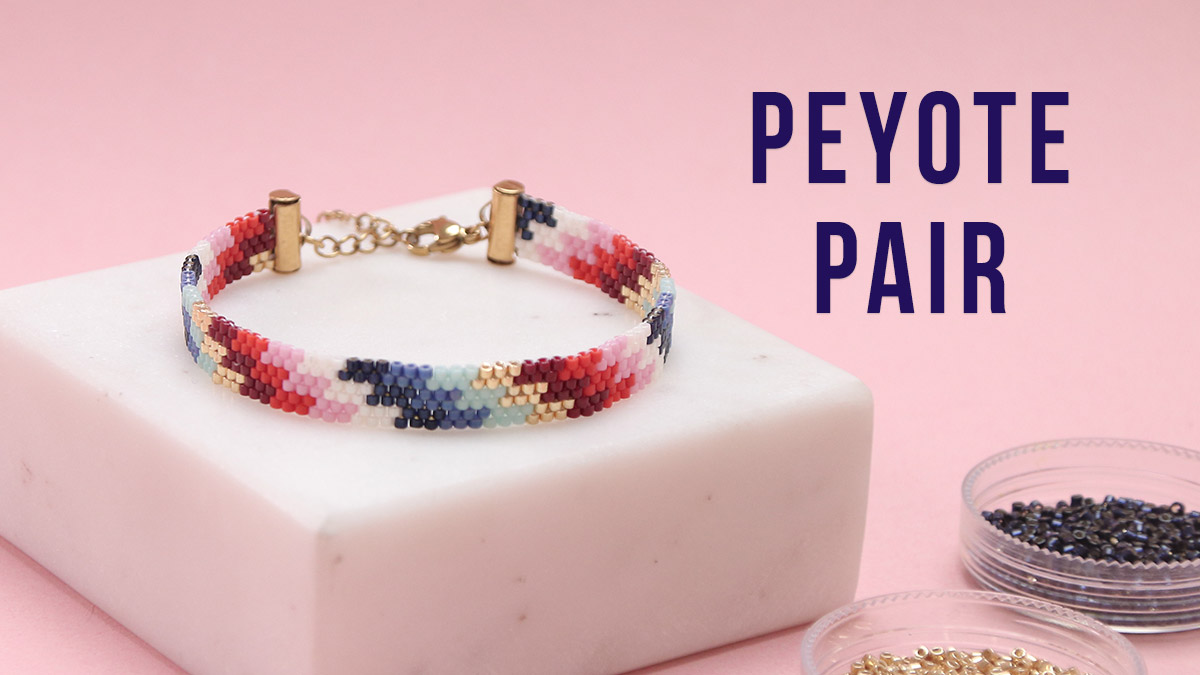
In the length, from the beginning of the decrease to the other beginning of the decrease, there are 75 beads. We take the other measure of 11/0 delicas, i.e. 1.6 mm. 75x1.6 = 120 mm. In this weaving direction, the beads are not glued tightly. So we need to add a little length. Approximately 8%. The calculation is 120x1.08 = 129.6 mm. Your weave will therefore be about 13 cm long, excluding weaving tips and clasp.
For a loom bracelet, the logic is the same. In our example of the miyuki nude bracelet, there are 14 beads in the width. 14x1,27 = 17,78. Here again, we can see that the beads are not glued, as there are warp threads between them. We can either add the thickness of the thread if it's thick (e.g. 0.5 mm or more), or add another 8% to the measurement obtained, so 17.78x1.08 = 19.02 or 1.9 cm wide. For the length, we have 84 beads. So 84x1.6 = 134.4. We add 8% 134.4X1.08 = 145.15. That's about 14.5 cm.
Once we have the weave length, we need to add the width of the end caps and clasp. In the case of our first bracelet, we need to add two 16 mm wide end pieces plus a clasp which, when closed, is 15 mm wide, and 4 mm rings. 130+16+15+8 = 185 mm or 18.5 cm. The bracelet currently fits wrists from 17.5 cm maximum to 16.5 cm. It can be made slightly longer by adding a few rings or an extension chain. To reduce its size, you'll need to modify the weaving grid.
In the case of the loom bracelet, we used a clasp with integrated tube ends. It measures 13 mm wide. 1 strand of beads on each side of the bracelet will be hidden inside the clasp, so the calculation will look like this: 145+13-1.6-1.6=154.8 or 15.5 cm. The bracelet is therefore suitable for wrists from 14.5 cm maximum to 13.5 cm. It can be lengthened by repeating the bead pattern.
You've got all you need. All that's left is to modify the weaving pattern. We advise you to print it out and make the modifications directly on it.
If the bracelet is too big.
This is the easiest case to adjust. Simply cross out the number of beads corresponding to the size you wish to remove from the ends of the bracelet. If the bracelet has a symmetrical pattern like our example, remember to stripe the beads symmetrically on both sides of the bracelet. If there is a gold border, remember to transform the last beads into gold. Example: I want to remove 1 cm of weave. I'm doing 10/1.6=6.25 so I need to remove about 6 beads. That's 3 beads on each side.
Case of a bracelet that's too small.
In the case of a Peyote and Brick Stitch weave, even if you've cut your thread, you can re-attach one in the weave and lengthen the weave either by making plain chevrons or by repeating a pattern from the weave. In the case of loom weaving, if you've already removed and cut the wires, there's not much you can do except add rings and an extension chain if you've only used glueless end caps. It's best to plan the length of the bracelet before you've cut everything.
Case of the bangle.
Add and remove beads 2 by 2, as a circular peyote weave for bangle is necessarily even. Also, if the pattern is symmetrical, adapt it symmetrically.




Credits
Perles & Co, Internet & E-Commerce company [16/04/2021] Any reproduction, representation, adaptation, in any form whatsoever, even partial, is prohibited, except for reproduction for private use not intended for collective use, representation in the family circle (art. L 122-5 CPI) and online publishing on condition that the source is mentioned and a link is included to the corresponding page of our site www.perlesandco.com.