Free shipping on orders over 50€ up to 500g
French Online shop for beads and accessories for the creation of DIY jewellery and other creative hobbies

Log-in

Create a mother-of-pearl polymer effect with 2 techniques

Made by : Perles & Co
Published on the :11/10/2019

How to create a mother-of-pearl effect in polymer clay?

Partner Tutorial

Time of realization: 15 minutes

Difficulty: easy

Directed by: Allison Cohade

How to achieve a mother-of-pearl effect in polymer clay?

In this technical sheet you are given all the hoses to easily achieve a mother-of-pearl effect in polymer clay.

Allison Cohade , thank you for sharing her tips, offers you two techniques:

- technique 1: made exclusively with polymer clay

- Technique 2: made of polymer clay and Mica powder.

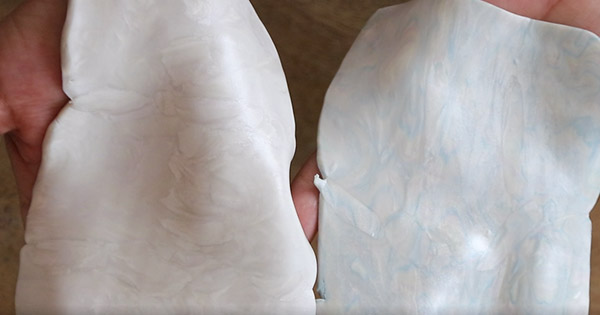
The techniques are more or less similar in terms of implementation but have a slightly different appearance, the first being darker than the first (right in the photo).

You choose according to your preferences;)

In both cases, you will need:

- dough machine
- roll
- blade

Technique 1

1. Cut the pearly white polymer clay loaf in its entirety to obtain pieces of equal size.

2. Place them next to each other and spread with the roll to obtain a dough plate.

3. Pass the dough into the machine:

- 1 x size 0 (the thickest)
- 1 x size 2
- 4/5 x size 4 to obtain a smooth and homogeneous paste

4. Cut in half the plate obtained and put in a piece of side.

5. On the other, cut 3 pieces of more or less identical sizes and add on each of them a very small piece of polymer clay of different colors (example: a piece of blue on the first piece of white dough / a piece of green on the second piece etc (refer to the video))

Go to steps 6 and 8 until complete mixing.

6. Pass each piece in turn through the dough machine to obtain a slightly colored dough of the color of the piece of dough you just added.

7. Once your pieces of color paste are obtained, cut each of them into 3 pieces. Do the same with the piece of white dough put aside.

8. Stack the pieces of dough by alternating a white piece, a piece of color. Cut the borders to get a square / rectangle shape with sharp edges.

9. Cut this shape in half and overlay the two pieces. Apply lightly using the roller and repeat the operation 2 to 3 times.

10. Make shapes in your piece using a spike, your fingers or a hand-held tool to create irregularities in the pearly mille-feuille. Mix the dough with your hands and repeat the process a second time.

11. Let the dough rest for 1 hour before cutting slices of equal thickness. Place them next to each other to form a uniform plate, first using the roller and then the dough machine.

Your mother of pearl plate is now complete;

Technique 2

To realize this variant of the mother-of-pearl effect in polymer clay, you can follow all the instructions given in technique 1 of step 1 to 4.

5. On the remaining piece of white paste, place striped mica powder in alternating 3 colors (purple, green, blue). Switch to the machine to get the color mix.

Continue building your mother of pearl plate using the steps of Technique 1.


For those who would like to go further with the mother of pearl effect, you can find our tutorial dedicated to the realization of a mosaic indeed mother-of-pearl .


Do not panic, in case of doubt you can find the explanatory video of the mother-of-pearl technique in polymer clay on our Youtube channel

At your pasta, we wait for the result. Feel free to share it with us on social networks: our Facebook page and Instagram page

Tutorial steps

Step 1

Technique 1

1. Cut the entire loaf of pearly white polymer clay into equal-sized pieces.

2. Place them next to each other and roll out to form a dough sheet.

3. Run the dough through the machine:

- 1 x size 0 (thickest)
- 1 x size 2
- 4/5 x size 4 to obtain a smooth dough

4. Cut the resulting sheet into 2 and set one piece aside.

5. On the other, cut 3 pieces of more or less identical size and add a tiny piece of polymer clay of a different color to each one (e.g.: a piece of blue on the first piece of white clay / a piece of green on the second piece etc.) (refer to the video).

Pass through notches 6 and 8 until completely mixed.

6. Pass each of the pieces in turn through the dough machine to obtain a slightly coloured dough in the color of the piece of dough you have just added.

7. Once you have obtained your coloured pieces of dough, cut each of them into 3 pieces. Do the same with the piece of white dough you've set aside.

8. Layer the pieces of dough, alternating one white piece and one colored piece. Cut the edges to obtain a square/rectangle shape with clean edges.

9. Cut this shape in half and superimpose the two pieces. Flatten slightly with the roller and repeat 2-3 times.

10. Make shapes in your piece using a pick, your fingers or a handy tool to create the irregularities in the pearly mille-feuille. Knead the dough with your hands and repeat the operation a second time.

11. Leave the dough to rest for 1 hour before cutting slices of equal thickness. Lay them next to each other to form a uniform slab, first using the rolling pin and then the dough machine.

Your mother-of-pearl plate is now finished ;)
Step 2

Technique 2

To create this variation of the mother-of-pearl effect in polymer clay, you can follow all the instructions given in technique 1 from steps 1 to 4.

Then, on the remaining piece of white clay, place mica powder in strips, alternating the 3 colors (violet, green, blue). Run through the machine to mix the colors.

Continue making your mother-of-pearl plate using the steps in technique 1.

Result
Schema  Create a mother-of-pearl polymer effect with 2 techniques
Share with my friends
Which material to use ?
Please note that the quantities of the suggested equivalents are not necessarily exact. You can adjust them in your basket.
List of useful products
Studio - Clay tools set doubled-ended: piercing and finish
12,50€
Imperia pasta machine Sfogliatrice type
OUTIL-525
Qty : 1
81 in stock
49,90€
Pearl Ex Pigments Reflex Violet x3g
OUTIL-624
Qty : 1
Only 2 in stock
3,60€
Pearl Ex Pigments Spring Green x3g
OUTIL-125
Qty : 1
Only 2 in stock
3,60€
Polymer clay Kato Polyclay  56 gr Violet (n°205)
2,60€
Polymer clay Kato Polyclay  56 gr Green (n°208)
2,60€
Polymer clay Kato Polyclay  56 gr Dark Blue (n°206)
2,60€
Polymer clay Kato Polyclay  56 gr Nacré Pearl (n°289)
2,60€
Clay Texture Stamps - 9 cm Africa
OTL-079
Qty : 1
Out Of Sotck
10,00€
Suggested reference for this article:
3 blades set - Fimo
TECH-153
Qty : 1
20 in stock
9,90€
20.5x2.5cm Stainless steel polymer clay roller x1
12,00€
Your questions (1)
You have a question about this sheet? Ask our team and the people who have already tested it. The Perles & Co community is here to help!
By hassani stephanie (01/10/2022 17:57:35)
qu ejje est la difference entre la pate fimo et polymere
Translate the question
Please log in to use this feature
Our Tiffanie J. expert answers you (03/10/2022 10:23:57)
Bonjour, la pâte Fimo est de la pâte polymère. Fimo est le nom de la marque, tout comme Cernit, Sculpey, Pardo et bien d'autres. Ce sont toutes des pâtes polymère.
Translate the answer
Your reviews (2)
Notices subject to control
4.5/5
Average Grades
Please log in to use this feature
By Anonyme (posted on : 20/01/2021 )
Question supplémentaire : a quoi sert la plaque de texture citée dans la liste des fournitures ?
Merci de la réponse...
Translate the notice
Our Perles & Co expert answers you (21/01/2021 09:45:18)
Bonjour, la plaque proposée ne sert pas particulièrement à l'effet nacre, mais le motif proposé par la créatrice sur les bijoux en photo est fait à partir de cette plaque.
Translate the answer
By Anonyme (posted on : 20/01/2021 )
Merci pour ce beau tuto qui donne envie ...
avant de lancer la video on voit des bijoux en noir et blanc (nacré) et y a-t-il un tuto pour nous guider dans la réalisation de ces bijoux ? J'aimerais vraiment.. l'escargot au centre du cercle, en nacré et noir est une très belle imitation d'escargots de mer en véritable nacre...
Merci.
Translate the notice
Our Perles & Co expert answers you (21/01/2021 09:47:56)
Vous avez toutes les explications dans le texte sous la vidéo ici : https://www.perlesandco.com/tutoriels/t11801-diy-mosaique-effet-nacre-en-pate-polymere.html
Translate the answer

Credits

Perles & Co, Internet & E-Commerce company [11/10/2019] Any reproduction, representation, adaptation, in any form whatsoever, even partial, is prohibited, except for reproduction for private use not intended for collective use, representation in the family circle (art. L 122-5 CPI) and online publishing on condition that the source is mentioned and a link is included to the corresponding page of our site www.perlesandco.com.