Free shipping on orders over 50€ up to 500g
French Online shop for beads and accessories for the creation of DIY jewellery and other creative hobbies

Log-in

Make a reduction of polymer clay

Made by : Perles & Co
Published on the :18/05/2017

Attention, we inform you that the following tutorial has been translated by the automatic translator Google Traduction. We are not responsible for the errors caused and we apologize in advance for the inconvenience. Feel free to contact our customer service via this online form if you need help to understand this tutorial.

How to reduce a cane in polymer clay?

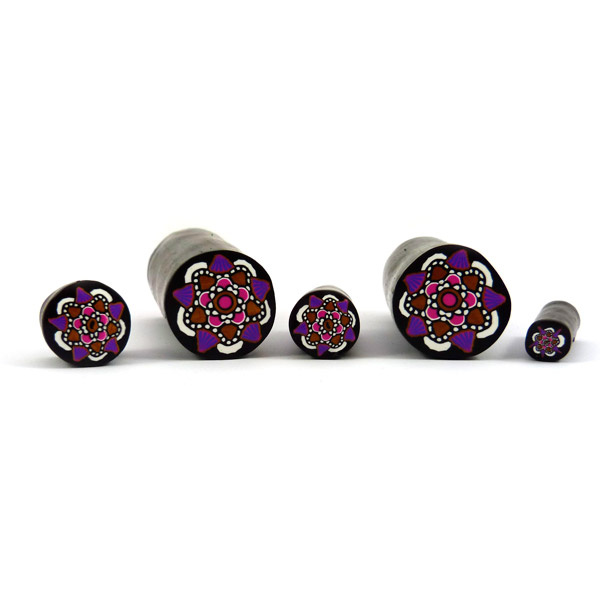
After creating this enormous mandala with polymer clay Kato Polyclay , we wanted to show you the technique of reduction. It takes patience and strength to achieve it, but nothing is impossible! The proof !

Take a look at our other jewelry tutorials made with polymer clay here .

Find the list of necessary equipment at the bottom of this page.

Result
Schema  Make a reduction of polymer clay
Share with my friends
Which material to use ?
Please note that the quantities of the suggested equivalents are not necessarily exact. You can adjust them in your basket.
List of useful products
Polymer clay Kato Polyclay 354 gr Black (n°511)
15,00€
Polymer clay Kato Polyclay 354 gr Gold Tone (n°591)
15,00€
Polymer clay Kato Polyclay  56 gr Violet (n°205)
2,60€
Polymer clay Kato Polyclay  56 gr Magenta (n°204)
2,60€
Polymer clay Kato Polyclay  56 gr White (n°209)
5,21€
Your questions (1)
You have a question about this sheet? Ask our team and the people who have already tested it. The Perles & Co community is here to help!
By Ashin (26/03/2025 06:32:18)
Bonjour est-ce que la pâte polymère et sans risque pour la santé ? Merci
Translate the question
Please log in to use this feature
Our Tiffanie expert answers you (26/03/2025 12:39:03)
Bonjour,
Oui, la pâte polymère est sans risque pour la santé lorsqu'elle est utilisée correctement. Elle est non toxique à la manipulation et conforme aux normes européennes en vigueur. Il est toutefois important de respecter les consignes de cuisson indiquées par le fabricant : ne pas dépasser la température recommandée (en général entre 110 °C et 130 °C), et bien aérer la pièce pendant et après la cuisson, ainsi que de nettoyer son four après cuisson s'il s'agit du four qui sert aussi à cuire des aliments.
La pâte polymère ne doit pas être utilisée pour fabriquer des objets destinés à entrer en contact avec des aliments. Enfin, il est conseillé de se laver les mains après usage et de surveiller les enfants lors de son utilisation.
Translate the answer
Answer from customer A.S B. (27/03/2025 13:03:19)
Merci à vous.
Translate the answer
Your reviews (0)
Notices subject to control
Please log in to use this feature

Credits

Perles & Co, Internet & E-Commerce company [18/05/2017] Any reproduction, representation, adaptation, in any form whatsoever, even partial, is prohibited, except for reproduction for private use not intended for collective use, representation in the family circle (art. L 122-5 CPI) and online publishing on condition that the source is mentioned and a link is included to the corresponding page of our site www.perlesandco.com.