Average Grades
Bonjour, comment reporter un patron sur du tissus éponge afin de découper? Je ne vois pas comment faire le traçage vu la matière.
merci
merci
1 Answer
Show answers


For successful sewing, start by washing and ironing your fabric to avoid shrinkage later on. Then mark the shapes to be cut with small lines, taking care to respect the straight thread, and use flat scissors to cut smoothly, without pulling on the fabric. Follow these steps for neat, precise work.
Attention, we inform you that the following tutorial has been translated by the automatic translator Google Traduction. We are not responsible for the errors caused and we apologize in advance for the inconvenience. Feel free to contact our customer service via this online form if you need help to understand this tutorial.
This week we will start sewing at the beginning: the preparation of the pieces of cloth.
But how to mark and cut his fabric properly?

When you really want to get behind your sewing machine, you can go quickly on this step. Yet, she is important!
Let's see how to proceed!
Prepare the fabric:
After buying fabric, remember to wash it (if it allows) to remove the primer so it is impregnated. This washing also allows the fabric to shrink and / or disgorge. Subsequently, no bad surprises, it will not move! Iron it afterwards.
Observe the fabric:
Before making the 1st mark, it is important to look at how the fabric is made. The warp, the weft, the bias, the right-thread, the place and the backside does it speak to you?
All these notions are to be found in the article " Find the meaning of the fabric ".
Mark the pattern pieces on the fabric:
To mark the shapes to cut, we have two possibilities:
- Draw contours to the ruler and square for simple geometric shapes.
- Place a pattern on the fabric and report it.
In any case, the fabric is marked with small features. We never draw a wide straight line around the boss because we risk stretching the fabric as we trace.
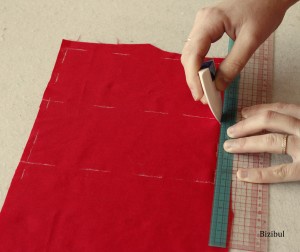
I want to post a rectangle on my fabric :
- I spot my right angle using the square. I mark the angle well and then continue using small strokes to the desired dimensions.
- I trace my other sides to the square or the rule.
- Each angle is well marked.
- The straight lines are punctuated by small lines of regular distances.
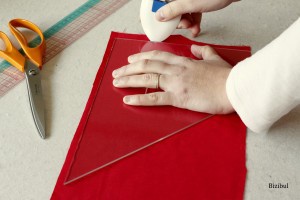
I want to postpone a pattern on my fabric:
- I mark my right-wire and I place the mark of my boss in the same direction as my right-wire.
- To maintain my boss, I place a heavy object over it.
- I draw the outline with small strokes.
- In the rounds, I can draw closer. In straight lines I can space my markings.


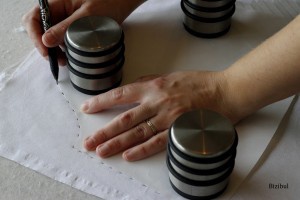
And the seam allowance in the story?
Sometimes it is included so we trace the outline as it is presented on the pattern. Sometimes you have to add it with a small ruler: + 1cm; + 1.5cm; more or less as indicated.
Cut the fabric:
And here is the long-awaited step, we begin to get to the heart of the matter!
Let's take off the scissors!

The 6 important things to watch for are:
- Have a good grip of the scissors
- Keep the scissors flat on the table. They slide along the table when cutting.
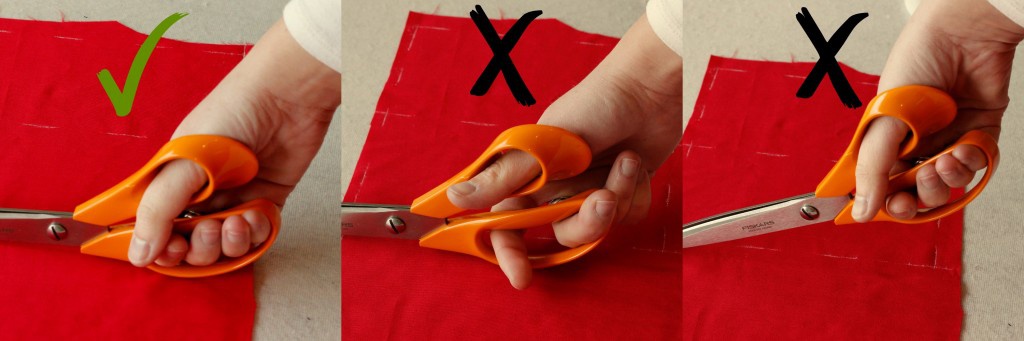
- Cut with a slight backward movement.
- Do not cut to the tip to avoid marks on the fabric.
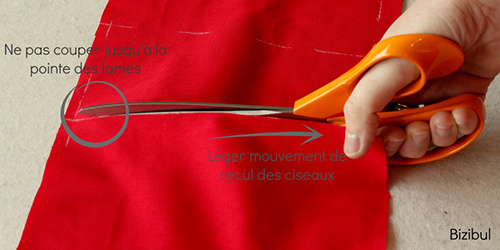
- Hold the piece of fabric with your other hand so that it does not move.
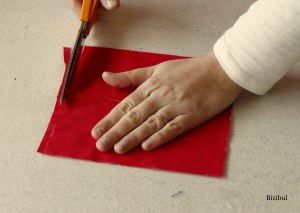
- Turn around his fabric.
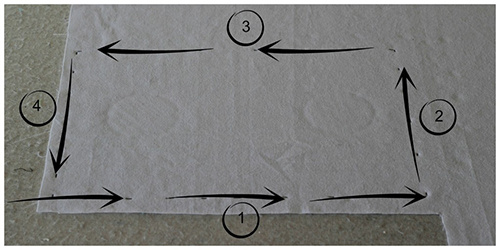
For example, I decide to cut my fabric counterclockwise from beginning to end. It's my body moving around the fabric but never my fabric moving on the table. My piece of cloth should take off from the table once it is completely cut.
Summary :
1. Wash and iron the fabric before use.
2. Observe his fabric to locate the right-thread.
3. Mark with small lines the shape to cut: the angles and roundings will be marked more closely.
4. Cut the fabric making sure to keep the scissors against the table. The point of the scissors is oriented towards the following marking line. I turn around my fabric keeping my other hand on the piece that I cut.
Now, marking and cutting his fabric has no secrets for you!
Thanks to Bizibul for this handy sheet.
Discover his universe here: Bizibul.fr





Credits
Perles & Co, Internet & E-Commerce company [22/10/2018] Any reproduction, representation, adaptation, in any form whatsoever, even partial, is prohibited, except for reproduction for private use not intended for collective use, representation in the family circle (art. L 122-5 CPI) and online publishing on condition that the source is mentioned and a link is included to the corresponding page of our site www.perlesandco.com.