Average Grades
Remember to protect your work surface.
Glue the amazonite cabochon with UV LED resin, epoxy resin or two-component glue resin.
UV LED resin only works with transparent cabochons.
Put it under the UV lamp.

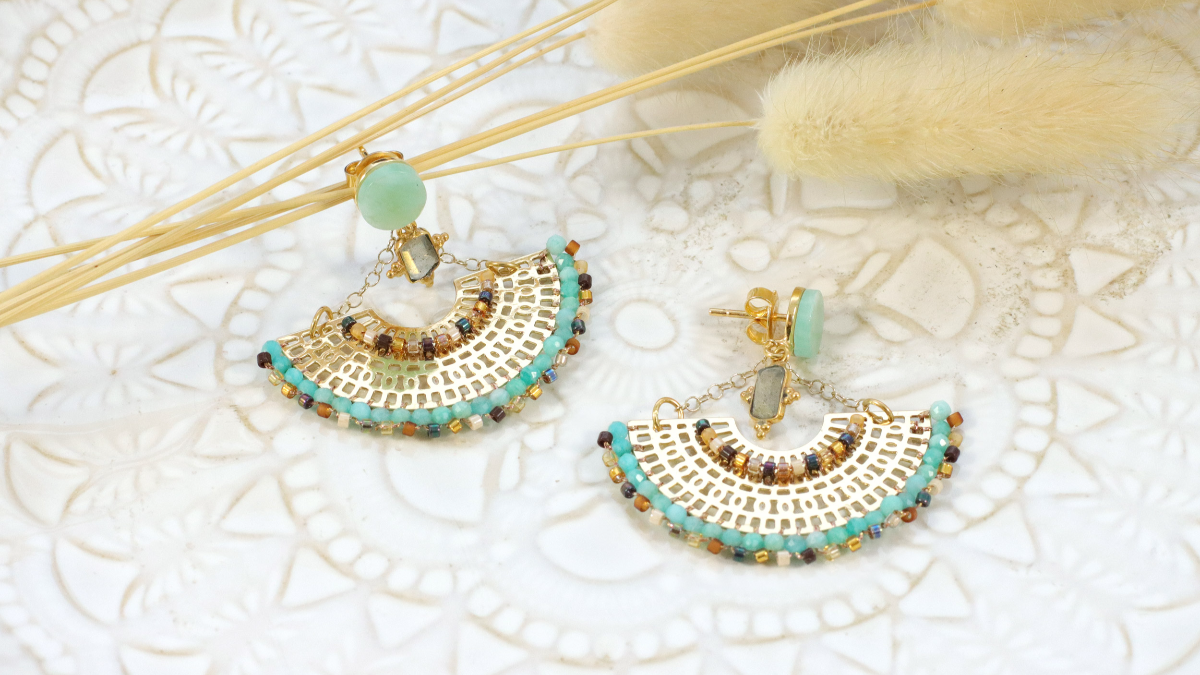
These trendy earrings are made of Amazonite stone, Labradorite and a mix of small glass beads Miyuki delicas. The mix of sand and turquoise shades will suit summer as well as winter. Amaze your friends by making these earrings yourself. You can customize them with thousands of different color combinations. We have a very large selection of Miyuki delicas 11/0 beads at your disposal, as well as dozens of references of 2mm gemstone beads.
The beads on these earrings have been woven with silkworm shiny thread. You can also use a weaving wire like Miyuki or KO brand wire spools. If you are a beginner, you should use the latter because you have to be careful not to damage the shiny thread when weaving the beads. It requires a little more comfort in the gestures.
In this video, we will glue the gemstone cabochons on the ear stud trays with UV LED resin. The metal trays are very smooth, so the classic hasulith type jewelry glue may not hold very well. This UV LED resin is very resistant but requires the use of a UV LED lamp. It is also necessary that the light can pass through the cabochons. This is the case with these Amazonite cabochons which are translucent, but it will not work with Onyx or Lapis Lazuli cabochons for example. If you are using opaque cabochons, or if the investment in the UV LED resin and lamp seems too high, use UHU bi-component glue which is also very resistant. You will just have to wait 24 hours before finishing the assembly of your loops, because it is not a fast-setting glue.
Remember to protect your work surface.
Glue the amazonite cabochon with UV LED resin, epoxy resin or two-component glue resin.
UV LED resin only works with transparent cabochons.
Put it under the UV lamp.
Use Ver à soie brand thread, shiny, size 4. Cut 1 m of thread and thread it through a slotted needle, or use Miyuki or Ko weaving thread.
Tie a double knot to secure the wire to the primer. Put glue, resin or UV LED resin on the knot to solidify it. Epoxy cures in 24-48 hours.
Place it under the UV lamp.
Go back to the front, the knot is at the back.
Now attach miyuki one by one. Pass through the 3rd hole, then 2 holes further on.
Thread a bead and return to the previous hole. Go back 2 holes.
Continue like this to the end.
Turn over in front and iron through all the beads to make a pretty arc.
Go back and secure your wire. Tie a double knot with the thread.
Now brick stitch around the edge.
Start by knotting your thread. Apply resin, then place it under the UV lamp.
Thread an amazonite bead, a miyuki bead and another amazonite bead.
Thread through the 2nd hole and back into the amazonite bead. Be careful not to go through the wire, to avoid damaging it.
Then thread a miyuki and an amazonite bead.
Tip: pinch the bead to pull the wire so as not to get caught in it again.
The beads are starting to tilt. Skip a hole to prevent them from being too tight.
Cut a 3 cm piece of chain with an odd number of links and attach one end to the spacer. Do the same on the other side.
Open the ring and attach the pendant and the middle of the chain. Your loop is now complete.


You have a question about this tutorial? Ask it to our team and the people who have already tested it. The Perles & Co community is here to help you!
Credits
Perles & Co, Internet & E-Commerce company [26/01/2022] Any reproduction, representation, adaptation, in any form whatsoever, even partial, is prohibited, except for reproduction for private use not intended for collective use, representation in the family circle (art. L 122-5 CPI) and online publishing on condition that the source is mentioned and a link is included to the corresponding page of our site www.perlesandco.com.