Average Grades
Free shipping on orders over 50€ up to 500g
French Online shop for beads and accessories for the creation of DIY jewellery and other creative hobbies
Log-in
0
Shopping cart
Shopping cart

How do I make a Brick Stitch long necklace?
We're all crazy about geometric patterns! They're everywhere, in fashion, decoration and costume jewelry! Charlotte Souchet has created a weaving pattern reminiscent of the Memphis decorative style, an Italian design trend from the 80s that has been making a strong comeback in recent months.
In this weave with a ziz zag pattern, Charlotte has chosen a pretty color combination of Miyuki Delicas beads with a deep, luminous cobalt blue and a powdery pink to soften. This long necklace will be perfect with all your spring/summer outfits for a touch of pep!
Many thanks to Charlotte for creating this step-by-step guide.
If you're a beginner, take a look at our bead weaving tutorials, after which you won't have to worry about brick stitch weaving with augmentation and reduction.
If you'd like to weave patterns or make woven jewelry again, check out our Miyuki bead weaving tutorials.

STEP 1: bead weaving
The "Brick Stitch" method is used for both weaves. Take a look at our technical sheets to learn how to weave beads.
Tips from the designer:

How do I start a Brick Stitch?
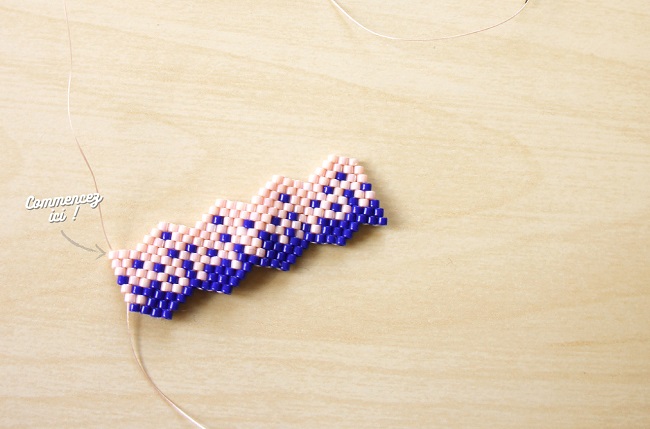
Start by threading the first two beads. Then thread through the first bead to create a loop, thread through the third bead and thread through the previous bead. Repeat for each bead in the first line.

How to make an invisible reduction?
Thread two beads, then pass your needle under the thread connecting the 2nd and 3rd beads in the row below. Then pass your thread back through the two beads in the opposite direction. Your thread is now in the first bead, so pass your needle through the second bead from bottom to top.
For the third bead, pass your needle under the thread connecting the 3rd and 4th beads, then pass it back through the bead in the opposite direction. Repeat until the end of the line.
How to make a simple increase?
Thread two beads, then pass your needle under the thread connecting the 1st and 2nd beads of the line below. Then pass your thread back through the last bead from bottom to top.
For the third bead, pass your needle under the thread connecting the 2nd and 3rd beads, then pass it back through the bead in the opposite direction. Repeat until the end of the line.
How do I make a multiple augmentation?
Using the same technique as for the first line, for each bead you add, pass the thread through the previous bead and then through the one you've just added. Repeat until you reach the end of the line.
How do I make a multiple reduction?
Simply pass the thread through the beads you've just woven, then depending on where the thread emerges, make a simple increase or an invisible reduction.
Tips from the designer :
STEP 2: Assembly
Once you've made both weaves, you need to attach the first weave to the warp using the rings and two clamps, then attach the second weave to the first using two small warp ends.
To do this, use the chain cutter to cut the chain to the desired length. Here, a length of 70 cm has been used to create a long necklace. For the two small chains, they need to be very short and are therefore made up of just two links.
To hold the rings open, use thread to fix the ring in the middle of the two beads at each end (see diagram). Pass the thread twice through the beads to create a knot and secure the ring, then insert the chain and close the ring. Repeat this action at each end of the first weave, as well as the top two ends for the second weave.

Tips from the designer:
Your long necklace is finished!

We'd love to see your sautoir (alone or worn) and, who knows, share it on our social networks. So send us your photos on Facebook or tag us on Instagram with #perlesandco!





You have a question about this tutorial? Ask it to our team and the people who have already tested it. The Perles & Co community is here to help you!
Credits
Perles & Co, Internet & E-Commerce company [27/06/2017] Any reproduction, representation, adaptation, in any form whatsoever, even partial, is prohibited, except for reproduction for private use not intended for collective use, representation in the family circle (art. L 122-5 CPI) and online publishing on condition that the source is mentioned and a link is included to the corresponding page of our site www.perlesandco.com.

