Free shipping on orders over 50€ up to 500g
French Online shop for beads and accessories for the creation of DIY jewellery and other creative hobbies

Log-in

Resin vs acrylic: what are the differences?

Made by :Laurence T Perles&Co
Published on the :05/04/2023
Resin vs acrylic: what are the differences?

Resin and acrylic are material names often found in jewelry. Technically, acrylic, whose scientific name is polymethyl methacrylate (PMMA), is a thermoplastic resin. On the other hand, the two-component epoxy resin used in DIY to make pendants and accessories using molds is a thermosetting resin.However, we won't be discussing DIY epoxy resins here, as their properties are very different from those of industrial resins. There are also pendants and beads made from industrially-produced thermosetting resin.

What are the differences between thermoplastic and thermosetting resins?

CharacteristicsThermoplastic resin (Acrylic)Thermosetting resin
MaterialThese resins require no hardener to solidify. They are initially in solid form (granules or powder), then heated to melt, molded and cooled to solidify.They consist of two elements (resin and hardener) which react chemically together. This process is irreversible, transforming the liquid resin into a solid, rigid structure.
TextureThey are generally more flexible and can soften under high temperatures, making them less rigid than thermosets.They are very rigid, resistant to high temperatures and more stable over time.
Impact resistanceYes, but more sensitive to scratches than resin.Yes, resin is more impact-resistant than acrylic.
UV resistanceDepends on additives used.Depends on additives used.
Manufacturing processBy injection molding or machiningBy injection molding or vacuum casting
WeightLightLight
Jewelry components and jewelry findingsLarge links.
Flower petals.
Pearls.
Earrings.
Pendants.
Cabochons.
Chains.
Lobster clasps
Oval spacers.
Cameos.
Pearls.
Cabochons.
Earrings.
Pendants.
Rope bracelets.
Half-round spacers.
Dog charms.
Rings.

What is resin?

There are several types of resin:

  • Natural resin: this is the substance that trees secrete to heal their wounds when they have been attacked or injured. Some plant resins can fossilize and become amber.
  • Synthetic resin: This refers to a liquid or solid polymer product, which is a base material for manufacturing plastics, paints, adhesives and varnishes, for example. It can be thermoplastic or thermosetting. The best-known is epoxy resin, but acrylic is also a resin, as are many other materials.

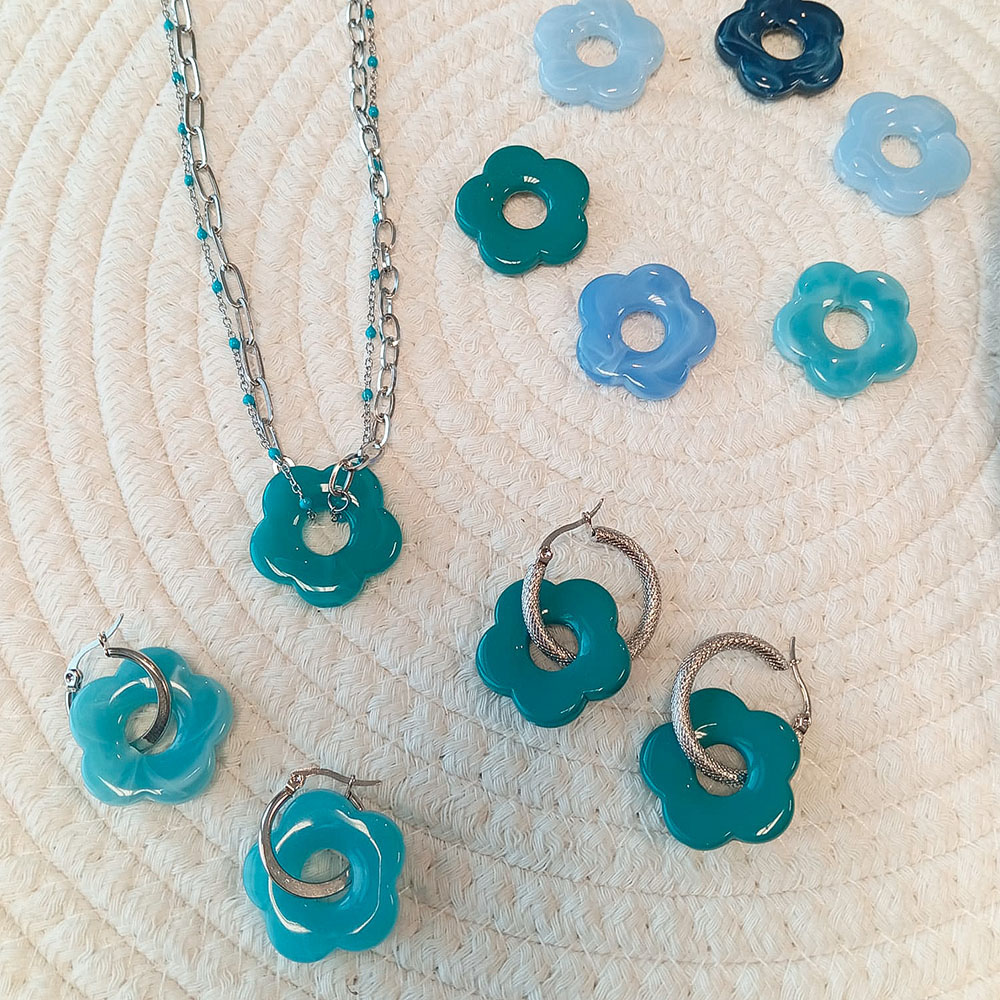
In jewelry, it is used to make beads, pendants, cabochons, bracelets, rings... Jewelry components are manufactured by molding, injection or vacuum casting. Resin components are lightweight and have a smooth, glossy finish. They are available in a wide range of colors and shapes.

Resin is a strong, hard material with a certain flexibility, making it highly resistant to cracking and bending.ithstanding cracks and impacts.

Resin jewelry components can be transparent or opaque. Manufacturers can include glitter and marbling.
Resin is the perfect ally for creating diversified, colorful jewelry with ease.
boucles oreilles créolespendentif résineboucles oreilles pendantes resine

What is acrylic?

Acrylic is a thermoplastic (PMMA: polymethyl methacrylate) used in the manufacture of paint, road signs, illuminated signs, decorative objects... In the jewelry world, it is used to make pendants, beads, links, cabochons...

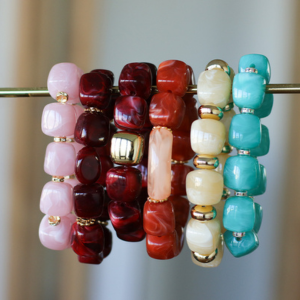
Light andcomfortable to wear, it is durable and resistant to daily wear and tear. It can be used to make jewelry that can be worn all day long, even if it's a large piece. Acrylic is scratch-, shock- and break-resistant. What's more, acrylic jewelry components, such as acrylic beads, are easy to clean.

Acrylic is a transparent or opaque material with a hard, smooth texture. It is easily shapedby molding or machining, enabling manufacturers to create jewelry components with complex shapes. It is available in a wide variety of colors and finishes.
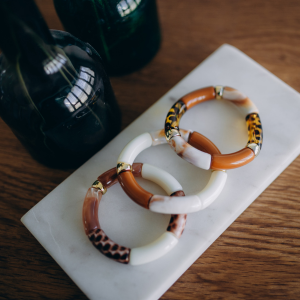
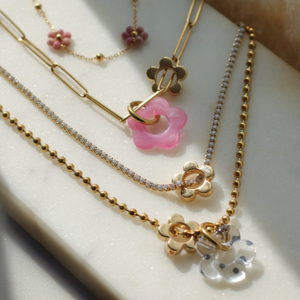
bracelet perle tube acryliquemaillons acryliquesboucles oreilles acryliques

Share with my friends
Which material to use ?
Please note that the quantities of the suggested equivalents are not necessarily exact. You can adjust them in your basket.
List of useful products
21mm Acrylic donut pendant - Transparent - Yellow x1
1,00€
Large resin ring - Size 54 - Transparent - Marbled purple x1
2,00€
41mm Half round opaque resin spacer - Black x1
1,30€
67mm Thick Opaque Resin Bracelet - Marbled Violet x1
5,70€
65.5mm thick opaque resin bracelet - flowers - Unbleached x1
6,20€
21x11mm Acrylic Bear Pendant - Transparent Purple x1
0,40€
10mm Matte effect resin bead - Eggplant x1
0,40€
8mm Matte effect resin bead - Fuchsia x1
0,30€
10mm Matte effect resin bead - Royal Blue x1
0,40€
14x10mm Oval opaque resin cabochon - eggplant x1
1,00€
39mm Round Hollow Acrylic Pendant - Dark Red Marbled x1
0,80€
35x11mm Opaque Acrylic curved tube beads - Denim x6
1,30€
32x23mm Acrylic Coffee Bean Link - Yellow x1
0,90€
39x34mm Oval Clear Acrylic Link - Marble Coral x1
0,90€
38x29mm Acrylic Drop Pendant - Marbled Petrol Blue x1
1,10€
Your questions (5)
You have a question about this sheet? Ask our team and the people who have already tested it. The Perles & Co community is here to help!
By Virginie (24/02/2025 22:19:56)
Bonjour
Je voudrais savoir si les perles tube en acrylique de couleur doré sont dorées dans la matière ou s’il s’agit d’une coloration en surface qui risquerait de partir ? Merci beaucoup.
Translate the question
Please log in to use this feature
Our Tiffanie expert answers you (25/02/2025 09:01:45)
Bonjour, oui c'est un revêtement qui peut s'oxyder ou s'endommager. 
Translate the answer
By Marceline (30/09/2024 11:22:26)
Bonjour j ai commande les perle tubes incurvées en acrylique sont elles bien résistante et comment pourrais elles se cassées?
Translate the question
Please log in to use this feature
Our Tiffanie J. expert answers you (02/10/2024 09:38:55)
Bonjour, il n'y a pas de raisons qu'elles se cassent, à moins que vous rouliez dessus avec votre voiture, pour donner un exemple au hasard.
Translate the answer
By Laurene (17/12/2023 14:25:57)
Bonjour, quelle est la durée de vie des bijoux fabriqués avec de la résine uv?
Translate the question
Please log in to use this feature
Our Tiffanie J. expert answers you (18/12/2023 08:55:29)
Bonjour, difficile de vous répondre car cela dépend de comment a été stocké et porté votre bijou. Je pense que deux trois ans doit être une bonne moyenne. Si très peu porté et stocké dans un endroit frais, sec et à l'ombre, probablement plus de 10 ans.
Translate the answer
By Laurene (17/12/2023 14:24:56)
Bonjour,
Translate the question
Please log in to use this feature
By flamant (15/06/2023 17:20:58)
Bonjour, je suis à la recherche de perles d'environ 6 à 7 mm de diamètre, en matière non cassable, de couleur différente et résistant à l'eau (notamment l'eau de mer)
Translate the question
Please log in to use this feature
Our Lucie T. expert answers you (21/06/2023 18:29:32)
Bonjour, nous vous conseillons d'utiliser des perles en résine. Nous avons un large choix de couleurs en 6 mm https://www.perlesandco.com/Perles-Rondes-c-2626_231_2053_1813.html?filters%5B6%5D=6
Vous trouverez dans la catégorie d'autres diamètres et d'autres formes. Merci
Translate the answer
Your reviews (1)
Notices subject to control
5/5
Average Grades
Please log in to use this feature
By VIRGINIE (posted on : 24/02/2025 )
Parfait merci beaucoup
Translate the notice
Our Tiffanie expert answers you (25/02/2025 09:04:07)
Merci beaucoup
Translate the answer

Credits

Perles & Co, Internet & E-Commerce company [05/04/2023] Any reproduction, representation, adaptation, in any form whatsoever, even partial, is prohibited, except for reproduction for private use not intended for collective use, representation in the family circle (art. L 122-5 CPI) and online publishing on condition that the source is mentioned and a link is included to the corresponding page of our site www.perlesandco.com.