Average Grades
Comment broder un accroc?
1 Answer
Show answers


This data sheet from Rico Design guides you through the various embroidery techniques essential for getting started. You'll discover a variety of stitches, such as pastel stitch for small areas, needle painting for colorful patterns, and cross-stitch for more complex designs, so you can choose the one best suited to your creative projects.
Attention, we inform you that the following tutorial has been translated by the automatic translator Google Traduction. We are not responsible for the errors caused and we apologize in advance for the inconvenience. Feel free to contact our customer service via this online form if you need help to understand this tutorial.
You want to start embroidery but you do not know where to start?
Discover this fact sheet proposed by Rico Design on different embroidery techniques!
After that you will become a pro and will be unbeatable on the different basic stitches in embroidery !
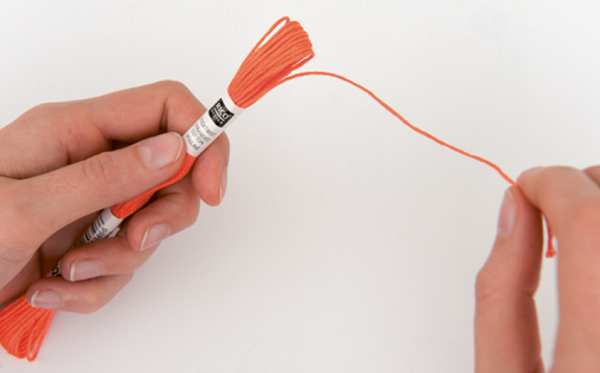
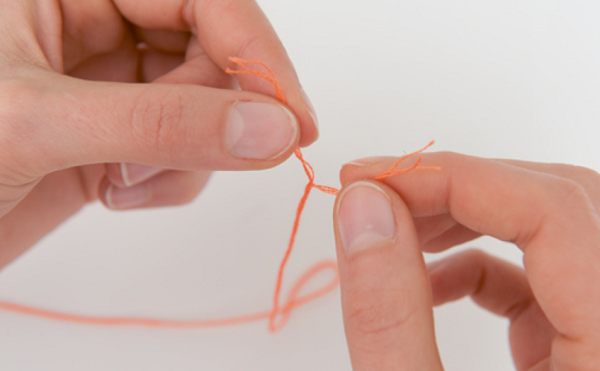
The preparation of the thread:
Choose a skein of the color of your choice then pull on the end of the thread. Cut a thread about 50 cm. You can then separate your thread according to the number of threads needed for embroidery.
Last point:
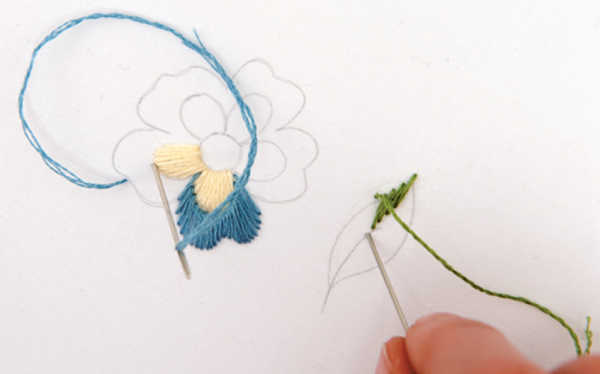
This point is usually used to fill small areas of one to two centimeters. The contours of the shape must be embroidered with an embroidery thread. You can fill your small areas with angled or straight points.
Tip : Start the pointed shapes with the tip and rounded shapes starting from the center.
The painting with the needle:
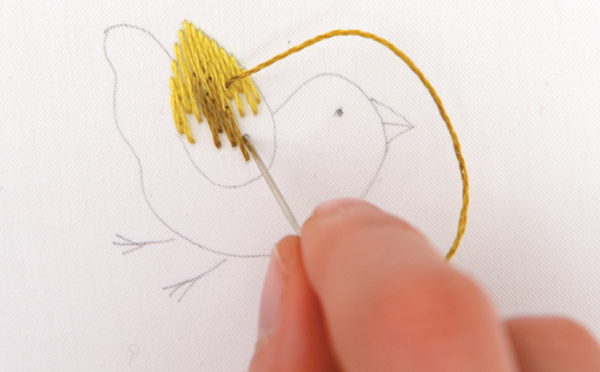
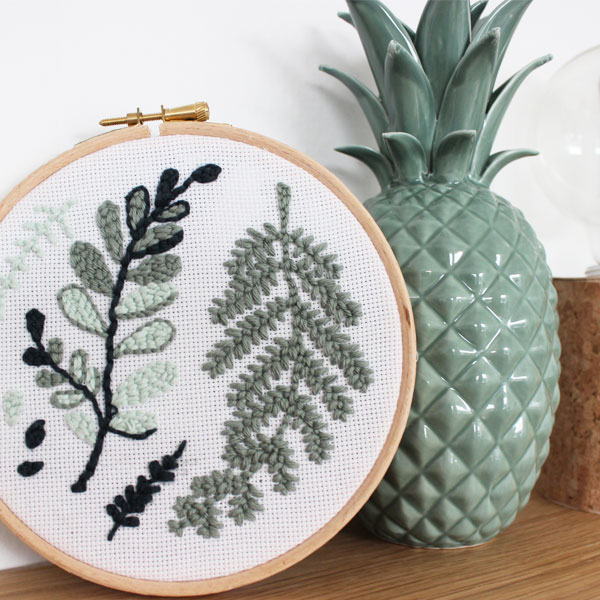
This embroidery technique consists in reproducing a drawing by filling the pattern with different colors and a succession of points launched. This technique is ideal for filling large surfaces and achieving shades and gradations of color.
Make the first row with dots of different lengths. For the second row, stitch the needle into the first row threads, you can vary the colors and length of the stitches.
The stitch point:
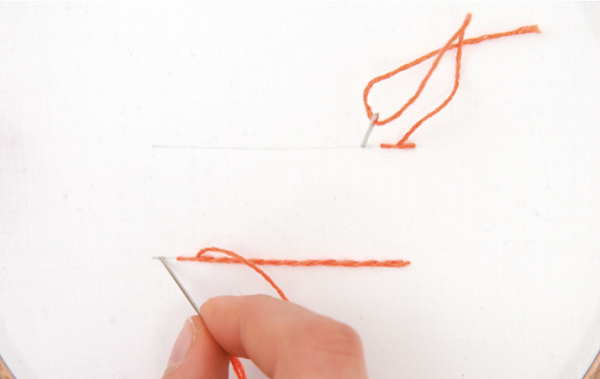
You can use this stalk stitch to make straight and curved contours, including flower stems. Prick with the needle on the line and then stick to the left to the desired length.
Then, go out halfway point and pass in front of the first point at the same length.
The embroidery thread is thus underneath, you can now come out at the last point. Repeat the operation.
The loop point:
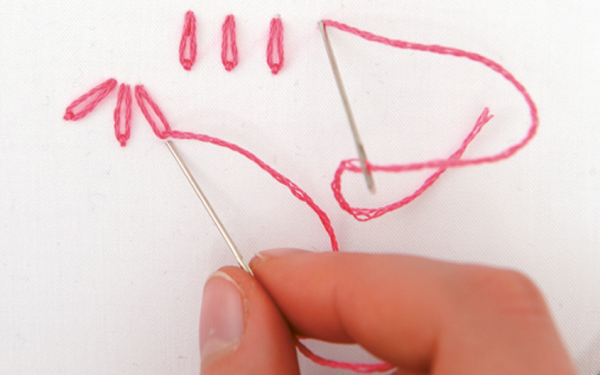
This point will allow you to make flower petals, it works from top to bottom. The beginning of the work resembles that of the chaineette point. Stitch the needle in the desired place, make a passer and then transplant at the beginning.
Then transplant into the loop, pull the loop and fix it with a reinforced point.

The knot point:
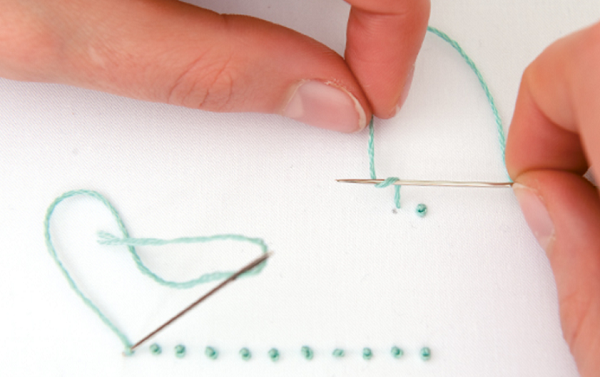
This point will allow you, alone, to realize eyes, or in groups, to create hearts of flowers, trees or animals! To do this, simply hold your thread with your left hand and make one, two or three loops with your right hand tight around the needle. Then prick the needle with the wire stretched through the fabric backwards, holding it near the exit hole. Then pull the thread by gently sliding the loops.
Shoot lightly: your knot is finished!
The back point:
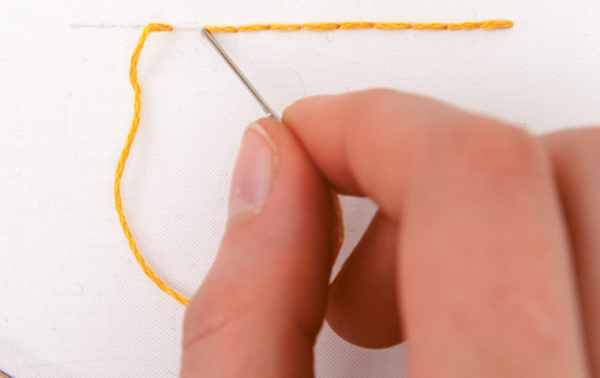
With this point, you will be able to make stems and outlines of cross stitch patterns. To do this, take the needle out from the back of the fabric, sew the needle to the right to the desired length and exit to the left over the double length of the stitch. Finally, pick the following points each time and stand out on the double length of the point.
The reinforced point:
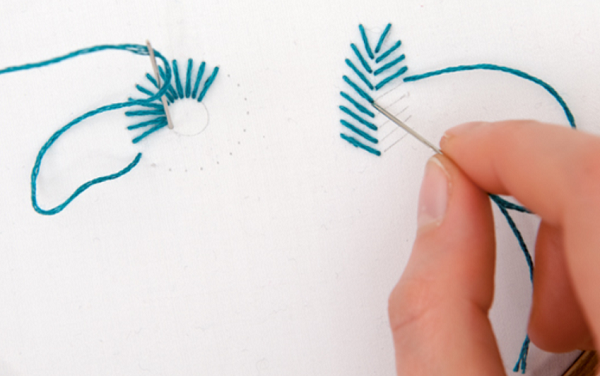
In order to make a flower, embroider the stitches: draw the stitches from the outside to the inside. To make a sheet, stitch the stitches from the outside to the inside.
The chain point:
This technique is achieved through a row of loops attached to each other. With this point you will be able to embroider monograms, spirals and outlines. To do this, prick the needle, make a loop with the thread and repel at the beginning while holding the loop. Get out inside the loop and prick it next. Secure the last loop with a short reinforced point.
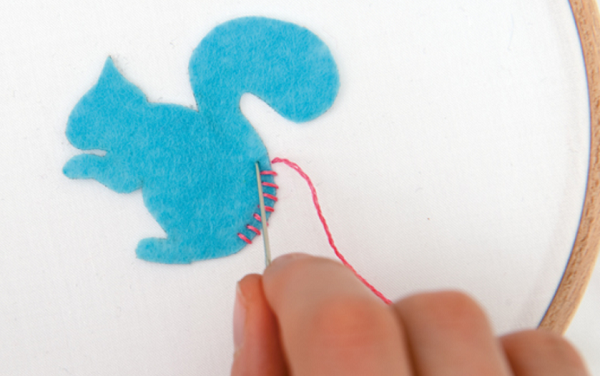
The casting point or reinforced point:
Use the stitch technique to sew applications. This point can also allow you to make a decorative finish with a contrasting color.
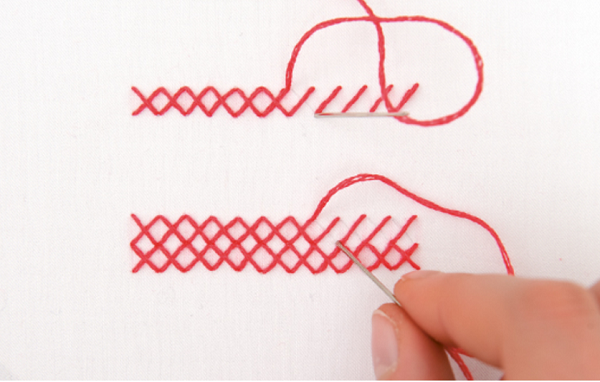
Cross stitch:
The cross stitch is composed of two different points, an oblique point and a point of recovery. The oblique point starts from the top right to the bottom left, the recovery point starts from the top left to the bottom right. It is important to start with the oblique point and then the point of recovery.
We love to see your creations, so do not hesitate to send us your photos on our Facebook page or to tag us on Instagram with #PerlesandCo!



Credits
Perles & Co, Internet & E-Commerce company [03/03/2020] Any reproduction, representation, adaptation, in any form whatsoever, even partial, is prohibited, except for reproduction for private use not intended for collective use, representation in the family circle (art. L 122-5 CPI) and online publishing on condition that the source is mentioned and a link is included to the corresponding page of our site www.perlesandco.com.