Average Grades
Quando e perché è nato il ricamo Glazig?
1 Answer
Show answers

Aida
It is a manufactured canvas mainly used as a support for counted stitch embroidery or punch needle. It has the shape of a precise grid, ideal for guiding the passage of the needle and obtaining regular stitches. During your purchase, the name of the A?da canvas is often accompanied by a number, which represents the size of the tiles per centimeter.
Boutis
It is also called Marseille embroidery or embossed embroidery. This is a traditional technique which consists of embellishing a fabric by giving it volume. To do this, we stitch two fabrics superimposed at the stitching point or at the front point on a previously produced design. We then bring relief by adding cotton wicks between the two layers using a needle with a slightly rounded end. The embroidery is as spectacular on the front as on the back.
Cannetille
It is a hollow wire that is made by winding a metal wire wound in a very tight spiral. The cannetille is in the form of a spring. We mainly use the cannetille for gold embroidery .
Canvas
It is a thick and semi-rigid canvas which will serve as a support for the embroidery. It is covered with a drawing called a "diagram".
It is also a counted stitch embroidery technique for which the 6 strands of the thread and the half cross stitch are used.
Canvas embroidery
It is a decorative technique located between tapestry and embroidery, hence its other name: needlepoint. It consists of completely covering a thick fleece with cotton or woolen threads.
Claim
It means embroidering with gold, silver or silk.
Cross stitch
This is an embroidery stitch that forms a small "x".
Cotton milled
It is the most widely used embroidery thread. Shiny and slightly twisted, it is composed of 6 easily separable strands. Most of the time, it comes in a skein.
Diagram
The diagram is a model reproduced on a grid, which is used to create a pattern on a canvas. But it also has a wealth of information to study well before embarking on the creation: the list of threads to use, a grid representing the pattern to be embroidered, the number of threads to use, symbols corresponding to each color or to the type of stitch to embroider (split cross or not) ... The squares of the diagram represent the squares of the canvas, this makes it easier to count the stitches to be embroidered. Sometimes the diagram is printed directly on the embroidery canvas.
Diamond embroidery
It is a very popular creative hobby in China. It is also called 3D diamond embroidery, mosaic embroidery or even diamond mosaic. This is the same principle as the cross stitch, but instead of embroidering thread, we glue rhinestones using a special stylus on an adhesive canvas. The objective is to cover the entire canvas to obtain a pattern.
Edging
It designates the border of gold or silver threads of an embroidery.
Embroidered days
Often worked in bands, they are spaces created in a fabric, by pulling and removing threads. The remaining thread is then embroidered to form decorative patterns. Embroidered days are often used to adorn collars, sleeves, fronts of blouses or tops.
There are different patterns of days: single days, V-shaped days, the Paris point, the knotted ladder day, the divided ladder day, the Venice day ...
Embroidery hoop
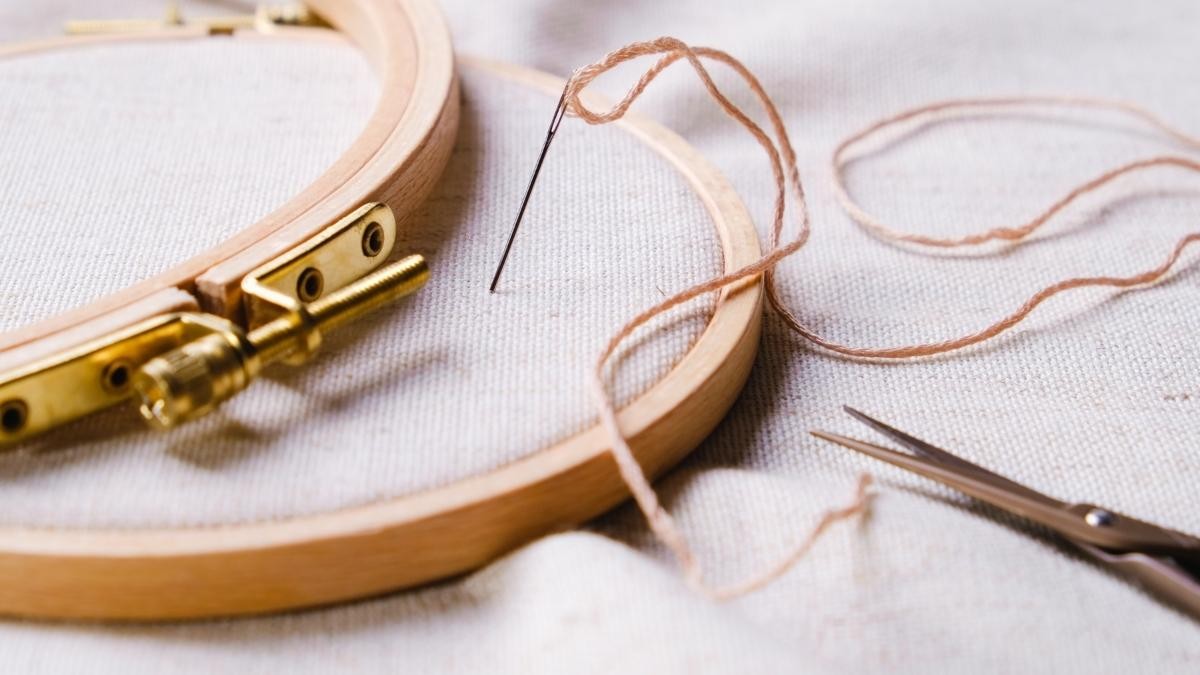
Circular shaped tool used to stretch the canvas. It is also called an embroidery hoop.
Embroidery hoop
This is the other name for the embroidery hoop. It is made up of two parts (two circles) which fit together perfectly. It keeps the fabric taut during embroidery work.
Embroider in one motion
This embroidery technique is used without an embroidery hoop. We always work on the front of the fabric by "laying down" the needle. This faster, but less precise method is used, among other things, for sashiko embroidery or glazig embroidery.
Embroider in two movements
It is a method of embroidery performed when using a drum or a loom. We prick the needle out on the front of the book (1st movement), then we transplant a little further to get the needle out on the back of the book (2nd movement). This technique allows you to be very precise.
Embroidery needle
It is the essential tool to have for embroidery. They are thin with a pointed end and a wide eye for threading different kinds of embroidery thread and preventing them from getting damaged. The embroidery needles are numbered from 1 to 10 (1 being the thickest and 10 being the thinnest).
Embroidery stitch
There are a multitude of more or less complex embroidery stitches: the satin stitch, the needle stitch, the rod stitch, the loop stitch, the knot stitch, the back stitch, the reinforced stitch, the chain stitch. , the built stitch or the famous cross stitch. These are all the stitches that will form the embroidery.
Embroidery thread
Essential element for embroidery, it will form the design of the embroidery. The choice of embroidery thread is made according to the fabric used and the technique. Presented most of the time in the form of a skein, it can be made of cotton (the most used), silk, acrylic, wool, polyester ... It is available in multiple colors, effects and color gradients.
English embroidery
Traditionally made on a fine cotton fabric, cotton batiste or linen, English embroidery consists in creating openwork patterns (openwork) in the fabric at regular intervals that are delimited by simple embroidery stitches. Today, we also use thicker fabrics like jeans or elastic fabrics like jersey.
English embroidery is often confused with lace.
To finish
You never end an embroidery with a knot. To finish the work, insert 5 cm of the thread under a group of stitches on the back of the embroidery.
Gate
This is the other name of the diagram.
Glazig embroidery
Embroidery style from Quimper. These are the colorful embroidery (yellow, orange, green) that can be seen on the traditional costumes worn by the Bretons for special occasions. Formerly made by men with a silk cord, these embroideries often represent geometric patterns or floral motifs. The larger the patterns were on the garment, the richer its owner.
Nowadays, this embroidery technique is taken up by many haute couture houses.
Gold embroidery
It is a very careful form of needlepoint embroidery. Formerly, it was used to adorn military, liturgical or royal clothing ... Today, this technique is widely used in haute couture or in decoration for the creation of jewelry and accessories. To achieve it, we use a smooth or curly cannetille.
No content for this part
No content for this part
No content for this part
No content for this part
Lunéville embroidery
This ancestral embroidery technique, originally from Lorraine, is traditionally performed on cotton tulle or organza fabric to imitate lace. Lun?ville embroidery is performed on an embroidery loom, using the chain stitch. It is always done blind, that is to say on the back of the fabric.
Lunéville embroidery
It consists of embroidering with Lun?ville crochet beads or sequins on cotton tulle, linen or organza fabric. It is performed most of the time on an embroidery loom , using the chain stitch. It is always done blind, that is to say on the back of the fabric.
Lunéville hook
This tool is used for Lun?ville embroidery. It includes a handle into which is inserted a fine hook tip, which looks like a hook.
Luneviller
Embroider with tiny glass or metal beads using the Lun?ville embroidery technique.
Magic needle
Also called "puncher needle", "perforating needle" or "pic pic", it is a special needle, used for the punch needle. This tool consists of a hollow point and a handle. To use it, you have to pass the chosen wool through the hole in the needle and then into the notch in the handle.
Monogram
It is the name of the initial letters which were embroidered in the past on household linen (sheets, towels, napkins, tablecloths ...), the engagement trousseau or the fabric handkerchiefs. When it came to ordinary linen, the embroidery was done in monochrome cross stitch (often red), but when it came to fine quality linen, the embroidery was neat and done white on white.
Needle painting
It is a very meticulous embroidery technique that consists of creating patterns in a hyper realistic way, as if it were a painting. To perform this spectacular embroidery, a fill stitch called the "encroaching past" is used.
Needlepoint tapestry
This is the other name for embroidery on canvas.
No content for this part
Pearl cotton
It is a twisted yarn with a silky feel and satin appearance. Very versatile, it is shinier and thicker than cotton floss. It consists of a single thread.
Peneloper
It is a question of undoing part of the embroidery, following an error. This term comes from the Greek myth of Odysseus. According to legend, Penelope, Ulysses' wife, undid the tapestry she had woven during the day at night, never to finish her embroidery. This ruse allowed her to repel her suitors while hoping for the return of her husband.
Plastic canvas
It is a modern canvas, made from PVC. Plastic canvas is dimensionally stable, which is why it is generally used for making rugs.
Point counted
This is the other name for cross stitch.
Punch needle
It is a relief embroidery technique performed with a tool called a "magic needle".
No content for this part
Ribbon embroidery
It is a technique carried out, not with thread, but with ribbons , often in silk. It allows embroidery of relief patterns. Also called "rococo embroidery", it is most often used to make flowers in volume.
Sampler
It is an embroidery sample that serves as a memory aid for the different techniques. Usually, we put all the different stitches in it.
Sashiko
It is a traditional Japanese embroidery technique , performed by hand. In the past, it consisted in aesthetically repairing or reinforcing worn clothes. Today, its function has become mainly aesthetic. Sashiko in Japanese means "small dots" or "small seams".
Satin
It is a relief embroidery executed on a cloth, with tight stitches, launched from one edge to the other of the previously stuffed pattern, so as to cover it completely. This embossed stitch was used by embroiderers to make monograms. Today, the word "plumetis" refers to a fine, light and transparent fabric, embroidered with small polka dots in relief.
Skein
It is an assembly of threads of the same color, folded several times on themselves and joined together so that they do not get tangled. They are labeled with a number that matches the name of their color.
The skein is typically 8 meters of 6-strand yarn.
Shisha point
The shisha stitch is used in Indian embroidery. This is an embroidery stitch used to embroider small mirrors using a combination of chain stitches and blanket stitches.
Stamen
It is a single-thread canvas that is very flexible to the touch. Beginners like it for the cross stitch, because it is embroidered like linen, but its threads are easier to count.
To start
You never start an embroidery with a knot. On the right side, we stitch a few centimeters from where we want to make our first stitch, then we come out at the start of the embroidery. The first stitches are embroidered over the thread. This way they will block and hide the end of the wire.
Strand
It is the set of threads that make up a skein. Depending on the fabric and the technique used, we take one, two or three strands to embroider.
No content for this part
No content for this part
No content for this part
No content for this part
No content for this part
No content for this part
No content for this part
Credits
Perles & Co, Internet & E-Commerce company [06/01/2022] Any reproduction, representation, adaptation, in any form whatsoever, even partial, is prohibited, except for reproduction for private use not intended for collective use, representation in the family circle (art. L 122-5 CPI) and online publishing on condition that the source is mentioned and a link is included to the corresponding page of our site www.perlesandco.com.