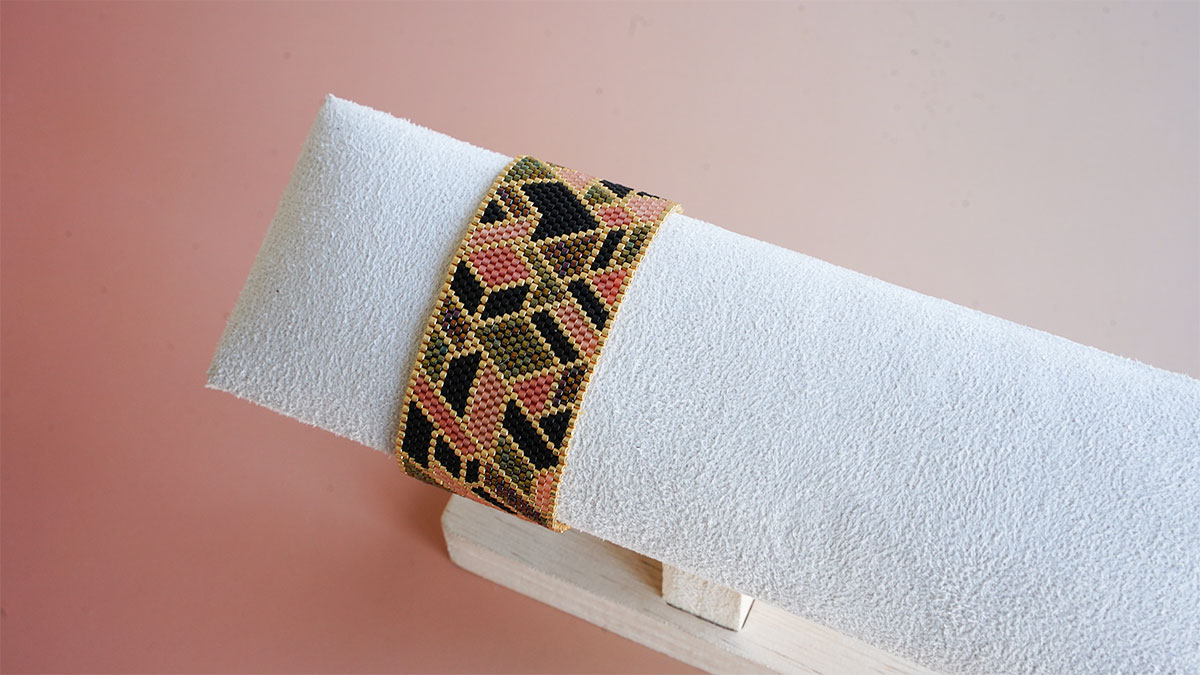
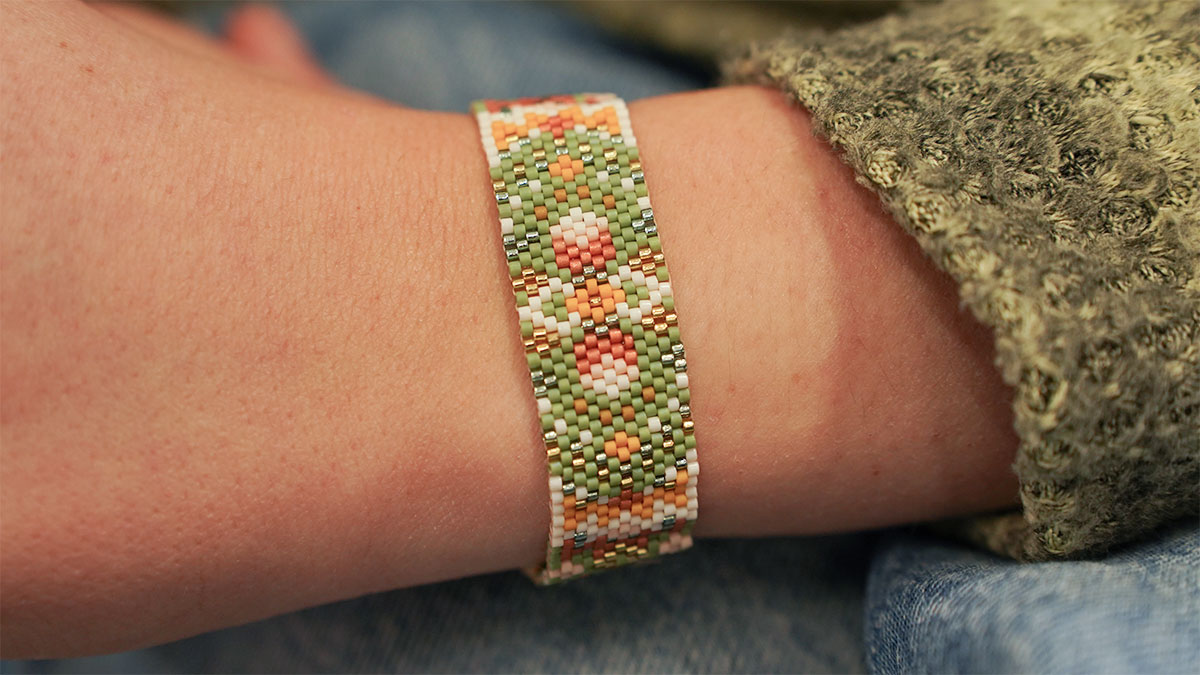
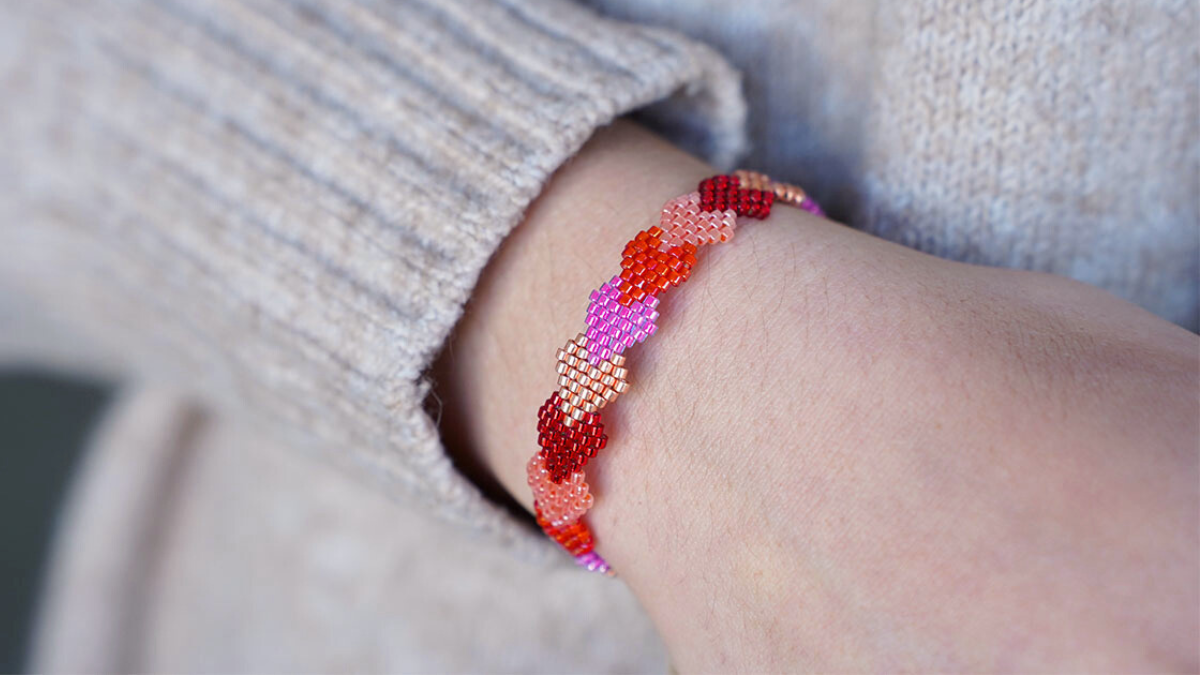
Cut 1.5 m of weaving thread and thread it onto a size 12 needle. Thread the following beads: 2x DB-2191 dark blue, 3x DB-0266 blue, 1x DB-1831 silver, 2x DB-2125 water green. They correspond to the first 2 rows of the weaving. Cross out the beads on the diagram as you string them.
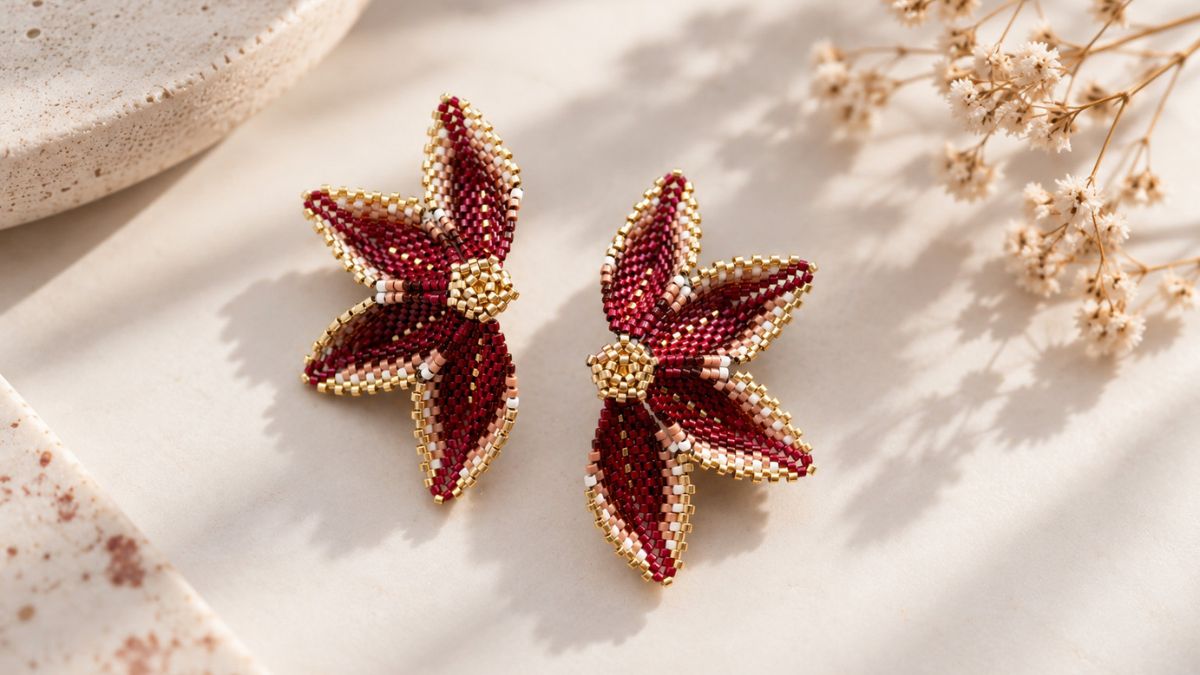
How to weave a Peyote Pair?
How to do a Peyote Pair Weaving?
Peyote Pair weaving is a bead weaving technique that does not require a loom. It allows you to create beaded jewellery with only thread and a needle. It is a very practical technique when you want to try bead weaving without having to buy a loom. It also allows you to take your project with you wherever you go, as the materials take up very little space in a bag: a few bags of beads, a small spool of weaving thread, a size 12 needle and a small beading mat that will keep your beads from rolling off the table. You can also cut up the mat to fit into a small tea cup tray. This will allow you to move from room to room with your work without having to store the beads in the bags.
The technique is totally different from loom bead weaving, however. The beads are not aligned in the same way. If you look closely at the diagram, the beads are aligned lengthwise, but not widthwise, whereas in the case of the loom, they are aligned in both directions. A weaving grid for Peyote is not compatible with the loom technique and vice versa.
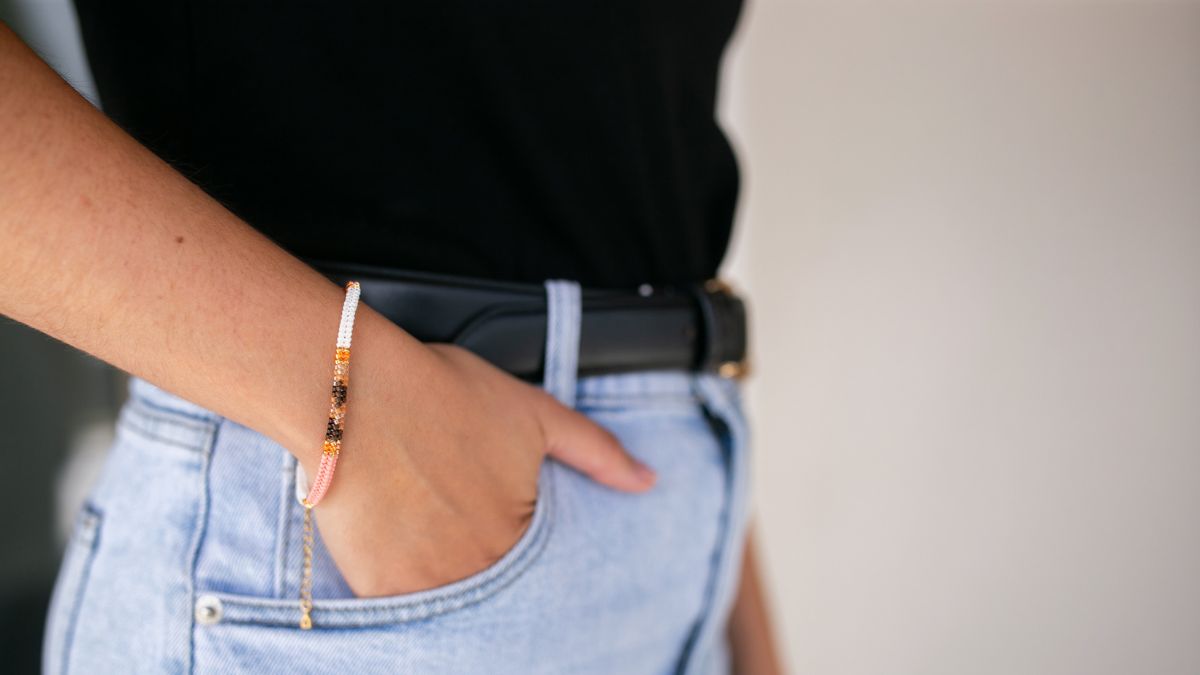
This video will show you how to make this bracelet in Peyote Pair. The Peyote Pair is the easiest of all the needle weaving techniques. So we advise you to start with this one. Afterwards you can move on to the odd Peyote weaving. If you ever have trouble holding your beads, which is totally normal when you are a beginner, you can try the same technique with the Quick Start Peyote tool presented in this tutorial: Miyuki Peyote Weaving Bracelet Pink.
Tutorial steps
Place them 15 cm from the end of the thread and prevent them from falling. There is a small accessory that can be slipped onto the thread to prevent the beads from falling off. It is called a bead stopper.
Thread a blue bead and pass through the next green bead. Place the green and gold beads side by side with your hand.
Then thread a water green bead into the next blue, a silver one into the third blue and a blue one into the last dark blue.
Continue to follow the pattern to make the fourth and following rows. Be careful, because the weaving turns on the first four rows, so follow the pattern carefully.
When you have only 15 cm of thread left, you must replace it. To do this, wedge the thread into the beads by running it diagonally through several beads side by side. The thread should not be visible over the beads. After 3 or 4 diagonals, you can cut the thread. Take a 1.5 m wire and wedge it in the same way and pass it through the beads to return to where you left off.
When the bracelet is almost around your wrist -1cm, add a bead on each bead that is sticking out as shown on the video. These 4 beads will not be visible. They will be slipped into the tube of the weaving tip. Do the same thing on the other side with your remaining piece of yarn.
Close one of the legs of the mouthpiece with a fine clip. Put a little glue on the beads, then slide them into the tube before closing the tab. Do the same thing on the other side, then add the clasp with open rings. Here is a video that shows you how to open and close rings. On one side, put several rings in a row to create like an extension chain and add the charm at the end for decoration.


You have a question about this tutorial? Ask it to our team and the people who have already tested it. The Perles & Co community is here to help you!
Faut il un métier à tisser pour faire ce bracelet ?
.merci
Merci
Avez-vous des embouts qui s'imbriquent l'un d'un l'autre sans devoir utiliser un mousqueton?
C’est la première fois que j’utilise ses embouts. Merci
Credits
Perles & Co, Internet & E-Commerce company [27/10/2021] Any reproduction, representation, adaptation, in any form whatsoever, even partial, is prohibited, except for reproduction for private use not intended for collective use, representation in the family circle (art. L 122-5 CPI) and online publishing on condition that the source is mentioned and a link is included to the corresponding page of our site www.perlesandco.com.