Average Grades
Je me posais pas mal de questions concernant le choix de perles stoppeur. Cette fiche est très bien réalisée et m'a été très utile. Merci!

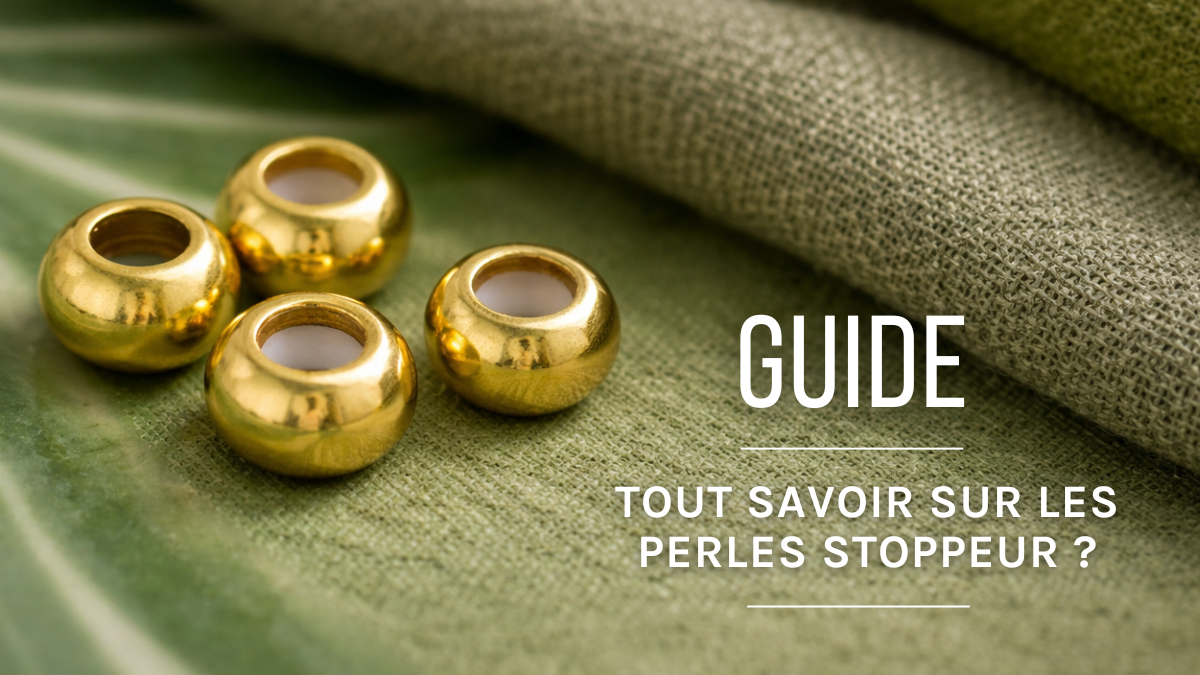
Stopper beads, made of metal with a stretchable rubber or silicone washer, are ideal for adjusting your jewelry, blocking beads or preventing them from falling out. Available in a variety of metals and shapes, choose a bead with a hole adapted to the size of your wire to guarantee optimal use.
Stopper beads are small metal beads with a rubber or silicone washer inside the hole. This washer is stretchy and will grip the thread(s) slightly without creating a permanent fastening. They can therefore be removed.
They come in various types of metal: Gold Filled, 925 Sterling Silver, brass fine gold plated, silver-plated brass, stainless steel, Rose Gold, bronze, etc. They also come in different shapes. Some are simple round beads or fancy shapes, others have a loop for attaching a charm, and some are double. Double stopper beads, in particular, serve as clasps or are used to create multi-strand jewelry.
These beads are primarily used in three different ways:


The hole size is usually listed on each bead’s product page. If this information is missing, feel free to ask our customer service team.
Since the rubber spacer is stretchy, you should choose a bead with a hole the same size as your thread if you want it to slide easily, or choose a bead with a hole smaller than your thread.
If you need to thread your wire through the bead twice—which is often the case when using it as a clasp—make sure the hole is just a tiny bit smaller than twice the diameter of your wire.
When we use the word “wire” here, this also applies to the metal wire of a hoop earring, for example.
If the wire is soft and flattens easily, you can use a much smaller hole.

It’s quite difficult to provide a perfect rule of thumb for determining which stopper beads are compatible with which threads. This is because the bead’s ability to stay in place will differ between a stiff thread and a soft one. Additionally, some threads only have an approximate or rounded measurement provided by the manufacturer. It’s best to rely on what has already been tested in our tutorials. You can also use the table below, which includes a few examples.
"Stop Beads" means that the stop bead fits over a single strand and holds the beads in place.
"Closure" means that the thread can be threaded through it twice and that the bead can be used as a clasp.
| Stop Beads / Threads | Griffin 0.3 mm braided nylon thread (looks like 0.5 mm) | 0.5 mm braided nylon thread | Linhasita thread 0.5 mm | Griffin 0.5 mm braided nylon thread (looks like 0.8 mm) | 0.8 mm braided nylon thread (excluding metallic threads) |
| 3 mm stopper bead with a 0.5 mm hole, Fine gold plated - TAL-372 | Stop Beads | Stop Beads and Clasp | Stop Beads | Thread too thick—cannot be threaded through the needle twice | Thread too thick—cannot be threaded through the needle twice |
| 3 mm stop beads with a 0.6 mm hole in Gold Filled (laminated gold) - GLD-189 | Stop Beads (less restrictive) and Clasp | Stop Beads (less secure) and Clasp (less secure) | Stop Beads (less tight) and Clasp | Stop Beads | Stop Beads |
| 4 mm stop beads with a 0.6 mm hole in Gold Filled - GLD-505 | Stop Beads (less secure) and Clasps | Bead Stops (less secure) and Clasp (less secure) | Stop Beads (less secure) and Clasp | Stop Beads | Stop Beads |
| 3 mm stop beads with a 0.8 mm hole in 925 Sterling Silver Fine gold plated - SSC-625 | Wire too thin | Wire too thin | Stop Beads (less secure) and Clasp (less secure) | Stop Beads | Stop Beads |
| 4 mm bead with a 1 mm hole in Gold filled - GFD-243 | Thread too thin | Wire too thin | Thread too thin | Closure | Clasp |
Since the hole is small, it can be very difficult to thread the string through the bead without a needle. However, sometimes needles that work with your string are too thick to fit through the bead, and when you have to thread the string through the bead twice, it becomes even more complicated. The trick is to wrap a slightly stiff metal wire around the thread to create a sort of makeshift needle. This technique also works with chain. In that case, attach the metal wire to the last link of the chain.
There are also flexible threads with a fine needle already attached. These braided nylon or silk threads are very convenient. Be sure to unroll the thread completely from the spool so you can use the end of the thread first. That way, you can keep using the needle until you’ve used up all the thread.

As mentioned, stopper beads can be used to secure beads on a base or serve as a sliding clasp. Here’s how to attach them in these different scenarios:


Yes, you can use a stopper bead instead of a macramé clasp.
For 1 mm wire (i.e. 2 mm when doubled), use a stopper bead with a hole smaller than 2 mm.
You need to choose a bead with a hole the same size as your wire if you want it to slide easily, or choose a bead with a hole smaller than your wire.
If you need to thread your wire twice through the bead, as is the case when using it as a clasp, then make sure that the hole is just a little smaller than twice the diameter of your wire.
If the wire is soft and flattens easily, you can use a much smaller hole.


Credits
Perles & Co, Internet & E-Commerce company [05/11/2025] Any reproduction, representation, adaptation, in any form whatsoever, even partial, is prohibited, except for reproduction for private use not intended for collective use, representation in the family circle (art. L 122-5 CPI) and online publishing on condition that the source is mentioned and a link is included to the corresponding page of our site www.perlesandco.com.