There are many different types of glass, often classified according to their coefficient of expansion or COE.
COE is a coefficient that takes into account viscosity and thermal elongation.
Murano glass has a COE of 104.
Bullseye glass has a COE of 90.
Float glass has a COE of 82.
It's important to use only glass with the same COE for a given project, to avoid stresses on heating and cooling that could lead to breakage in the long term.
To avoid thermal shock or devitrification, glass melting must follow a firing curve with more or less significant stages depending on the quantity and size of the glass.
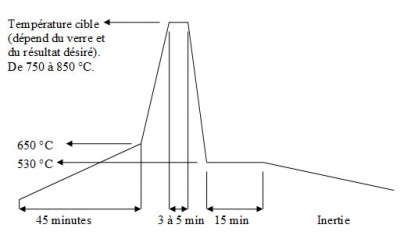
The firing curve shown below is a simplified curve valid for small pieces such as jewelry. The temperatures given are indicative and should be adjusted according to your kiln and the glass used.
From room temperature to 650°C, the temperature should rise in 45 min (at a rate of 867°C per hour).
From 650 to the target temperature, the temperature should rise as quickly as possible (full) to avoid devitrification at around 700°C. Similarly, the temperature must drop as quickly as possible to the annealing temperature.
Annealing (quenching) should last about 15 min at 530°C for small parts.
The temperature should then drop slowly, following the inertia of the furnace.
Typically, fusing projects include the following elements:

Accessories other than glass.
Gold (liquid, like porcelain gold) or thick sheet (paillon).
Silver (caution: stains glass).
Mica-coated ceramic fiber
Mica powder
Copper (in foil or Tiffany ribbon)
Etc
First use:
Place the Hi Gloo container in the center of the microwave oven, having first removed the turntable.
Make sure that the round ceramic paper is centered on the base so that it does not touch the lid.
Place the lid with the hole facing you.
Set the microwave to 800 W and run for about 2 min 30 until a steady orange color is obtained in the hole.
Turn down to 400 W and run for 3 min 30.
Put on your heat-resistant gloves and immediately remove the container from the microwave.
Place on a refractory base and allow to cool to room temperature.
Next uses:
With murines
Make a shape with the flat wire, using the pliers, and close it securely, remembering to make a ring.
Dip the murines in the glue and place them in the shape to fill it completely. Leave to dry for ½ hour.
Place the ceramic fiber on the base, cut a paper divider leaving ½ cm around the form and place in the microwave oven.
Set the oven to 400 W and cook until orange. Then cook for 4 min.
Put on your heat-resistant gloves and check that the mixture is cooked through. If not, cook again, minute by minute.
With dichroic glass
Cook for approx. 3 min at 800 W (orange color).
Then 3 min at 400 W
Another 3 min at 800 W
Additional equipment:
800 W microwave oven
Heat-resistant gloves
Refractory brick
Glass tongs
Glass cutter
Miscellaneous tools...
Thanks to Sabine Aliénor for this data sheet.