Average Grades
Bonjour,je souhaiterai connaître la différence entre les numéros des fils lizbeth .Quel est le plus fin ou le plus gros.Merci
1 Answer
Show answers

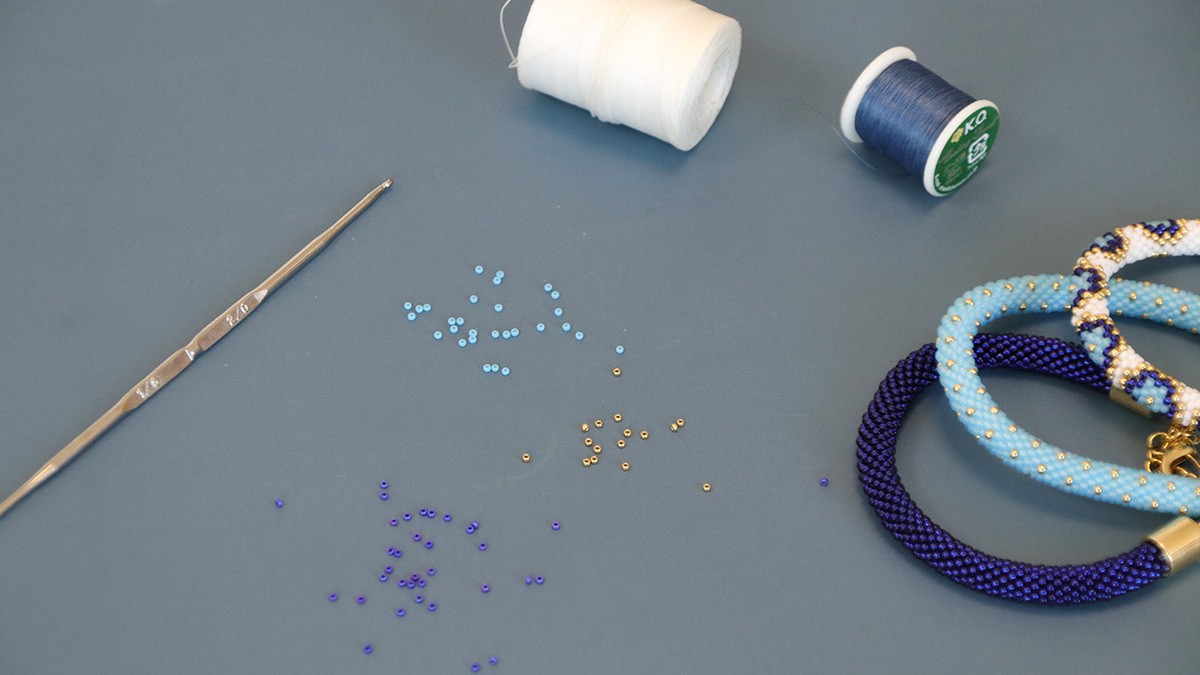
Spiral crochet is a bead-weaving technique that creates a tube of aligned beads. For this method, you'll need a long eye needle, seed beads and a suitable crochet hook, and mastering basic stitches such as cast-on and tight stitch is essential to the success of your project. This technique, although tricky at first, offers superb results with practice.
Attention, we inform you that the following tutorial has been translated by the automatic translator Google Traduction. We are not responsible for the errors caused and we apologize in advance for the inconvenience. Feel free to contact our customer service via this online form if you need help to understand this tutorial.
Level: difficult
In pearl weaving, there is a technique as much loved as feared ... the spiral crochet ! Thanks to this technical sheet, you will learn how to make a crochet spiral step by step. Two options will be presented to you: the technique of the slip stitch and the technique of the tight mesh.
To go further, find our tutorial Crochet spiral bracelet beads Miyuki .
Knowledge required (classical hook)
- Mesh chain (mesh in the air) - abbreviation: ml
- Casting mesh - abbreviation: mc
- Mesh tightened - abbreviation: ms
Equipment
- Long eye needle
- Rocailles 11/0 : wire type C-LON Micro Cord 0.30 mm and hook 0.75 mm
- Rocailles 15/0 : One-G or Ko 0.25 mm type wire and 0.60 mm hook
We work in circles and spirals: unlike the classic flat hook, we do not make a change of rank, we crochet the next stitch as it is. The work takes the form of a tube. The hidden interior consists of the points made with the thread; the exterior, visible only, presents only pearls tight against each other.
If you are not familiar with this technique, it is strongly recommended to practice some time with pearls, a wire and a larger hook. The first ranks are the most difficult. Patience, with a little practice, we get there!
There are two techniques, depending on the number of "beads per turn / rank" of the work (circumference):
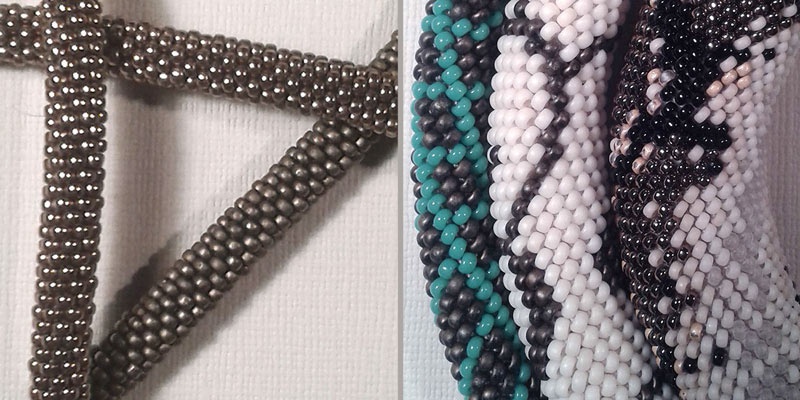
The technique of the slip stitch (left picture) is indicated for spirals that do not exceed 10/12 beads per turn, the beads are lying one above the other.
Beyond 10/12 pearls per turn, we will use the technique of the tight mesh (photo right); the spiral thus formed has diagonally aligned beads.
In both cases, pre-thread the beads on the coil wire (especially do not cut this wire!). Absolutely respect the threading order if the model has a pattern. Crochet, make as many ml as beads per turn + 1, then close in circles (1
mc in the first ml):

NB: Some beaders add the pearls of the first row directly in this row of stitches in the air (forming the starting loop, bring a pearl, 1 thrown, pull the buckle). In this case, disregard the steps marked "1" in the two techniques below.
Technique of the slip stitch
1. First round with pearls. * Stitch the hook in the next ml, advance a bead. 1 cast, cast the two loops together *. We just made the first MC, the pearl is "captured" in a mesh. Repeat * à * as many times as there are pearls for the first round:
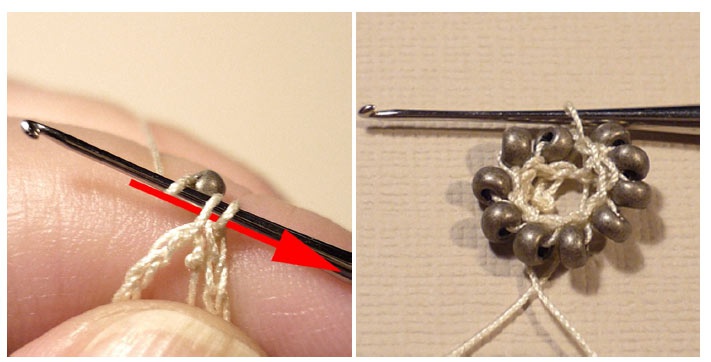
2. Start the second round. Stitch the hook IN THE ARCEAU which bears the pearl of the previous row.
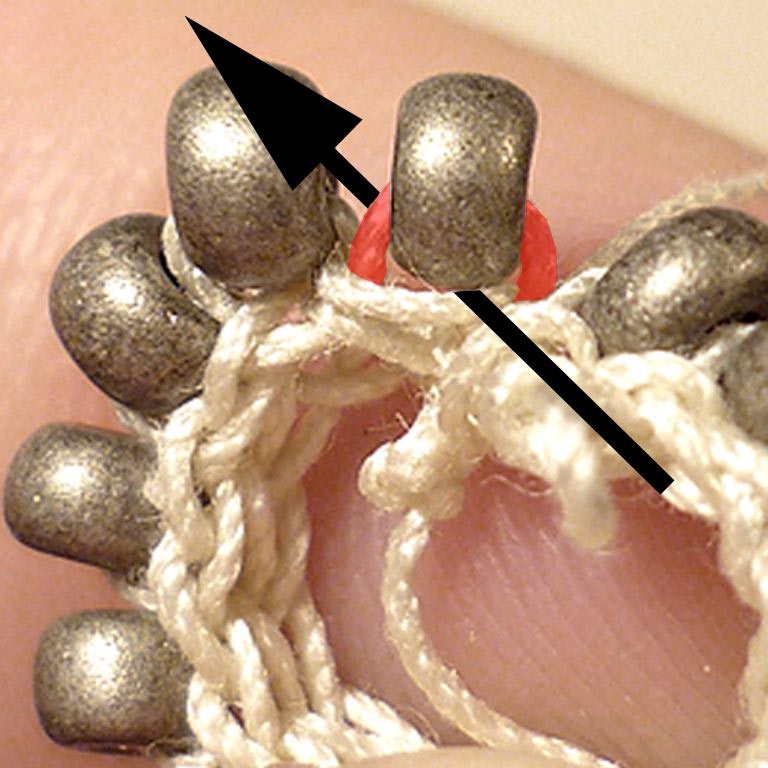
3. Rock the pearl of the previous row to the right of the hook; she goes to bed alone.
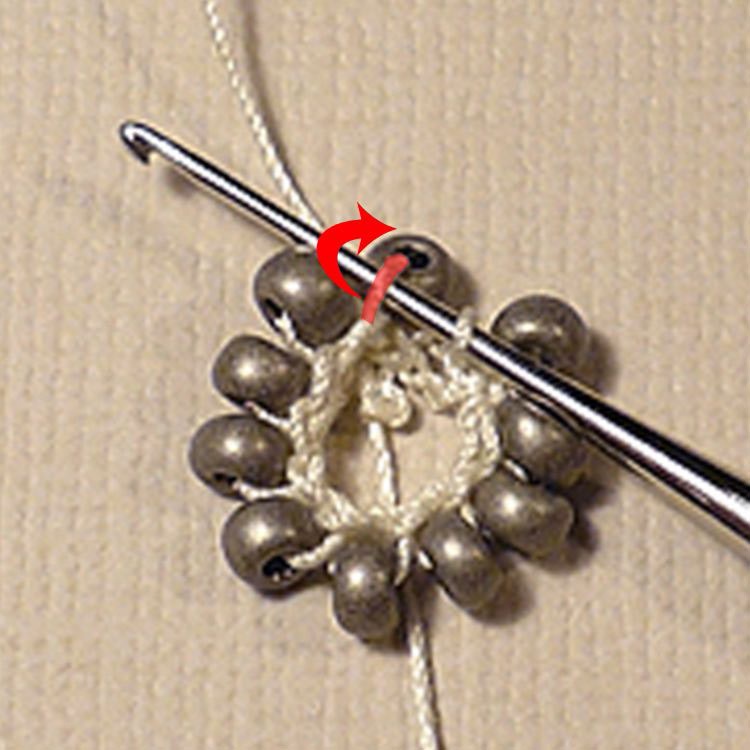
4. Place the working wire BEFORE the tilted bead.
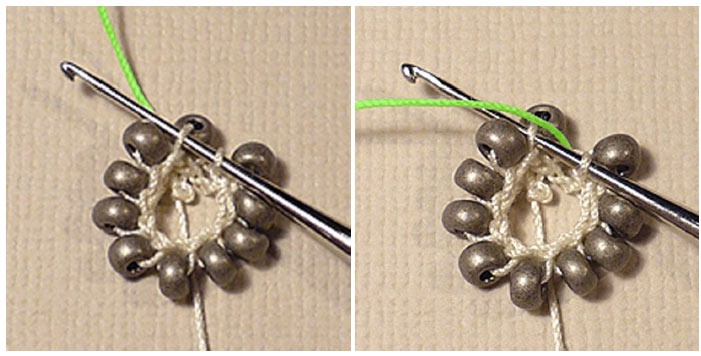
5. Advance a new pearl.

6. Make 1 throw, and cast the two loops together.
Repeat steps 2 to 6 until the end of the work.
Tight mesh technique
1. First round with pearls. * Stitch the hook in the next ml, advance a bead. 1 cast, draw 1 loop, 1 cast, cast both loops together *. We just made the first ms. Repeat * at * as many times as there are beads for the first round.
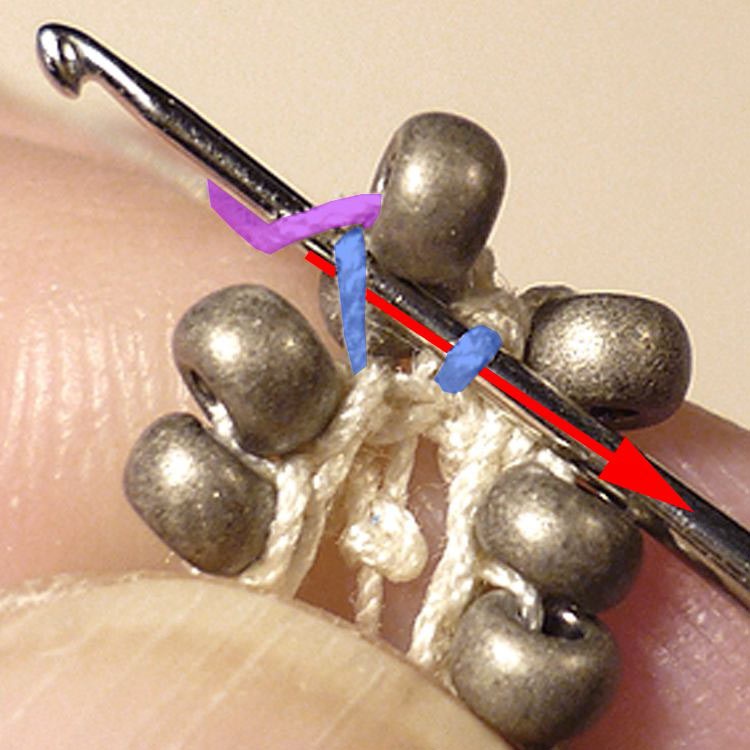
2. We move to the second round. Prick the hook IN THE "V" of the stitch, under the pearl of the previous row.

In red, the first mesh "V". One hooks the hook through to make the first point in tight mesh. In blue, the next "V" mesh. It is through it that we will sting to make the second stitch tight. And so on all around work.
3. Advance a new pearl.
4. 1 thrown, one draws a loop, 1 throws, one sinks the two loops together.
Repeat steps 2 to 4 until the end of the work.
Change of thread
The manufacture of a crocheted spiral does not always allow the threading of all the pearls necessary for the realization of the jewel. It often happens that we work in portions. Similarly, we can arrive at the end of the reel before having finished the work. You must learn to change the thread.
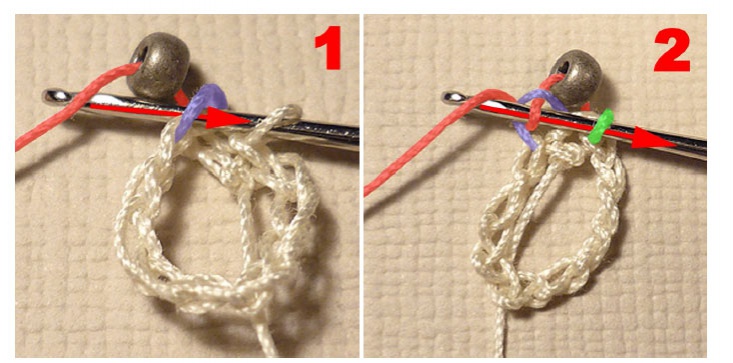
Cut your thread keeping 10/15 cm of margin. Thread your new thread in the eye of a needle, and prick it from top to bottom in the two arches (in blue on the picture) from which the loop (in red) that was on your hook came out:
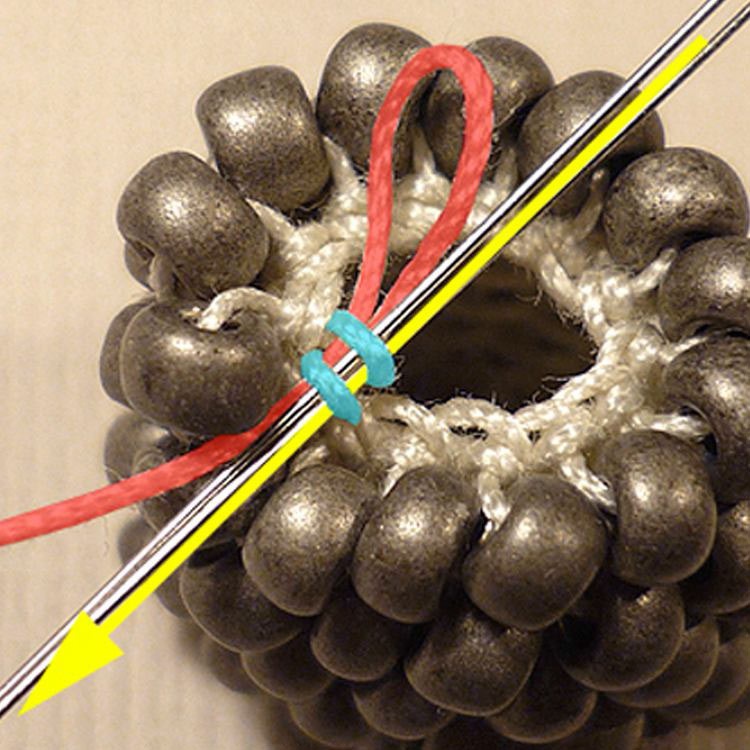
Iron the hook in the loop, and continue crochet with the new thread. The operation is invisible. You will return the old thread and the end of the new in the pearls of your work to hide them (we never knot).
Increases and decreases
Some models (necklaces in particular) require that we know this technique.
The increase of a pearl is foreseen on the previous rank: to crochet a point with a pearl normally, then to crochet another point in the same mesh but without pearl this time. This stitch will be crocheted with a pearl on the next row.
To reduce the work, just skip a stitch of the previous rank.
Finishes
When the spiral is right for you, keep 10/15 cm of wire and cut it. Pass it through the loop of your hook (1 throw) and tighten. We must now make the fasteners, you will need the following equipment:
- 2 metal round head nails
- 2 metal caps (tips with a hole), check their diameter, they must accept that of your spiral.If this is not the case, you can achieve with 11/0 delicas and rockeries 15/0: work peyote a flat round until you reach the diameter of your spiral, then stop the increases and continue in circular peyote on a few rows to form the tip.
- Open metal rings and clasp of your choice
- Round forceps
- Flat pliers
- Cutting pliers
- Needle + thread
Attach the round head nail to the end of the spiral with thread and needle.
Thread the cap on the nail. It encloses the first rows of your spiral.
Using the pliers, form a loop with the nail, to lock the cap in position.
Cut the superfluous thread of the nail.
Repeat the same operation at the other end of the spiral.
Add an open ring on one side, an open ring and the clasp on the other:
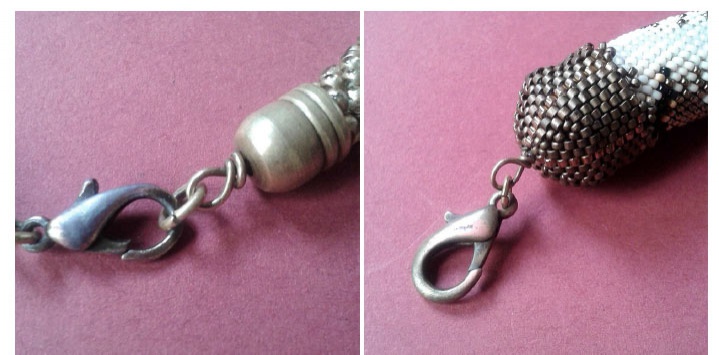
Your jewel is finished.
Various tips
- Some beaders offer to crochet several rows without pearls at the beginning and the end of the work, which can be practical during finishing, if the caps are too small to accept the diameter of the spiral.
- It is also possible to start the first rows with larger pearls; we will take care to hide them in the caps or to disassemble with care these first ranks when the spiral has been formed.
- Between two beadings, it is recommended to fix a safety pin in the loop of the hook. An unraveling has happened so quickly ...
- Spirals of large diameter tend to collapse, especially if worn on bracelets. Before finishing, it is necessary to insert a padding (polyester flakes for example), a cord or a flexible plastic tube.
- Approximate calculation of the total length of beads to be pre-threaded: the desired length of spiral (in cm) is multiplied by the number of beads per revolution (circumference). Ex: bracelet of 15 cm x 6 beads per turn = 90 cm of beads to put on the thread.
- An error while threading? You have the option of breaking the threads of your spool with pliers, being careful not to cut your thread.
Good beading!
Produced by Tomahna for www.perlesandco.com, February 2015.
All rights reserved. Reproduction, even partial, prohibited without the agreement of the author.

Credits
Perles & Co, Internet & E-Commerce company [19/05/2022] Any reproduction, representation, adaptation, in any form whatsoever, even partial, is prohibited, except for reproduction for private use not intended for collective use, representation in the family circle (art. L 122-5 CPI) and online publishing on condition that the source is mentioned and a link is included to the corresponding page of our site www.perlesandco.com.