Average Grades
Chez nous il a beaucoup de pyrite mais il a personne pour acheter ou Congo
0 Answer

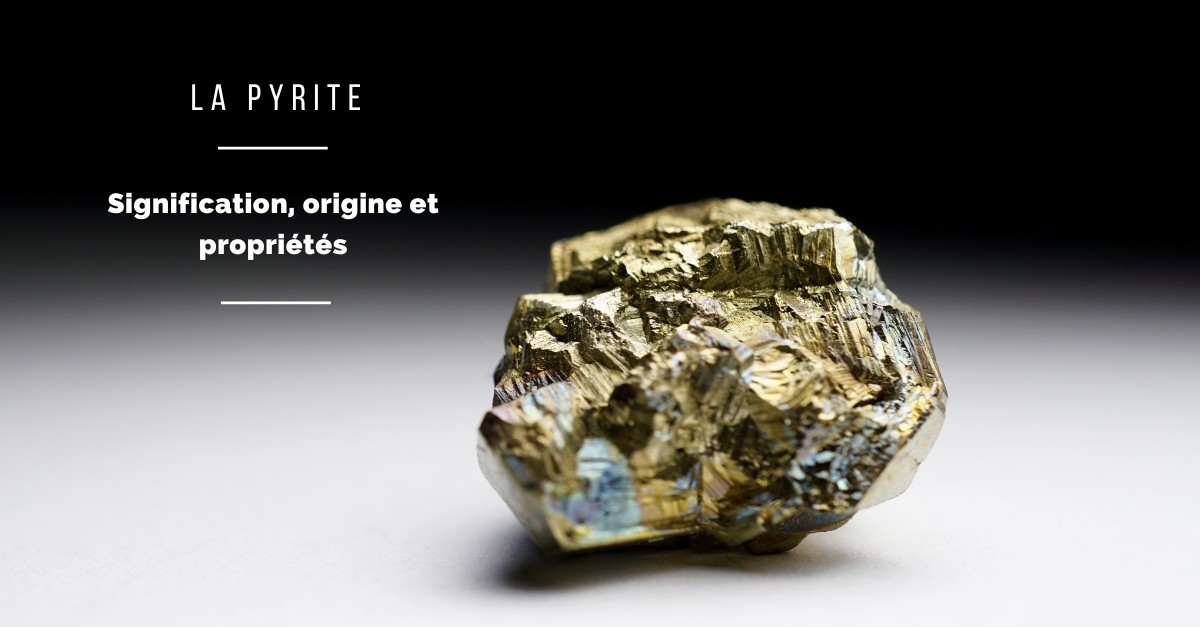
Pyrite, with its golden color and metallic luster, is often called "fool's gold" because of its deceptive resemblance to real gold. Mined primarily in Peru, Italy, and the United States, it is prized for its aesthetic appeal in DIY jewelry, adding a touch of sophistication to your creations.
With its golden luster and metallic sheen, pyrite has fascinated people for centuries with its luxurious appearance, reminiscent of gold. This natural stone not only adds a touch of sophistication to your DIY jewelry creations, but it’s also prized in crystal healing for its protective and energizing properties.
Get inspired by our natural stone jewelry tutorials and incorporate our pyrite beads into your designs to create one-of-a-kind jewelry.
The name of this gemstone comes from the Greek “pyrites lithos,” which means “the sparkling stone.”
It is also called “fool’s gold.” This nickname comes from its deceptive golden luster, which misled many miners—particularly during the Gold Rush in the United States—into believing they had discovered real gold deposits.
It was also called “the stone of the Incas” because of its importance in Inca culture.
Pyrite was already known in prehistoric times. When struck against another stone, such as flint, it produced sparks and was used to start fires. Artifacts found at archaeological sites show that this method was used by many prehistoric cultures around the world.
In ancient Greece, it was used to make jewelry.
Among the Incas, it was used in religious rituals and ceremonies. Because of its golden luster, it was considered a sacred stone associated with the Sun, which the Incas worshipped as a god. It was polished to serve as mirrors used during rituals.
They also used it to create jewelry and ornaments.
Medieval alchemists were fascinated by this gemstone because of its deceptive resemblance to real gold. Although it contains no gold, alchemists believed it possessed mystical properties that could be harnessed to transmute it into gold.
This gemstone was sometimes used as a source of golden pigment in art and decoration. In particular, illuminated manuscripts and certain medieval paintings used pyrite powders to create golden and metallic effects. This practice was not as common as the use of real gold leaf, but it offered a less expensive alternative.
During the Victorian era, jewelers used it to make jewelry—such as brooches, rings, necklaces, and other pieces —because of its attractive golden luster. This practice was particularly popular because it offered an affordable and aesthetically pleasing alternative.
It wasn’t until the mid-19th century that it was given its current name, which was coined by the Austrian mineralogist Wilhelm Karl Ritter von Haidinger.
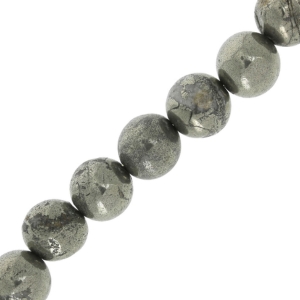
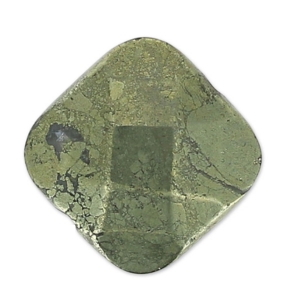

It is usually golden or brass-yellow in color with a bright metallic luster. It is completely opaque.
This gemstone has a hardness of 6 to 6.5 on the Mohs scale and a density of 5 g/cm³.
It consists of crystals that often take on a dodecahedral shape with pentagonal faces, commonly known as pyritohedra.
The main deposits are in Peru, Italy, Greece, Spain, the United States, Mexico, China, and France.
In crystal healing, pyrite is a natural stone recognized for its many benefits. Considered a powerful protective stone, it is known for warding off negative energies and energy pollution. It is said to help reduce anxiety and stress, promoting a calm and balanced state of mind. Some beliefs also claim that it helps boost self-confidence and willpower. It is often used to stimulate motivation and help overcome emotional blocks.
This gemstone is primarily associated with the solar plexus chakra, where it is said to strengthen self-confidence, vitality, and willpower. It is believed to help manifest desires and increase personal energy.
It is also connected to the root chakra due to its protective properties and its ability to ground energy. It is said to help stabilize energy, dispel stress and anxiety, and foster a sense of security.
It is the birthstone for those born under the zodiac signs of Aries, Libra, and Leo.
Please note: Our gemstones are not sold for the purpose of crystal healing. The effects of gemstones have not been scientifically proven. Natural gemstones are in no way a substitute for medical expertise or medical treatment.
Over time, your stone—like all natural stones—can accumulate negative or unwanted energies. This is why crystal healers recommend purifying and recharging it regularly so that it regains its effectiveness.
There are several ways to purify your stone: you can run it under a gentle stream of water for a few minutes or pass it through the smoke of sage, incense, or palo santo.
To recharge it, sunlight is ideal.
This natural stone pairs equally well with both golden and silvery hues. The choice of metal depends on the style of jewelry you want to create and the aesthetic effect you’re aiming for. Whether you opt for gold-plated or Gold Filled for a classic look, brass for a vintage style, or925 Sterling Silver andstainless steel for a modern design,
Which stones pair well with pyrite? In crystal healing, it can be paired with several other stones, such as citrine, rock crystal,hematite, carnelian, oramethyst, to enhance or balance its effects.
However, it is generally not recommended to pair this gemstone with stones whose energies might conflict with its properties, such as selenite.
Credits
Perles & Co, Internet & E-Commerce company [28/09/2024] Any reproduction, representation, adaptation, in any form whatsoever, even partial, is prohibited, except for reproduction for private use not intended for collective use, representation in the family circle (art. L 122-5 CPI) and online publishing on condition that the source is mentioned and a link is included to the corresponding page of our site www.perlesandco.com.