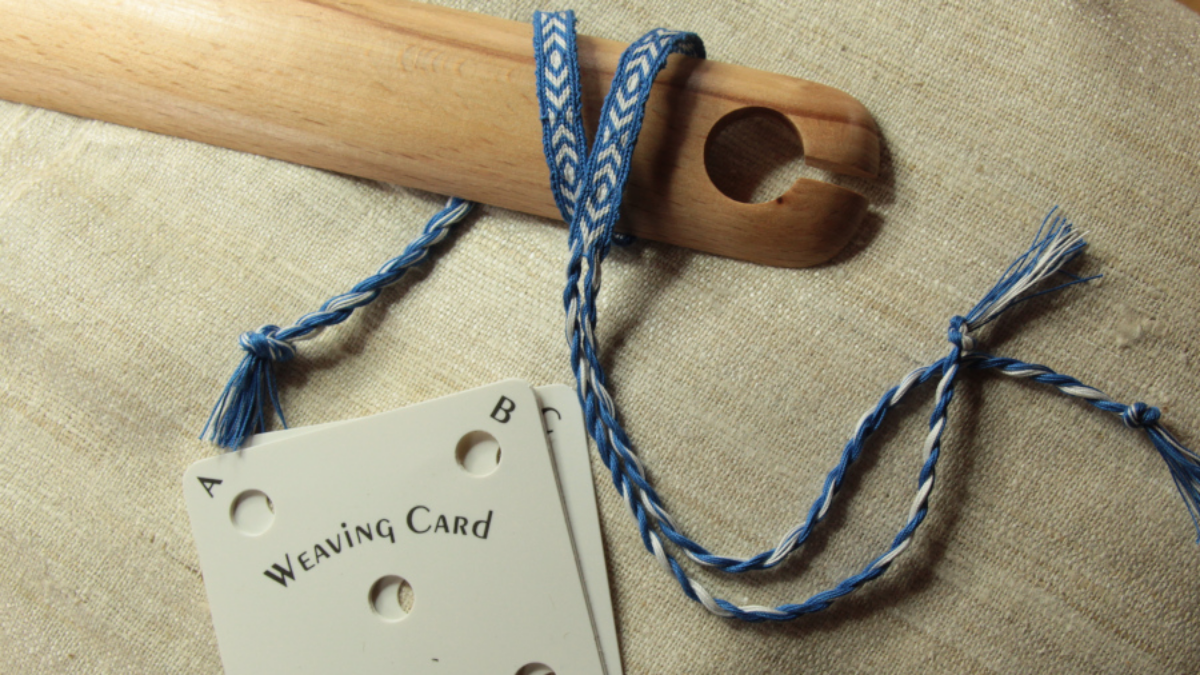
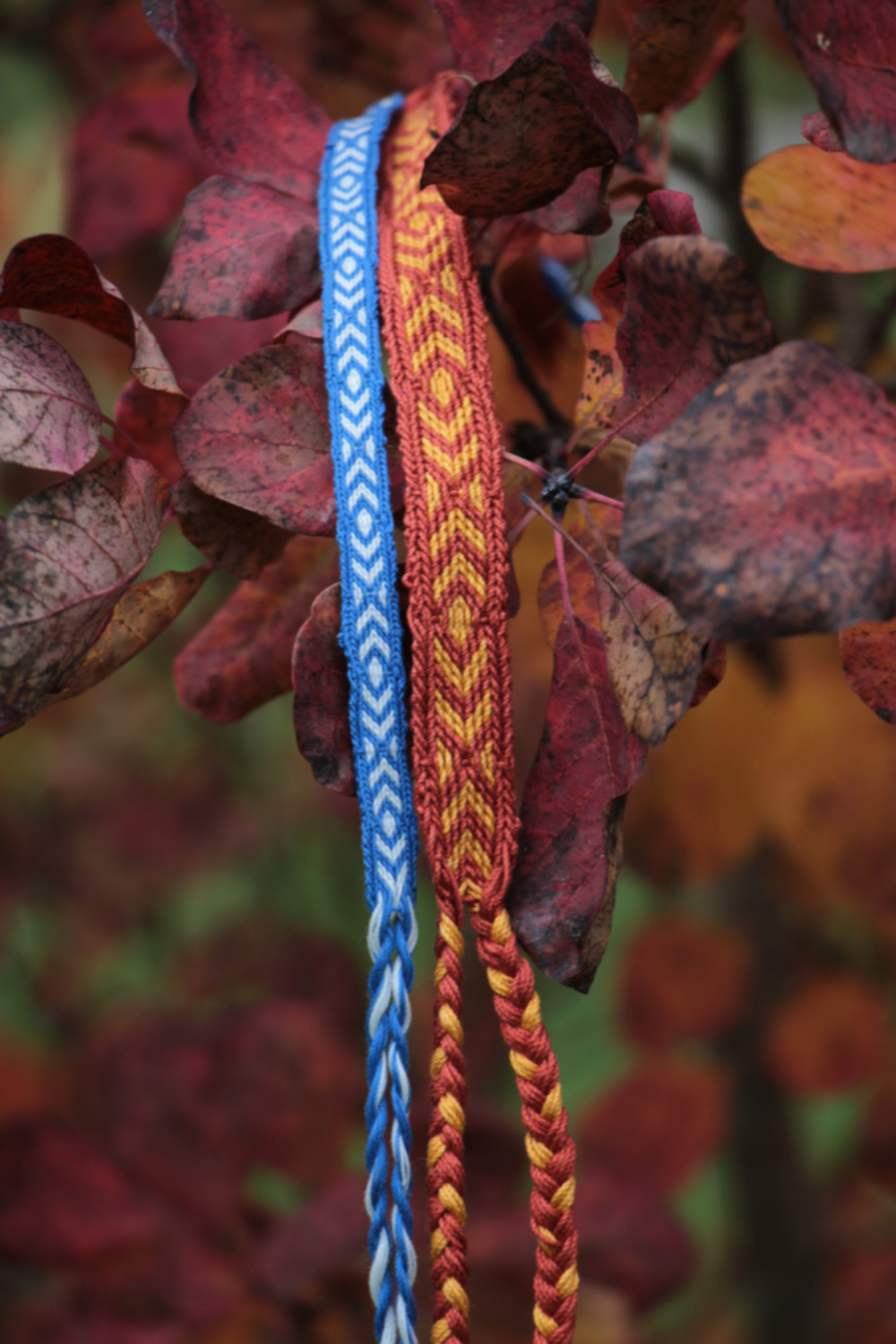
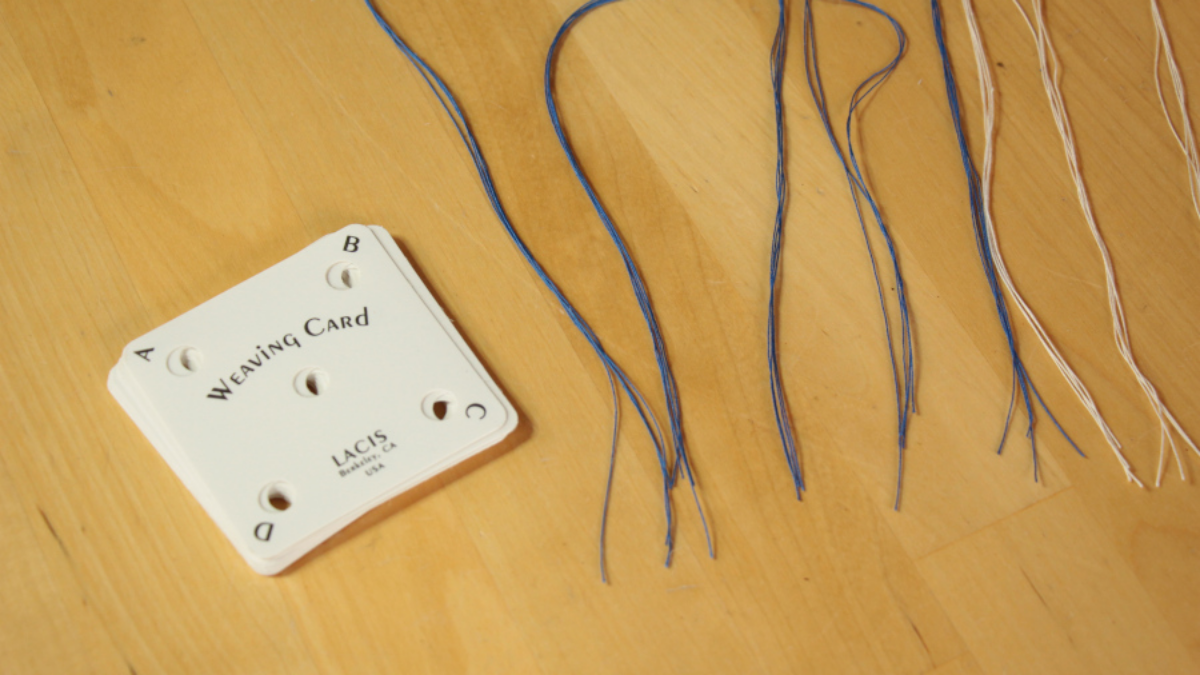
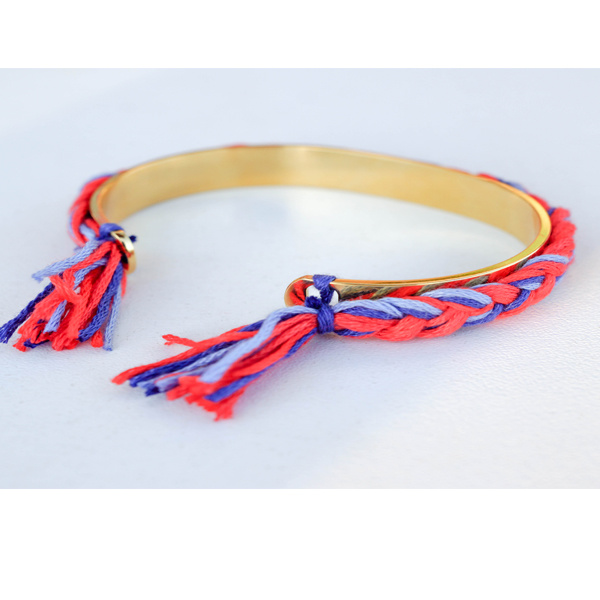
Have you ever heard of card weaving or tablet weaving? Our partner l'Atelier de Micky shows you how to use weaving cards to make woven braids of varying widths to make woven bracelets. If you don't know this very old technique of weaving threads , this is the opportunity to try it!
The technique may seem quite complex at first glance, but Micky explains the steps step by step in the tutorial below and in the video. Once you've got the hang of it, you're done. This tutorial and the card weaving diagram is specially designed for beginners. With this tutorial, you will be able to make a two-tone bracelet out of cotton threads. Generally speaking, card weaving allows you to obtain a result quite similar to a Brazilian bracelet weaving with the difference that it is not knots but twisting of threads. This technique allows you to create mixed or unisex jewelry. Micky explains all you need to know in the video. It's up to you ;)
Don't hesitate to have a look at our size 40 cotton threads used for the blue and white bracelet as well as our size 10 cotton threads for a thicker weave (orange and yellow bracelet in the video). You can also find color suggestions in the "variation" material list at the bottom of the page.
To go further and experiment with other weaving patterns, you can downloadother weavingdiagrams made and generously shared by Micky.
You will need 10 weaving tablets and 28 dark and 12 light threads of 90cm each. Choose colors that contrast well, it will be easier to spot any mistakes.
Tip: To avoid having a pile of threads that could get tangled up, it is advisable to cut them as you thread them onto the cards. Number your cards with a pencil from 1 to 10.
Step 2
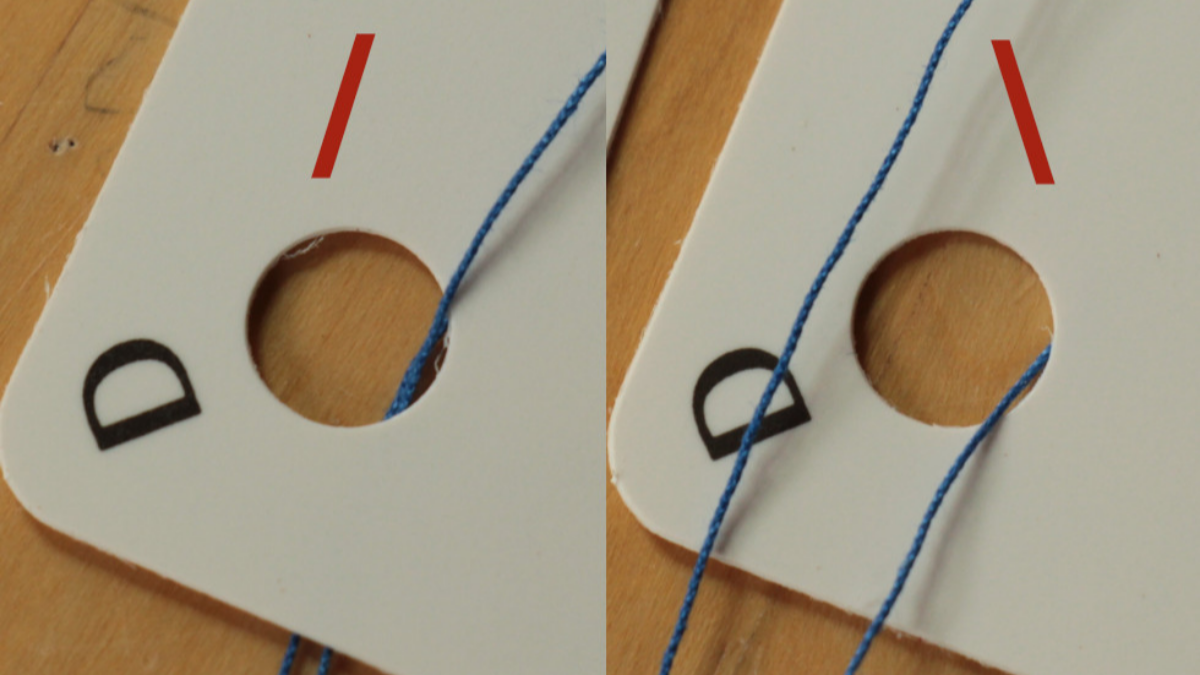
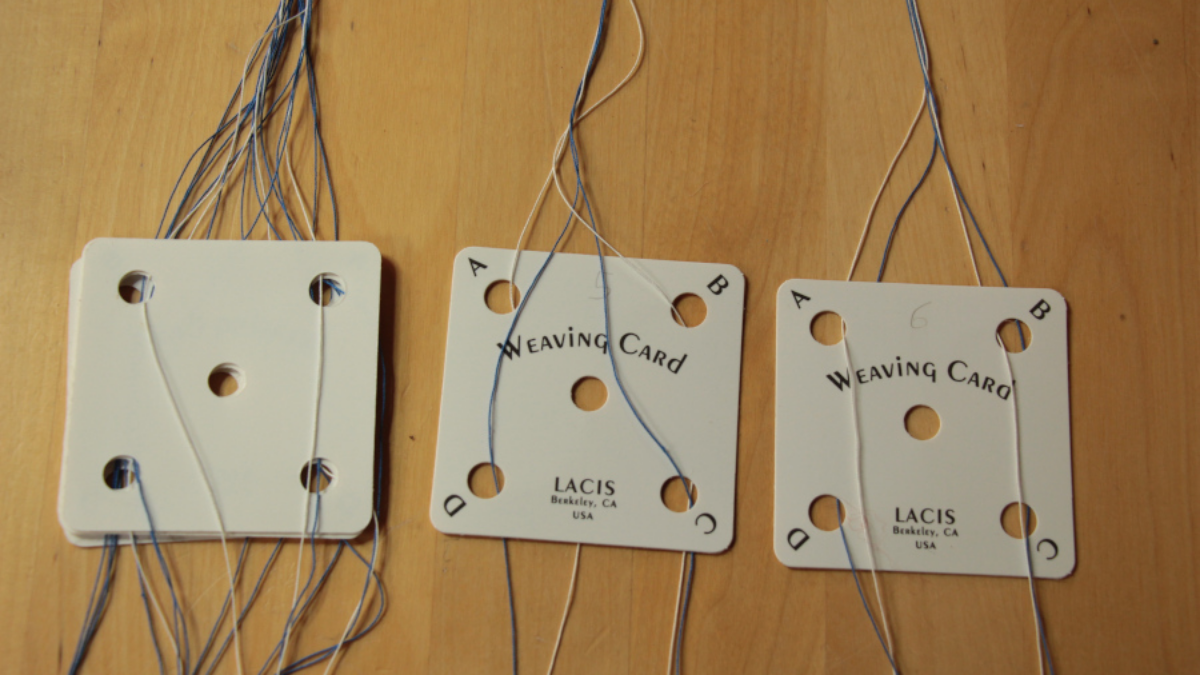
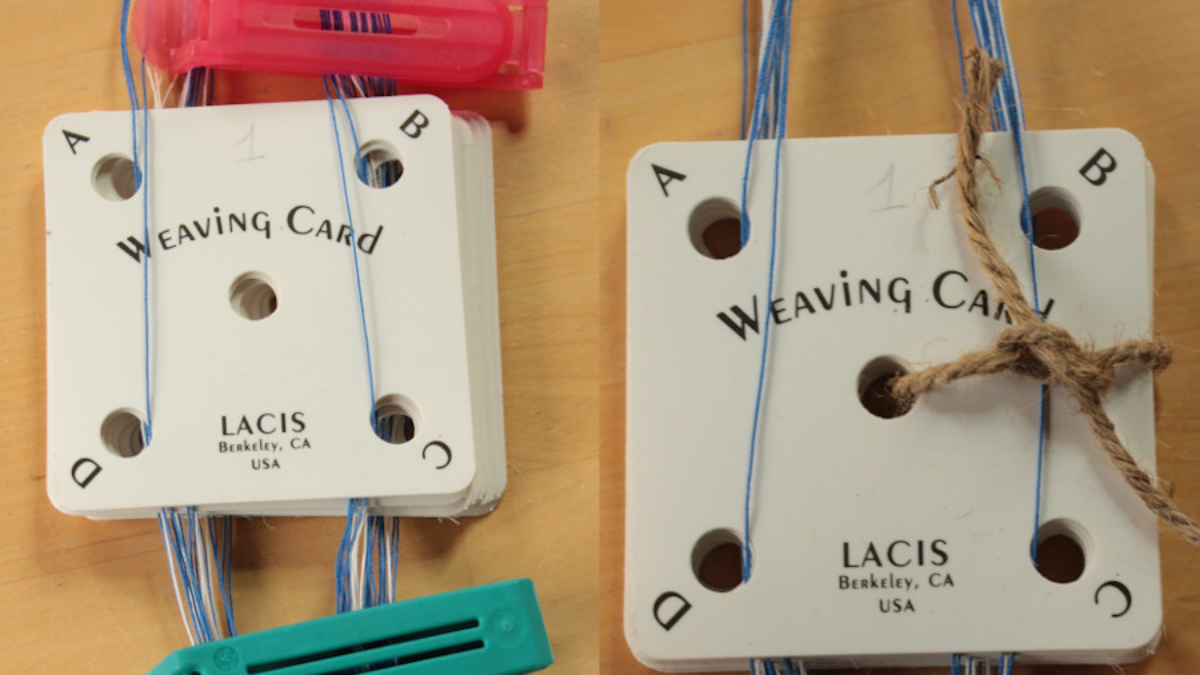
Thread the wires onto the shelves. It is very important at this stage to make sure you don't get the wrong direction! Follow the diagram provided, each column of the diagram represents a card and the boxes tell you whether to thread a dark thread (gray boxes) or a light thread (white boxes). The signs : and / indicate the direction in which you must thread your thread and this step is essential!
: your thread will go from the front side of the card (where the letters " ABCD " are written) to the back side
/ : your wire will go from the back of the card to the front
Tie the 4 wires of each shelf together.
Step 3
Lay your shelves face down on the table, making sure that the length of yarn between the knots and the shelves is even.
Step 4
The hardest part is done! Now you have to stretch and secure the weaving warp. There are several ways to do this, the easiest being to attach the end to a fixed point, such as a door handle or a clamp attached to a table.
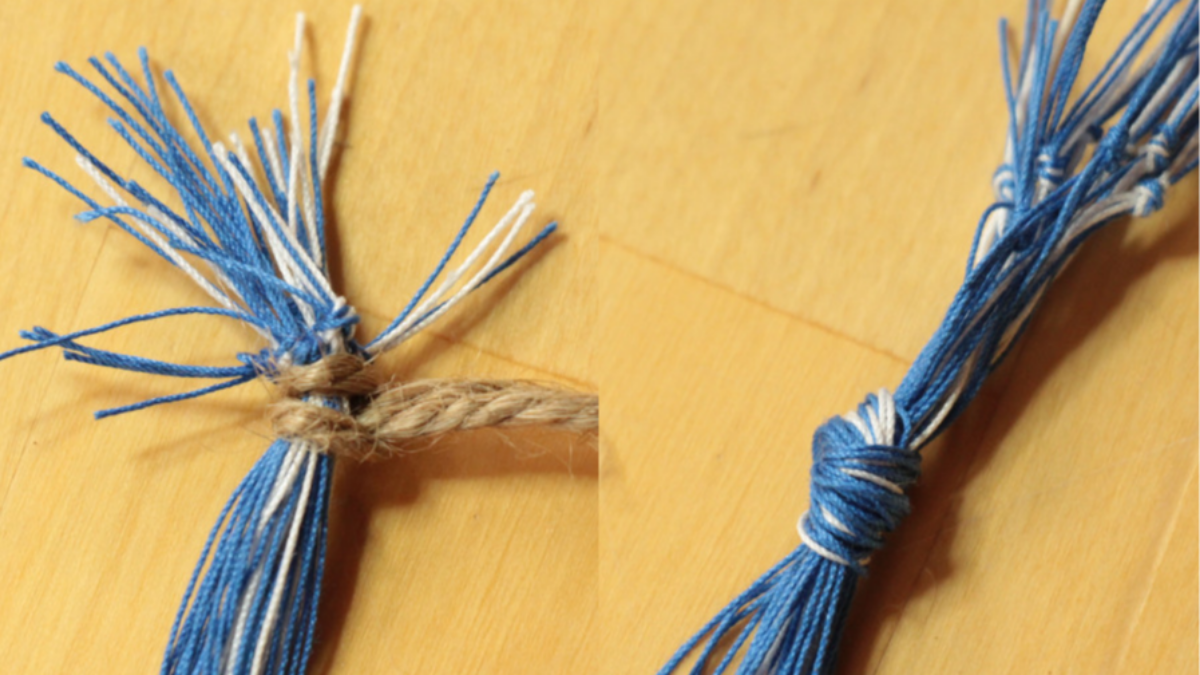
First, gather all the ends of the threads that you have knotted 4 by 4. You can tie a final knot or use a strong string to make a slip knot. Be careful that your tablets don't get mixed up or fall off during this step!
Step 5
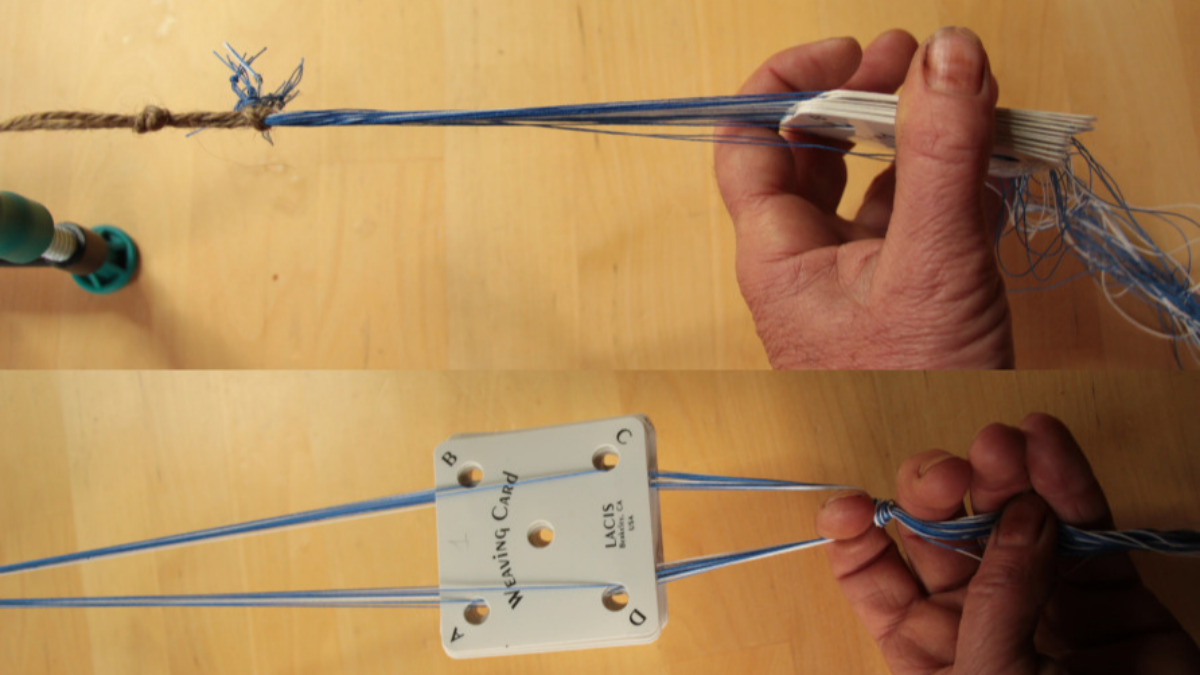
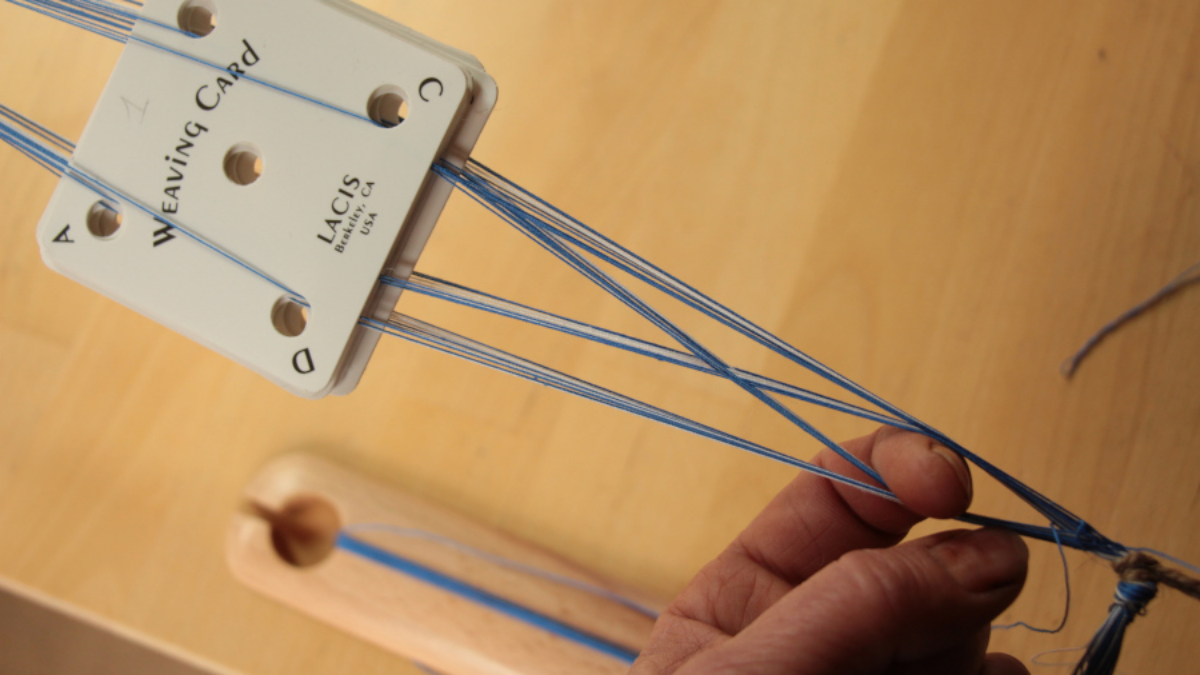
Tension the warp. Attach the end of your weaving warp to the fixed point and gather your deck of cards in one hand.
Then, gently pull the deck of cards toward you so that you are stretching and possibly untangling some of the threads. You can "comb" the threads behind the cards with your fingers to make this process easier. Don't go too far, we will keep a margin. When your wires are untangled and all tight, tie a final knot about 20 centimeters from the end of the chain.
The chain will tend to wrap around itself, so simply rotate the deck of cards to undo any twisting.
Step 6
It's a good idea to secure your bundle of shelves whenever you handle the chain (for example, to move it and secure it elsewhere, or to store it).
A string around the package through the center hole or plastic clips will do the trick.
Step 7
Attach the end knot to your belt or to a second fixed point such as a clamp (using the loose threads or using string or a clip).
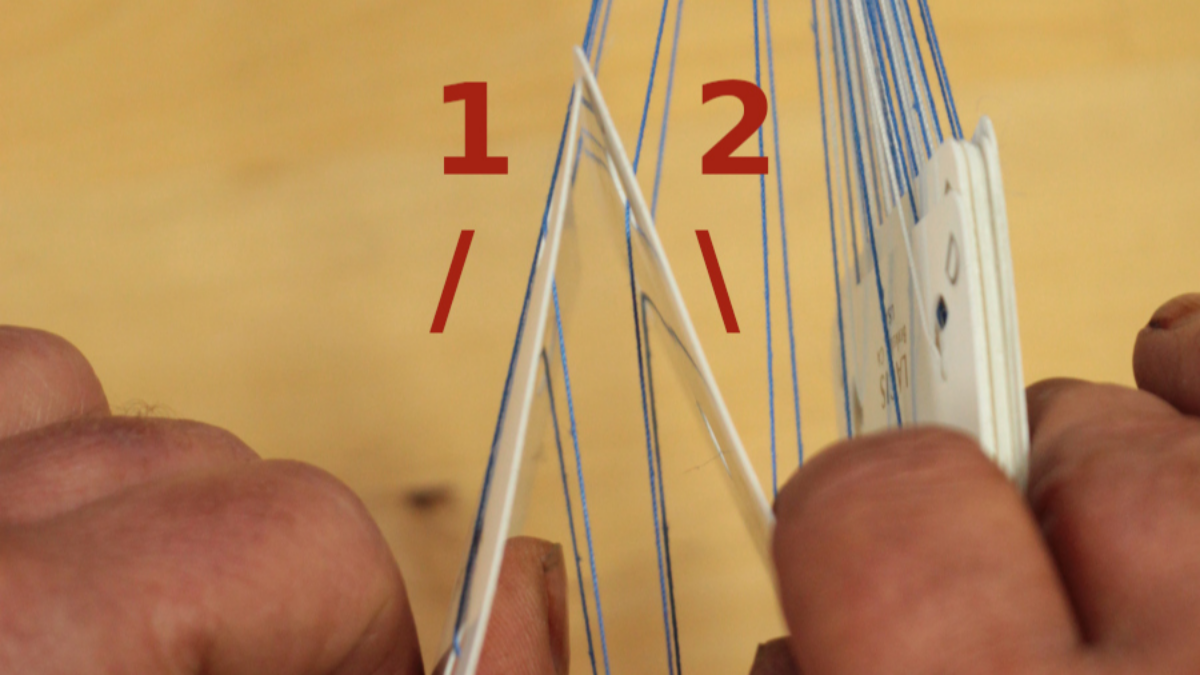
Now it's time to check your threading using the diagram provided: first, make sure that the A, B, C and D are lined up in your deck, if not just turn the card so it's in its place. Is everything okay? Then it's time to check the threading: remember the signs and / from the starting diagram? If you look at the cards in front of you and try to tilt it to the right or left, you will see that some naturally tilt to the right, these are the shelves in the / position. On the contrary, the others will tend to tilt naturally to the left, these are the cards in position . Make sure that each card is correctly inclined in relation to the starting diagram!
Next, we will check if the suits are in the right position, always with the help of the diagram. If one of your cards is not in the right position, it is better to put your pack down, undo the final knot that is towards you and redo the threading correctly.
Step 8
Start weaving, it's about time!
Sit comfortably so that your warp is taut, but not too taut either, you need a warp that stays a little flexible. At first it's a little difficult to find the right tension, but you'll learn. Wrap some thread (preferably the color of the borders) around your shuttle or a rectangular piece of cardboard, this will be your weft thread.
Take your deck of cards and turn them all together so that the A is up towards you and the D is up towards the warp, this is the starting position found on most card weaving diagrams found on the internet. Your cards should not be too close to the knot facing you, if necessary, push them forward without turning them. When you turn the shelves a quarter turn, 2 out of 4 threads will cross each other, you will have to make sure they find their new place.
Step 9
It's time for our first weft passage!
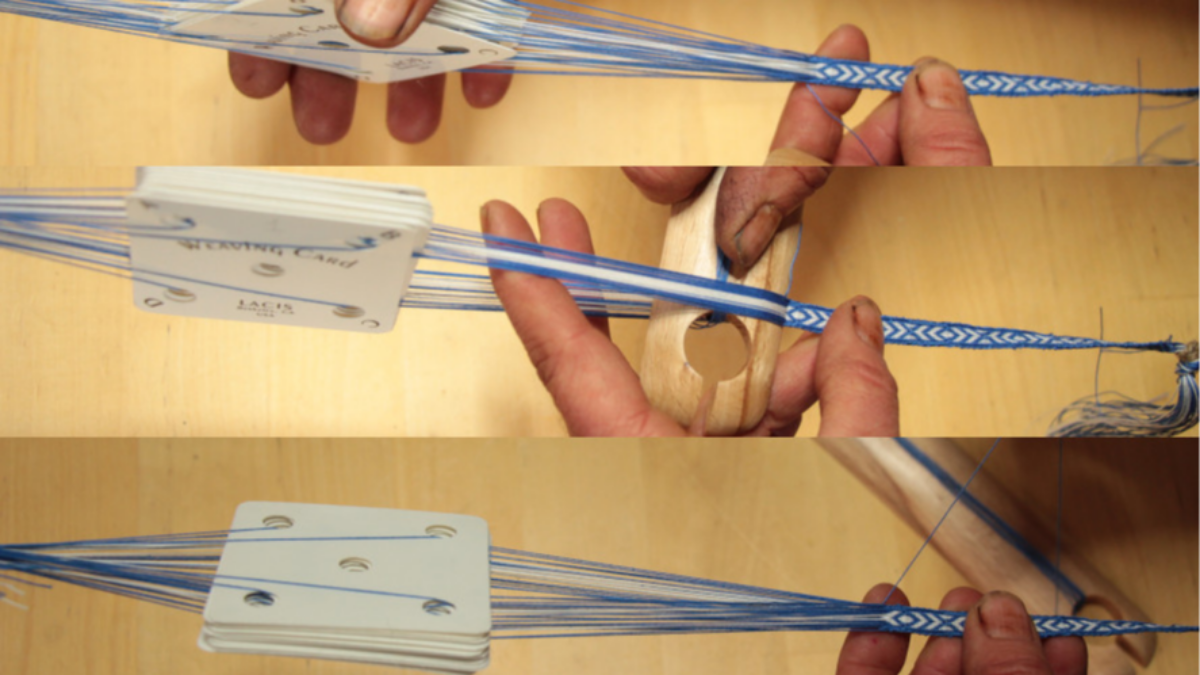
The threads form two layers, one at the top and one at the bottom, and it is through this space (called the "shed" in weaving) that the weft will pass. Pass simply pass your weft thread on the shuttle in this space and leave a small piece of it sticking out.
Turn all the shelves forward (towards the warp).
Pack with your fingers, your shuttle or a plastic ruler, then pass the shuttle back through the crowd without pulling too much on the thread: just make sure it doesn't loop along the edge.
And we start again until we find our starting position with A up towards us! We have done 4 quarters. In all we will make 12 quarter turns towards the front with always the same song: I turn the cards, I pack and I pass my weft.
Step 10
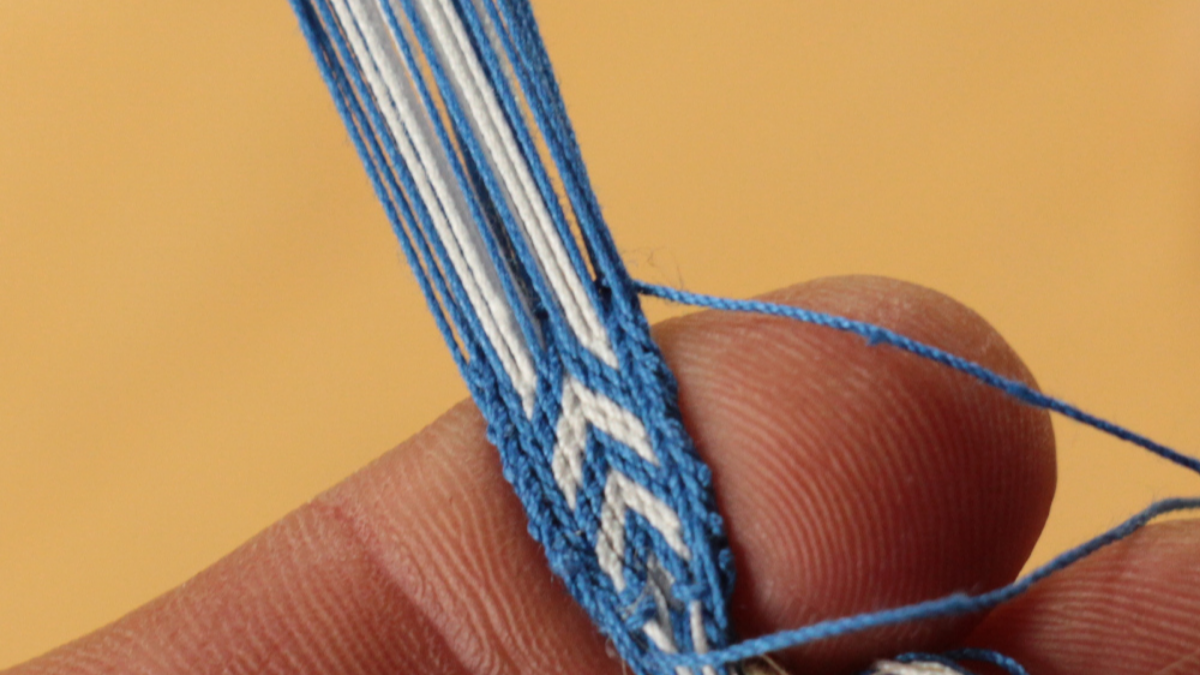
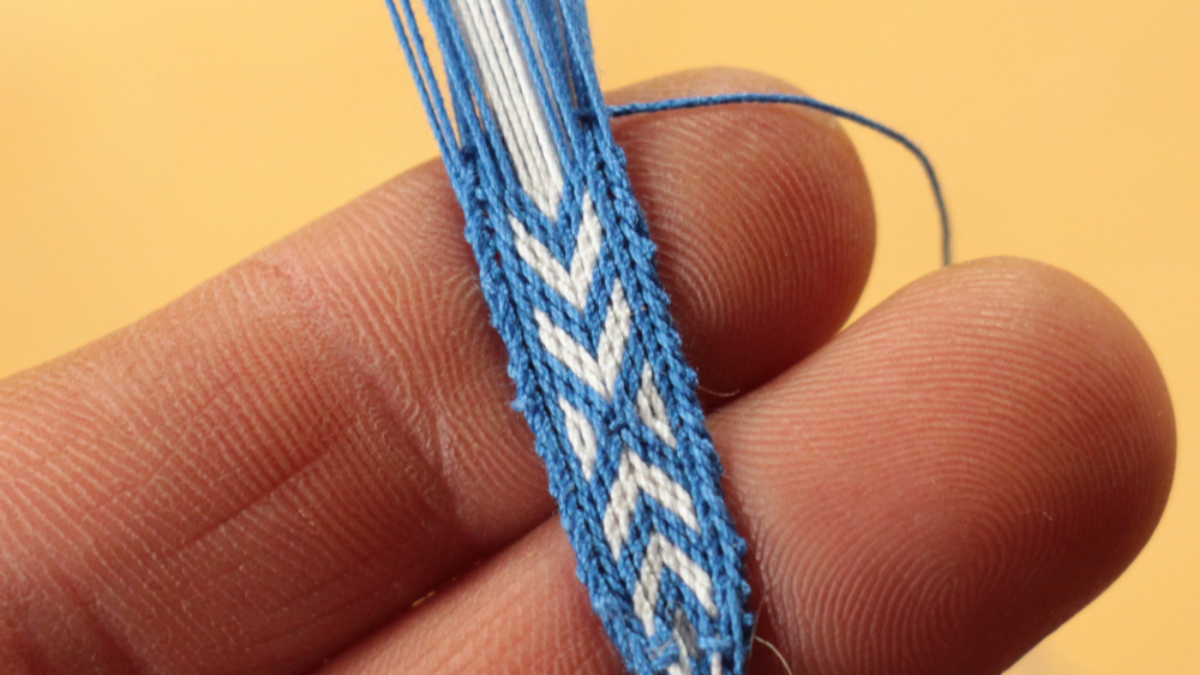
After 12 quarter turns forward, you should see a pattern of two chevrons.
Step 11
The patterns that appear on the weave are determined by three things: the threading in one direction or the other, the direction of rotation of the cards and the position of the thread colors in the holes.
After our 12 rotations forward, it's time to reverse the direction of rotation of the cards and turn them backwards (towards you), which will reverse the pattern.
Step 12
You will continue to weave at this rate, 12 times forward and 12 times backward until you have a strip of about 15 centimeters. You will then leave a margin for finishing your bracelet.
You can use the end of this chain to do some experimentation, like making 4, 6 or 8 rotations instead of 12 for example.
When you are done, simply cut your chain and braid or twist the warp strands to your liking to make attachments to your woven bracelet.
Je suis teinturière spécialisée en teintures naturelles et historiques, mais également passionnée de tissage aux tablettes depuis 2009.
Il me tient à coeur de faire découvrir et aimer cette technique de tissage particulière et très ancienne, qui s'adapte bien à des projets de création modernes.
Depuis plus de 10 ans, j'anime des stages de tissage aux tablettes dans mon atelier d'Eure-et-Loir, pour débuter ou progresser sur le chemin de la complexité, pour un public moderne ou intéressé par la reconstitution de tissages historiques.
Please note that the quantities of the suggested equivalents are not necessarily exact. You can adjust them in your basket.
Supplies
Equivalent product
Your questions (1)
You have a question about this tutorial? Ask it to our team and the people who have already tested it. The Perles & Co community is here to help you!
By suzanne (17/11/2023 10:24:16)
bonjour : ou trouver les clips pour sécuriser les fils lors du montage . Merci
2 Answers
Show answers
Hide answers
Translate the question
Please log in to use this feature
Answer from customer suzanne B.
(17/11/2023 13:20:48)
merci pour votre réponse , après l'avoir envoyé , je me suis dit que je pourrais aussi, employer des pinces à linge . J'aime beaucoup ce tuto , je vais essayer de m' y mettre même si au début , ça parait un peu complexe , y a t'il un site où on peut admirer vos créations ? cordialement . SUZANNE
Translate the answer
Answer from customer Micky S.
(17/11/2023 10:41:12)
Bonjour,
on peut utiliser les clips prévus pour les sachets de conservation/congélation, ils se trouvent très facilement dans la plupart des magasins.
Bons tissages!
Micky
Translate the answer
Your reviews (3)
Notices subject to control
5/5
Average Grades
By PEREZ (posted on : 08/07/2024 )
Excellent tuto : explications simples, détaillées. Merci.
Our Aurore B. expert answers you
(09/07/2024 08:51:59)
Bonjour, Merci beaucoup pour votre retour positif ! Nous sommes ravis que le tutoriel vous ait plu et que vous ayez trouvé les explications simples et détaillées.L'Équipe Perles & Co
Translate the answer
By Anonyme (posted on : 15/11/2022 )
J ai réalisé des bracelets avec du fils micro macramé, ils sont magnifiques! Merci pour ce tuto!
Merci pour ce tutoriel très bien expliqué. Je souhaitais l?apprendre depuis longtemps, c'est chose faite :-) je vais maintenant essayer.
Merci beaucoup !!!
Our Tiffanie J. expert answers you
(07/11/2022 11:15:23)
Nous sommes ravis que cette technique vous plaise. Merci à la créatrice.
Translate the answer
Credits
Perles & Co, Internet & E-Commerce company [22/10/2022] Any reproduction, representation, adaptation, in any form whatsoever, even partial, is prohibited, except for reproduction for private use not intended for collective use, representation in the family circle (art. L 122-5 CPI) and online publishing on condition that the source is mentioned and a link is included to the corresponding page of our site www.perlesandco.com.